



 Chat with AI
Exam 13: Carbohydrate Metabolism: Glycolysis, Gluconeogenesis, Glycogen Metabolism, and the Pentose Phosphate Pathway

Exam 1: The Scope of Biochemistry17 Questions
Exam 2: The Matrix of Life: Weak Interactions in an Aqueous Environment25 Questions
Exam 3: The Energetics of Life25 Questions
Exam 4: Nucleic Acids28 Questions
Exam 5: Introduction to Proteins: the Primary Level of Protein Structure25 Questions
Exam 6: The Three-Dimensional Structure of Proteins24 Questions
Exam 7: Protein Function and Evolution27 Questions
Exam 8: Contractile Proteins and Molecular Motors19 Questions
Exam 9: Carbohydrates: Sugars, Saccharides, Glycans28 Questions
Exam 10: Lipids, Membranes and Cellular Transport25 Questions
Exam 11: Enzymes: Biological Catalysts24 Questions
Exam 12: Chemical Logic of Metabolism25 Questions
Exam 13: Carbohydrate Metabolism: Glycolysis, Gluconeogenesis, Glycogen Metabolism, and the Pentose Phosphate Pathway41 Questions
Exam 14: Citric Acid Cycle and Glyoxylate Cycle25 Questions
Exam 15: Electron Transport, Oxidative Phosphorylation, and Oxygen Metabolism24 Questions
Exam 16: Photosynthesis26 Questions
Exam 17: Lipid Metabolism I: Fatty Acids, Triacylglycerols, and Lipoproteins26 Questions
Exam 18: Interorgan and Intracellular Coordination of Energy Metabolism in Vertebrates22 Questions
Exam 19: Lipid Metabolism Ii: Membrane Lipids, Steroids, Isoprenoids, and Eicosanoids25 Questions
Exam 20: Metabolism of Nitrogenous Compounds I: Principles of Biosynthesis, Utilization, and Turnover25 Questions
Exam 21: Metabolism of Nitogenous Compounds II: Amino Acids, Porphyrins, and Neurotransmitters25 Questions
Exam 22: Nucleotide Metabolism25 Questions
Exam 23: Mechanisms of Signal Transduction24 Questions
Exam 24: Genes, Genomes and Chromosomes25 Questions
Exam 25: DNA Replication25 Questions
Exam 26: DNA Restructuring: Repair, Recombination, Rearrangement, Amplification25 Questions
Exam 27: Information Readout: Transcription and Post-Transcriptional Processing25 Questions
Exam 28: Information Decoding: Translation and Post-Translational Protein Processing28 Questions
Exam 29: Regulation of Gene Expression25 Questions
Select questions type


In most bacteria that utilize glucose, what molecule both aids in transport of glucose into the cell and is phosphorylating agent for conversion of glucose to glucose-6-phosphate?
(Multiple Choice)
4.9/5  (77)
(77) Besides two molecules of pyruvate, what are the net products of glycolysis?
(Multiple Choice)
4.8/5 (71)
(71) Provide the missing names or structures for the following scheme of the fermentation of pyruvate 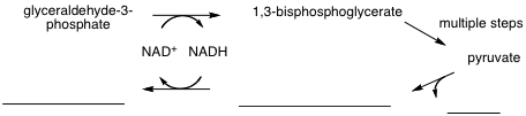
(Essay)
4.7/5 (75)
(75) When lipid biosynthesis is active using carbohydrates as a source of carbon, three things are needed: NADPH, ATP and acetyl-CoA (from pyruvate). Which of the following best explains the operation of the pentose phosphate pathway (PPP)under such conditions? G6P = glucose-6-phosphate, F6P = fructose-6-phosphate, G3P = glyceraldehyde-3-phosphate
(Multiple Choice)
4.7/5 (77)
(77) The oxidative phase of the pentose phosphate pathway has _____ oxidation reactions, effectively oxidizing an ___________ to ____________.
(Multiple Choice)
4.8/5 (86)
(86) Which of the following is the fate of pyruvate in a blood cell?
(Multiple Choice)
4.8/5 (95)
(95) Besides its role in glycogen synthesis, which of the following directly relies on UDP-glucose?
(Multiple Choice)
4.9/5 (87)
(87) When glucagon binds to its receptor on a liver cell, which of the following sequence of events occurs to activate protein kinase A?
(Multiple Choice)
5.0/5 (87)
(87) Assuming that gluconeogenesis was active in a mammalian liver, under what conditions would PEPCK have more activity in the mitochondria than in the cytosol?
(Multiple Choice)
4.8/5 (62)
(62) The conversion of phosphoenolpyruvate and ADP to pyruvate and ATP occurs in two distinct steps, first the transfer of the phosphate from PEP to ADP, then the conversion of enolpyruvate to pyruvate. Which of the following describes the reversibility of this process?
(Multiple Choice)
4.9/5 (70)
(70) Which of the following activators is correctly paired with the glycolytic or gluconeogenic enzyme that it activates?
(Multiple Choice)
4.8/5 (93)
(93) Which of the following enzymes is used by the gluconeogenic pathway but not the glycolytic pathway?
(Multiple Choice)
4.9/5 (79)
(79) What sequence of enzymes allows for the synthesis of glycogen from glucose-6-phosphate?
(Multiple Choice)
4.9/5 (92)
(92) The reaction catalyzed by triose phosphate isomerase is most similar in mechanism to which of the following glycolytic enzymes?
(Multiple Choice)
5.0/5 (79)
(79) Which enzyme catalyzes the primary regulation site of glycolysis?
(Multiple Choice)
5.0/5 (84)
(84) During aerobic glycolysis, pyruvate is most likely oxidized to ________ while in anaerobic glycolysis, pyruvate is converted to _________.
(Multiple Choice)
4.7/5 (77)
(77) In the vertebrate liver, which major regulatory point is bypassed during fructose metabolism, often leading to conversion of excess fructose into fat?
(Multiple Choice)
4.8/5 (98)
(98) If a residue of glucose in glycogen is removed from the glycogen molecule and then allowed to proceed through glycolysis to pyruvate, what is the net production of ATP?
(Multiple Choice)
4.8/5 (84)
(84) What is the link between glutathione and the pentose phosphate pathway (PPP)?
(Multiple Choice)
4.9/5 (72)
(72) Which of the following intermediates is a feed-forward activator of pyruvate kinase?
(Multiple Choice)
4.9/5 (76)
(76) 
Filters
- Essay(0)
- Multiple Choice(0)
- Short Answer(0)
- True False(0)
- Matching(0)