
Exam 9: How Chemicals React

arrow
  • Select Tags
search iconSearch Question
flashcardsStudy Flashcards
  • Select Tags

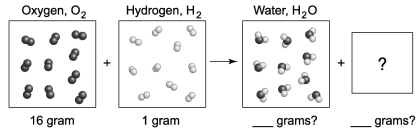
The following diagram depicts the reaction between gaseous oxygen, The following diagram depicts the reaction between gaseous oxygen,   , and gaseous hydrogen,   , to form water vapor,   O. What molecules and how many of them should be drawn in the empty box? How many grams of water are formed under these conditions? How many grams of which chemical remain unreacted?  , and gaseous hydrogen, The following diagram depicts the reaction between gaseous oxygen,   , and gaseous hydrogen,   , to form water vapor,   O. What molecules and how many of them should be drawn in the empty box? How many grams of water are formed under these conditions? How many grams of which chemical remain unreacted?  , to form water vapor, The following diagram depicts the reaction between gaseous oxygen,   , and gaseous hydrogen,   , to form water vapor,   O. What molecules and how many of them should be drawn in the empty box? How many grams of water are formed under these conditions? How many grams of which chemical remain unreacted?  O. What molecules and how many of them should be drawn in the empty box? How many grams of water are formed under these conditions? How many grams of which chemical remain unreacted? The following diagram depicts the reaction between gaseous oxygen,   , and gaseous hydrogen,   , to form water vapor,   O. What molecules and how many of them should be drawn in the empty box? How many grams of water are formed under these conditions? How many grams of which chemical remain unreacted?
(Multiple Choice)
4.9/5
(79)

How much energy, in kilojoules, is released or absorbed from the reaction of one mole of nitrogen, How much energy, in kilojoules, is released or absorbed from the reaction of one mole of nitrogen,   , with three moles of molecular hydrogen,   , to form two moles of ammonia, N   ? H-N (bond energy: 389 kJ/mol) H-H (bond energy: 436 kJ/mol) N   N (bond energy: 946 kJ/mol) N   N + H-H + H-H → N   + N  , with three moles of molecular hydrogen, How much energy, in kilojoules, is released or absorbed from the reaction of one mole of nitrogen,   , with three moles of molecular hydrogen,   , to form two moles of ammonia, N   ? H-N (bond energy: 389 kJ/mol) H-H (bond energy: 436 kJ/mol) N   N (bond energy: 946 kJ/mol) N   N + H-H + H-H → N   + N  , to form two moles of ammonia, N How much energy, in kilojoules, is released or absorbed from the reaction of one mole of nitrogen,   , with three moles of molecular hydrogen,   , to form two moles of ammonia, N   ? H-N (bond energy: 389 kJ/mol) H-H (bond energy: 436 kJ/mol) N   N (bond energy: 946 kJ/mol) N   N + H-H + H-H → N   + N  ? H-N (bond energy: 389 kJ/mol) H-H (bond energy: 436 kJ/mol) N How much energy, in kilojoules, is released or absorbed from the reaction of one mole of nitrogen,   , with three moles of molecular hydrogen,   , to form two moles of ammonia, N   ? H-N (bond energy: 389 kJ/mol) H-H (bond energy: 436 kJ/mol) N   N (bond energy: 946 kJ/mol) N   N + H-H + H-H → N   + N  N (bond energy: 946 kJ/mol) N How much energy, in kilojoules, is released or absorbed from the reaction of one mole of nitrogen,   , with three moles of molecular hydrogen,   , to form two moles of ammonia, N   ? H-N (bond energy: 389 kJ/mol) H-H (bond energy: 436 kJ/mol) N   N (bond energy: 946 kJ/mol) N   N + H-H + H-H → N   + N  N + H-H + H-H → N How much energy, in kilojoules, is released or absorbed from the reaction of one mole of nitrogen,   , with three moles of molecular hydrogen,   , to form two moles of ammonia, N   ? H-N (bond energy: 389 kJ/mol) H-H (bond energy: 436 kJ/mol) N   N (bond energy: 946 kJ/mol) N   N + H-H + H-H → N   + N  + N How much energy, in kilojoules, is released or absorbed from the reaction of one mole of nitrogen,   , with three moles of molecular hydrogen,   , to form two moles of ammonia, N   ? H-N (bond energy: 389 kJ/mol) H-H (bond energy: 436 kJ/mol) N   N (bond energy: 946 kJ/mol) N   N + H-H + H-H → N   + N

(Multiple Choice)
4.8/5
(81)

Since some of the compounds that are destroying ozone are found in nature normally, how is it possible to tell that the reactive molecules destroying the ozone are due to our actions?

(Multiple Choice)
4.9/5
(91)

Balance these equations. ____ Balance these equations. ____   (g)+ ____   (g)→ ____ N   (g) (g)+ ____ Balance these equations. ____   (g)+ ____   (g)→ ____ N   (g) (g)→ ____ N Balance these equations. ____   (g)+ ____   (g)→ ____ N   (g) (g)

(Multiple Choice)
5.0/5
(73)

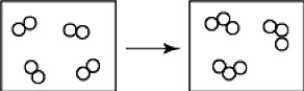
What is wrong with the following depiction of a chemical reaction? What is wrong with the following depiction of a chemical reaction?
(Multiple Choice)
5.0/5
(72)

Given that the above energy profiles have the same scale, which of the reactions is the most exothermic?

(Multiple Choice)
4.9/5
(81)

According to the following balanced chemical equation, if you want to generate two moles of H2O , how many molecules of O2 do you need? 2 H2 + O2 → 2 H2O

(Multiple Choice)
4.8/5
(75)

How many oxygen molecules are needed to make 10 carbon dioxide molecules according to the following balanced chemical equation? 2 CO + O2 → 2 CO2

(Multiple Choice)
4.8/5
(76)

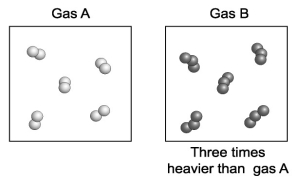
Gas A is composed of diatomic molecules (two atoms per molecule)of a pure element. Gas B is composed of triatomic molecules (three atoms per molecule)of another pure element. A volume of gas B is found to be three times more massive than an equal volume of gas A. How does the mass of an atom of gas B compare with the mass of an atom of gas A? Gas A is composed of diatomic molecules (two atoms per molecule)of a pure element. Gas B is composed of triatomic molecules (three atoms per molecule)of another pure element. A volume of gas B is found to be three times more massive than an equal volume of gas A. How does the mass of an atom of gas B compare with the mass of an atom of gas A?
(Multiple Choice)
4.8/5
(72)

Why is it important for a chemist to know the relative masses of atoms?

(Multiple Choice)
4.8/5
(87)

Carefully examine the following reaction sequence for the catalytic formation of ozone, O3, from molecular oxygen, Carefully examine the following reaction sequence for the catalytic formation of ozone, O<sub>3</sub>, from molecular oxygen,   . Which chemical compound is behaving as the catalyst?   + 2 NO → 2 N   2 N   → 2 NO + 2 O 2 O + 2   → 2  . Which chemical compound is behaving as the catalyst? Carefully examine the following reaction sequence for the catalytic formation of ozone, O<sub>3</sub>, from molecular oxygen,   . Which chemical compound is behaving as the catalyst?   + 2 NO → 2 N   2 N   → 2 NO + 2 O 2 O + 2   → 2  + 2 NO → 2 N Carefully examine the following reaction sequence for the catalytic formation of ozone, O<sub>3</sub>, from molecular oxygen,   . Which chemical compound is behaving as the catalyst?   + 2 NO → 2 N   2 N   → 2 NO + 2 O 2 O + 2   → 2  2 N Carefully examine the following reaction sequence for the catalytic formation of ozone, O<sub>3</sub>, from molecular oxygen,   . Which chemical compound is behaving as the catalyst?   + 2 NO → 2 N   2 N   → 2 NO + 2 O 2 O + 2   → 2  → 2 NO + 2 O 2 O + 2 Carefully examine the following reaction sequence for the catalytic formation of ozone, O<sub>3</sub>, from molecular oxygen,   . Which chemical compound is behaving as the catalyst?   + 2 NO → 2 N   2 N   → 2 NO + 2 O 2 O + 2   → 2  → 2 Carefully examine the following reaction sequence for the catalytic formation of ozone, O<sub>3</sub>, from molecular oxygen,   . Which chemical compound is behaving as the catalyst?   + 2 NO → 2 N   2 N   → 2 NO + 2 O 2 O + 2   → 2

(Multiple Choice)
4.8/5
(72)

What is the mass of one mole of H2?

(Multiple Choice)
4.8/5
(73)

What role do CFCs play in the catalytic destruction of ozone?

(Multiple Choice)
4.7/5
(67)

What is the number of molecules of O2 consumed if you combust one mole of CH4 according to the following balanced equation? CH4 + 2 O2 → CO2 + 2 H2O

(Multiple Choice)
4.7/5
(80)

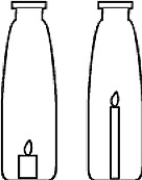
Two candles of the same mass, one wide and short and the other thin and tall, are placed in identical jars as shown below and lit at the same time. Lids are then placed on each jar. Which candle goes out first? Two candles of the same mass, one wide and short and the other thin and tall, are placed in identical jars as shown below and lit at the same time. Lids are then placed on each jar. Which candle goes out first?
(Multiple Choice)
5.0/5
(77)

For the above energy profiles, which reaction has the lowest activation energy?

(Multiple Choice)
4.8/5
(87)

Which equations are balanced? a)Mg (s)+ 2HCl (aq)→ Which equations are balanced? a)Mg (s)+ 2HCl (aq)→   (aq)+   (g) b)3Al (s)+ 3   (l)→     (s) c)2HgO (s)→ 2 Hg (l)+   (g) (aq)+ Which equations are balanced? a)Mg (s)+ 2HCl (aq)→   (aq)+   (g) b)3Al (s)+ 3   (l)→     (s) c)2HgO (s)→ 2 Hg (l)+   (g) (g) b)3Al (s)+ 3 Which equations are balanced? a)Mg (s)+ 2HCl (aq)→   (aq)+   (g) b)3Al (s)+ 3   (l)→     (s) c)2HgO (s)→ 2 Hg (l)+   (g) (l)→ Which equations are balanced? a)Mg (s)+ 2HCl (aq)→   (aq)+   (g) b)3Al (s)+ 3   (l)→     (s) c)2HgO (s)→ 2 Hg (l)+   (g) Which equations are balanced? a)Mg (s)+ 2HCl (aq)→   (aq)+   (g) b)3Al (s)+ 3   (l)→     (s) c)2HgO (s)→ 2 Hg (l)+   (g) (s) c)2HgO (s)→ 2 Hg (l)+ Which equations are balanced? a)Mg (s)+ 2HCl (aq)→   (aq)+   (g) b)3Al (s)+ 3   (l)→     (s) c)2HgO (s)→ 2 Hg (l)+   (g) (g)

(Multiple Choice)
4.9/5
(93)

What is the main difficulty in trying to eliminate chlorinated fluorocarbons from the atmosphere?

(Multiple Choice)
4.7/5
(69)

If it takes three golf balls to equal the mass of one tennis ball, what mass of tennis balls do you need to equal the number of golf balls in one kilogram of golf balls?

(Multiple Choice)
5.0/5
(85)

Given the following generic chemical reaction, which is the product? X → Y

(Multiple Choice)
5.0/5
(62)
Showing 121 - 140 of 150
close modal

Filters

  • Essay(0)
  • Multiple Choice(0)
  • Short Answer(0)
  • True False(0)
  • Matching(0)