



 Chat with AI
Exam 6: How Atoms Bond

Exam 1: About Science65 Questions
Exam 2: Particles of Matter104 Questions
Exam 3: Elements of Chemistry116 Questions
Exam 4: Subatomic Particles146 Questions
Exam 5: The Atomic Nucleus128 Questions
Exam 6: How Atoms Bond153 Questions
Exam 7: How Molecules Mix157 Questions
Exam 8: How Water Behaves140 Questions
Exam 9: How Chemicals React150 Questions
Exam 10: Acids and Bases in Our Environment135 Questions
Exam 11: Oxidations and Reductions Charge the World138 Questions
Exam 12: Organic Compounds162 Questions
Exam 13: Nutrients of Life138 Questions
Exam 14: Medicinal Chemistry85 Questions
Exam 15: Optimizing Food Production115 Questions
Exam 16: Protection Water and Air Resources147 Questions
Exam 17: Capturing Energy93 Questions
Select questions type


What needs to be done to convert a neutral nitrogen atom into an N3- species?
(Multiple Choice)
4.9/5  (98)
(98) If the following generic atom were to undergo ionization, what would the most likely product be? 
(Multiple Choice)
4.9/5 (74)
(74) If carbonic acid (H2CO3)were to undergo ionization, what would one of the products be?
(Multiple Choice)
4.9/5 (80)
(80)  crystals are composed of ________.
Consider the electron-dot geometries of P  and S
 . Which do you expect is the more polar compound?
and S . Which do you expect is the more polar compound? (Multiple Choice)
4.8/5 (90)
(90) Many analogies can be drawn between chemical bonds and human relationships. For example, which is more analogous to marriage: the ionic bond or the covalent bond? Which is more analogous to the single life?
(Multiple Choice)
5.0/5 (70)
(70) Which of the following is the correct electron dot structure for carbon (atomic no. = 6)? 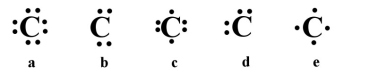
(Multiple Choice)
4.8/5 (91)
(91) 
Which of the following elements has six valence electrons?
(Multiple Choice)
4.8/5 (84)
(84) How many oxide ions (O2-)are needed to balance the positive charge of a titanium ion (Ti4+)?
(Multiple Choice)
4.9/5 (84)
(84) If the concentration of gold in seawater is 2.0 milligram per ton of sea water and the mass of the ocean is 1.5 × 10¹⁸ tons, how much gold is in the ocean?
(Multiple Choice)
4.9/5 (70)
(70) Two molecules, A and B, have very different physical properties. A and B do not mix. Molecule A boils at 80°C and freezes at -30°C. Molecule B boils at 35°C and freezes at -100°C. Which molecule is likely to have the largest dipole?
(Multiple Choice)
4.8/5 (72)
(72) 
The neon atom tends NOT to gain any additional electrons because ________.
(Multiple Choice)
4.9/5 (66)
(66) The source of an atom's electronegativity is the ________.
(Multiple Choice)
4.9/5 (81)
(81) How is the number of unpaired valence electrons in an atom related to the number of bonds that the atom can form?
(Multiple Choice)
4.8/5 (79)
(79) 
Filters
- Essay(0)
- Multiple Choice(0)
- Short Answer(0)
- True False(0)
- Matching(0)