



 Chat with AI
Exam 3: Accrual Accounting

Exam 1: Fundamentals of Financial Accounting Theory33 Questions
Exam 2: Conceptual Frameworks for Financial Reporting60 Questions
Exam 3: Accrual Accounting160 Questions
Exam 4: Revenue and Recognition108 Questions
Exam 5: Cash and Receivables119 Questions
Exam 6: Inventories156 Questions
Exam 7: Financial Assets137 Questions
Exam 8: Property, plant and Equipment128 Questions
Exam 9: Intangible Assets, goodwill, mineral Resources, and Government Grants81 Questions
Exam 10: Applications of Fair Value to Non-Current Assets121 Questions
Select questions type


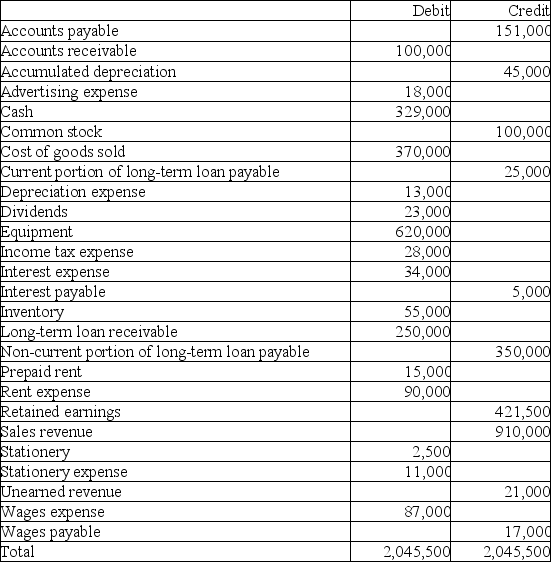
An adjusted trial balance for Soorya Industries Limited at December 31,2017,follows.
Prepare a balance sheet at December 31,2017,with items classified as current or non-current.
(Essay)
4.9/5  (79)
(79) Which of the following is an example of a change in accounting policy?
(Multiple Choice)
4.8/5 (90)
(90) Which of the following would be accounted for as a change in accounting policy? (More than one answer may be correct. )
(Multiple Choice)
4.9/5 (84)
(84) 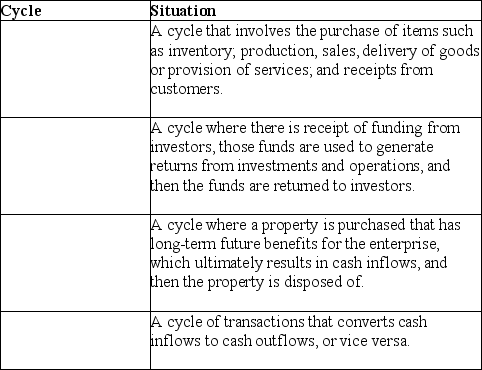
Explain why companies prepare financial statements on an annual basis.
(Essay)
4.9/5 (72)
(72) The following entry was recorded by Woodrow Inc.:
 What is the effect on Woodrow's financial statements?
 (Multiple Choice)
5.0/5 (99)
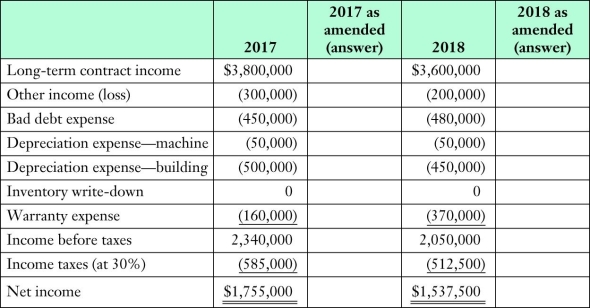
(99) Hatcher Limited,a private company,was started on January 1,2017.For the first year,the chief accountant prepared the financial statements and a local accountant completed the necessary review of these statements.However,for the year ended December 31,2018,an external auditor was appointed.For each situation outlined below,determine the correct accounting treatment and prepare the corrected statements of comprehensive income for 2017 and 2018.
1) Long-term contracts: Hatcher used the completed contract method for revenue recognition in 2017. Management now believes that the percentage of completion method would be better. Income under the completed contract method for 2017 was $3,800,000 and for 2018 it was $3,600,000. If the percentage of completion method had been used, the income would have been $5,800,000 (2017) and $3,400,000 (2018).
2) Accounts receivable: The accounts receivable on December 31, 2017, included a $30,000 account which was not provided for but subsequently was written off during 2018 as the customer went bankrupt after the issuance of the financial statements. Hatcher would like to adjust 2017 for this oversight as it sees this as an error.
3) Machine depreciation: Hatcher has a machine that cost $500,000 and has been depreciated over an estimated useful life of 10 years. Upon reviewing the manufacturer's reports in 2018, management now firmly believes the machine will last a total of 15 years from date of purchase. They would like to change last year's depreciation charge based on this analysis. Depreciation expense of $50,000 has been recorded for 2018.
4) Building depreciation: The company's building (cost $5,000,000, estimated salvage value $0, useful life 20 years) was depreciated last year using the 10% declining-balance method. The company and auditor now agree that the straight-line method would be a more appropriate method to use. A depreciation provision of $450,000 has been made for 2018.
5) Inventories: The accountant last year failed to apply the lower of cost or net realizable value to ending inventory. Upon review, the inventory balance for last year should have been reduced by $250,000. The closing inventory allowance for this year-end should be $370,000. No entry has been made for this.
6) Warranties: Hatcher does not accrue for warranties; rather it records the warranty expense when amounts are paid. Hatcher provides a one-year warranty for defective goods. Payments to satisfy warranty claims in 2017 were $160,000, and $370,000 in 2018. Out of the $370,000 paid in 2018, $170,000 related to 2017 sales. A reasonable estimate of warranties payable at the end of 2018 is $270,000.
(Essay)
4.8/5 (87)
(87) Using the conceptual frameworks and other ideas,discuss whether a change in accounting policy should be treated prospectively or retrospectively.
(Essay)
4.9/5 (83)
(83) Handy Corp.retired bonds payable with a carrying value of $980,000.What effect does this transaction have on total assets and shareholders' equity?
(Multiple Choice)
4.8/5 (79)
(79) Which statement is incorrect about the cash flow statement?
(Multiple Choice)
4.8/5 (75)
(75) Which statement correctly explains the relationship between cash flows,accruals and reported earnings?
(Multiple Choice)
4.8/5 (71)
(71) The following event occurred after the company's year-end but before the completion of the audit.For this subsequent event,determine whether the event:
• requires an adjustment to the year-end financial statements,
• requires note disclosure,or
• requires neither adjustment to recognized amounts nor disclosure.
There is a significant fall in the market price of a major portion of inventory due to new technology making the existing items obsolete.The market price is lower than the current carrying value.(Justify your recommendation. )
(Essay)
4.8/5 (77)
(77) You are having coffee with a friend of yours who is interested in investing in a Canadian public company.Your friend gives you the audited financial statements but says he does not understand how this information is supposed to be helping him.Explain what is contained in a complete set of financial statements and how this information can help your friend with his decision-making needs.
(Essay)
4.7/5 (77)
(77) Which of the following would be accounted for as correction of an error?
(Multiple Choice)
4.8/5 (78)
(78) 
Filters
- Essay(0)
- Multiple Choice(0)
- Short Answer(0)
- True False(0)
- Matching(0)