Essay
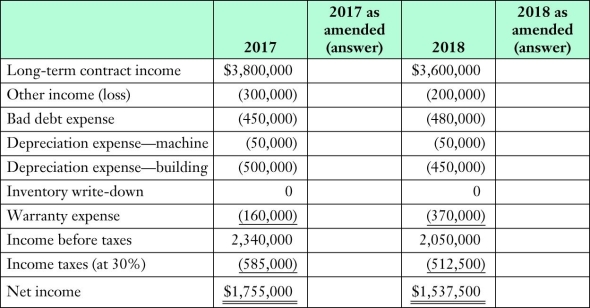
Hatcher Limited,a private company,was started on January 1,2017.For the first year,the chief accountant prepared the financial statements and a local accountant completed the necessary review of these statements.However,for the year ended December 31,2018,an external auditor was appointed.For each situation outlined below,determine the correct accounting treatment and prepare the corrected statements of comprehensive income for 2017 and 2018.
1) Long-term contracts: Hatcher used the completed contract method for revenue recognition in 2017. Management now believes that the percentage of completion method would be better. Income under the completed contract method for 2017 was $3,800,000 and for 2018 it was $3,600,000. If the percentage of completion method had been used, the income would have been $5,800,000 (2017) and $3,400,000 (2018).
2) Accounts receivable: The accounts receivable on December 31, 2017, included a $30,000 account which was not provided for but subsequently was written off during 2018 as the customer went bankrupt after the issuance of the financial statements. Hatcher would like to adjust 2017 for this oversight as it sees this as an error.
3) Machine depreciation: Hatcher has a machine that cost $500,000 and has been depreciated over an estimated useful life of 10 years. Upon reviewing the manufacturer's reports in 2018, management now firmly believes the machine will last a total of 15 years from date of purchase. They would like to change last year's depreciation charge based on this analysis. Depreciation expense of $50,000 has been recorded for 2018.
4) Building depreciation: The company's building (cost $5,000,000, estimated salvage value $0, useful life 20 years) was depreciated last year using the 10% declining-balance method. The company and auditor now agree that the straight-line method would be a more appropriate method to use. A depreciation provision of $450,000 has been made for 2018.
5) Inventories: The accountant last year failed to apply the lower of cost or net realizable value to ending inventory. Upon review, the inventory balance for last year should have been reduced by $250,000. The closing inventory allowance for this year-end should be $370,000. No entry has been made for this.
6) Warranties: Hatcher does not accrue for warranties; rather it records the warranty expense when amounts are paid. Hatcher provides a one-year warranty for defective goods. Payments to satisfy warranty claims in 2017 were $160,000, and $370,000 in 2018. Out of the $370,000 paid in 2018, $170,000 related to 2017 sales. A reasonable estimate of warranties payable at the end of 2018 is $270,000.
Correct Answer:

Verified
Correct Answer:
Verified
Q9: What is the accrual basis of accounting?<br>A)A
Q24: A correction of an accounting error involves<br>A)the
Q25: Which cycle is being described in the
Q27: The following entry was recorded by Woodrow
Q33: Handy Corp.retired bonds payable with a carrying
Q51: What is a "deferral"?<br>A)An entry to record
Q64: Using the conceptual frameworks and other ideas,
Q72: Explain why companies prepare financial statements on
Q107: Which statement is incorrect about the cash
Q118: Which statement is not correct?<br>A)The balance sheet