



 Chat with AI
Exam 2: The Financial Markets and Interest Rates

Exam 1: An Introduction to the Foundations of Financial Management127 Questions
Exam 2: The Financial Markets and Interest Rates148 Questions
Exam 3: Understanding Financial Statements and Cash Flows110 Questions
Exam 4: Evaluating a Firms Financial Performance148 Questions
Exam 5: The Time Value of Money162 Questions
Exam 6: The Meaning and Measurement of Risk and Return147 Questions
Exam 7: The Valuation and Characteristics of Bonds145 Questions
Exam 8: The Valuation and Characteristics of Stock128 Questions
Exam 9: The Cost of Capital135 Questions
Exam 10: Capital-Budgeting Techniques and Practice155 Questions
Exam 11: Cash Flows and Other Topics in Capital Budgeting155 Questions
Exam 12: Determining the Financing Mix151 Questions
Exam 13: Dividend Policy and Internal Financing164 Questions
Exam 14: Short-Term Financial Planning141 Questions
Exam 15: Working-Capital Management165 Questions
Exam 16: Current Asset Management181 Questions
Exam 17: International Business Finance134 Questions
Select questions type


The date today is January 1,2010.A one-year security maturing on 1/1/11 yields 3%.A two-year security maturing on 1/1/12 yields 6%.A three-year security maturing on 1/1/13 yields 11%.Calculate the expected annual return on a two-year security beginning 1/1/11 and maturing on 1/1/13.
(Essay)
4.9/5  (90)
(90) You are considering an investment in a U.S.Treasury bond but you are not sure what rate of interest it should pay.Assume that the real risk-free rate of interest is 1.0%; inflation is expected to be 1.5%; the maturity risk premium is 2.5%; and,the default risk premium for AAA rated corporate bonds is 3.5%.What rate of interest should the U.S.Treasury bond pay?
(Multiple Choice)
4.7/5 (87)
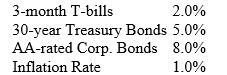
(87) Given the rate information in the table below,estimate the nominal rate for a AA-rated corporate bond.Assume a liquidity premium of 8 basis points.Identify as part of your answer the inflation risk premium,the default risk premium,the maturity premium,and the liquidity premium.
(Essay)
4.7/5 (82)
(82) Preferred stock is traded in the money market,while common stock is traded in the capital market.
(True/False)
4.8/5 (84)
(84) The provisions of the Sarbanes-Oxley Act of 2002,or SOX,apply to all U.S.-based corporations,as well as to foreign corporations conducting business in U.S.markets.
(True/False)
4.9/5 (78)
(78) Given the anticipated rate of inflation (i)of 1.7% and the real rate of interest (R)of 1.4%,find the nominal rate of interest (r).
(Essay)
4.8/5 (65)
(65) Common stock is considered a short-term security because it has no maturity date and a long-term security is one with a maturity date of more than one year.
(True/False)
4.8/5 (67)
(67) 
Filters
- Essay(0)
- Multiple Choice(0)
- Short Answer(0)
- True False(0)
- Matching(0)