



 Chat with AI
Exam 19: Magnetism Magnets

Exam 1: Introduction60 Questions
Exam 1: Introduction: Part A47 Questions
Exam 2: Motion in One Dimension64 Questions
Exam 2: Motion in One Dimension: Part A42 Questions
Exam 3: Vectors and Two-Dimensional Motion74 Questions
Exam 3: Vectors and Two-Dimensional Motion: Part A64 Questions
Exam 4: The Laws of Motion93 Questions
Exam 4: The Laws of Motion: Part A69 Questions
Exam 5: Energy84 Questions
Exam 5: Energy: Part A32 Questions
Exam 6: Momentum and Collisions83 Questions
Exam 6: Momentum and Collisions: Part A61 Questions
Exam 7: Rotational Motion and the Law of Gravity84 Questions
Exam 7: Rotational Motion and the Law of Gravity: Part A48 Questions
Exam 8: Rotational Equilibrium and Rotational Dynamics60 Questions
Exam 8: Rotational Equilibrium and Rotational Dynamics: Part A61 Questions
Exam 9: Solids and Fluids78 Questions
Exam 9: Solids and Fluids: Part A46 Questions
Exam 10: Thermal Physics82 Questions
Exam 10: Thermal Physics: Part A56 Questions
Exam 11: Energy in Thermal Processes Heat and Internal Energy82 Questions
Exam 11: Energy in Thermal Processes Heat and Internal Energy: Part A54 Questions
Exam 12: The Laws of Thermodynamics Work in Thermodynamic Processes70 Questions
Exam 12: The Laws of Thermodynamics Work in Thermodynamic Processes: Part A40 Questions
Exam 13: Vibrations and Waves83 Questions
Exam 13: Vibrations and Waves: Part A48 Questions
Exam 14: Sound81 Questions
Exam 14: Sound: Part A67 Questions
Exam 15: Electric Forces and Electric Fields81 Questions
Exam 15: Electric Forces and Electric Fields: Part A42 Questions
Exam 16: Electrical Energy and Capacitance81 Questions
Exam 16: Electrical Energy and Capacitance: Part A33 Questions
Exam 17: Current and Resistance Electric Current83 Questions
Exam 17: Current and Resistance Electric Current: Part A37 Questions
Exam 18: Direct-Current Circuits Sources of EMF77 Questions
Exam 18: Direct-Current Circuits Sources of EMF: Part A54 Questions
Exam 19: Magnetism Magnets82 Questions
Exam 19: Magnetism Magnets: Part A67 Questions
Exam 20: Induced Voltages and Inductance83 Questions
Exam 20: Induced Voltages and Inductance: Part A46 Questions
Exam 21: Alternating-Current Circuits and Electromagnetic Waves98 Questions
Exam 21: Alternating-Current Circuits and Electromagnetic Waves: Part A32 Questions
Exam 22: Reflection and Refraction of Light81 Questions
Exam 22: Reflection and Refraction of Light: Part A49 Questions
Exam 23: Mirrors and Lenses82 Questions
Exam 23: Mirrors and Lenses: Part A31 Questions
Exam 24: Wave Optics88 Questions
Exam 24: Wave Optics: Part A71 Questions
Exam 25: Optical Instruments79 Questions
Exam 25: Optical Instruments: Part A59 Questions
Exam 26: Relativity62 Questions
Exam 26: Relativity: Part A29 Questions
Exam 27: Quantum Physics Blackbody Radiation and Plancks Hypothesis79 Questions
Exam 27: Quantum Physics Blackbody Radiation and Plancks Hypothesis: Part A52 Questions
Exam 28: Atomic Physics71 Questions
Exam 28: Atomic Physics: Part A38 Questions
Exam 29: Nuclear Physics75 Questions
Exam 29: Nuclear Physics: Part A43 Questions
Exam 30: Nuclear Energy and Elementary Particles88 Questions
Exam 30: Nuclear Energy and Elementary Particles: Part A37 Questions
Exam 31: Particle Collisions, Mediating Photons, and Quark Structures: Exploring the Fundamentals of Physics16 Questions
Select questions type


A horizontal wire of length 4.3 m carries a current of 6.2 A and is oriented so that the current direction is 75° S of W.The Earth's magnetic field is due north at this point and has a strength of 0.14 × 10⁻⁴ T.What is the size of the force on the wire?
(Multiple Choice)
4.7/5  (89)
(89) The force on a charged particle created by its motion in a magnetic field is maximum at what angle between the particle velocity and field?
(Multiple Choice)
4.8/5 (82)
(82) When a magnetic field causes a charged particle to move in a circular path,the only quantity listed below which the magnetic force changes significantly as the particle goes around in a circle is the particle's:
(Multiple Choice)
4.9/5 (69)
(69) There is a current I flowing in a clockwise direction in a square loop of wire that is in the plane of the paper.If the magnetic field B is toward the right,and if each side of the loop has length L,then the net magnetic force acting on the loop is: 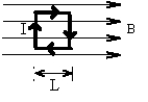
(Multiple Choice)
4.9/5 (76)
(76) Two long parallel wires 10 cm apart carry currents of 4.2 A and 8.7 A in the same direction.Is there any point between the two wires where the magnetic field is zero?
(Multiple Choice)
4.9/5 (87)
(87) The path of a charged particle moving parallel to a uniform magnetic field will be a:
(Multiple Choice)
4.9/5 (85)
(85) A square coil and a triangular coil each have sides of length L.The triangular coil has twice as many turns as the square coil.If a the same current is sent through each coil,when the coils are placed in the same uniform magnetic field making an angle of 30° with the planes of the coils,which coil experiences the greater torque?
(Multiple Choice)
4.9/5 (76)
(76) Assume that a uniform magnetic field is directed into this page.If an electron is released with an initial velocity directed from the bottom edge to the top edge of the page,which of the following describes the direction of the resultant force acting on the electron?
(Multiple Choice)
4.7/5 (78)
(78) Consider two long,straight parallel wires,each carrying a current I.If the currents are flowing in opposite directions:
(Multiple Choice)
4.9/5 (74)
(74) Two parallel wires are separated by 0.25 m.Wire A carries 5.0 A and Wire B carries 10 A,both currents in the same direction.The force on 0.80 m of Wire A is:
(Multiple Choice)
4.9/5 (80)
(80) Solenoid №1 has a length L,cross-sectional area A,and N turns.Solenoid №2 has a length 2L,cross-sectional area 2A,and 2N turns.Which solenoid has the greater magnetic field at its center when equal currents are going through them?
(Multiple Choice)
4.9/5 (80)
(80) A proton and a deuteron are moving with equal velocities perpendicular to a uniform magnetic field.A deuteron has the same charge as the proton but has twice its mass.The ratio of the magnetic force on the proton to that on the deuteron is:
(Multiple Choice)
4.8/5 (98)
(98) The right-hand rule allows one to find a property of the interaction of a magnetic field with a charged particle.The right-hand rule applied to moving charges:
(Multiple Choice)
4.8/5 (87)
(87) Two singly ionized isotopes,X and Y,of the same element move with the same speed perpendicular to a uniform magnetic field.Isotope X follows a path of radius 3.29 cm while isotope Y moves along a path 3.43 cm in radius.What is the ratio of the two isotope masses, 
(Multiple Choice)
4.8/5 (76)
(76) Different units can be used to measure the same physical quantity,differing only by some multiplicative factor.The cgs unit for magnetic field,the gauss,is equal to ________ tesla.
(Multiple Choice)
4.8/5 (88)
(88) An incredible amount of electrical energy passes down the funnel of a large tornado every second.Measurements at a distance of 11.95 km from a large tornado showed an almost constant magnetic field of 2.69 × 10⁻⁸ T associated with the tornado.What was the average current going down the funnel? (µ0 = 4π × 10−7 T⋅m/A)
(Multiple Choice)
4.9/5 (82)
(82) A proton,mass 1.67 × 10⁻²⁷ kg and charge +1.6 × 10⁻¹⁹ C,moves in a circular orbit perpendicular to a uniform magnetic field of 0.66 T.Find the time for the proton to make one complete circular orbit.
(Multiple Choice)
4.9/5 (85)
(85) If a proton is released at the equator and falls toward the Earth under the influence of gravity,the magnetic force on the proton will be toward the:
(Multiple Choice)
4.9/5 (83)
(83) Superconductors can carry very large currents with no resistance.If a superconducting wire is formed into a solenoid of length 74.6 cm with 660 turns,what is the magnetic field inside the solenoid when the current is 6.5 kA? (µ0 = 4π × 10−7 T⋅m/A)
(Multiple Choice)
4.9/5 (71)
(71) 
Filters
- Essay(0)
- Multiple Choice(0)
- Short Answer(0)
- True False(0)
- Matching(0)