



 Chat with AI
Exam 19: Magnetism Magnets

Exam 1: Introduction60 Questions
Exam 1: Introduction: Part A47 Questions
Exam 2: Motion in One Dimension64 Questions
Exam 2: Motion in One Dimension: Part A42 Questions
Exam 3: Vectors and Two-Dimensional Motion74 Questions
Exam 3: Vectors and Two-Dimensional Motion: Part A64 Questions
Exam 4: The Laws of Motion93 Questions
Exam 4: The Laws of Motion: Part A69 Questions
Exam 5: Energy84 Questions
Exam 5: Energy: Part A32 Questions
Exam 6: Momentum and Collisions83 Questions
Exam 6: Momentum and Collisions: Part A61 Questions
Exam 7: Rotational Motion and the Law of Gravity84 Questions
Exam 7: Rotational Motion and the Law of Gravity: Part A48 Questions
Exam 8: Rotational Equilibrium and Rotational Dynamics60 Questions
Exam 8: Rotational Equilibrium and Rotational Dynamics: Part A61 Questions
Exam 9: Solids and Fluids78 Questions
Exam 9: Solids and Fluids: Part A46 Questions
Exam 10: Thermal Physics82 Questions
Exam 10: Thermal Physics: Part A56 Questions
Exam 11: Energy in Thermal Processes Heat and Internal Energy82 Questions
Exam 11: Energy in Thermal Processes Heat and Internal Energy: Part A54 Questions
Exam 12: The Laws of Thermodynamics Work in Thermodynamic Processes70 Questions
Exam 12: The Laws of Thermodynamics Work in Thermodynamic Processes: Part A40 Questions
Exam 13: Vibrations and Waves83 Questions
Exam 13: Vibrations and Waves: Part A48 Questions
Exam 14: Sound81 Questions
Exam 14: Sound: Part A67 Questions
Exam 15: Electric Forces and Electric Fields81 Questions
Exam 15: Electric Forces and Electric Fields: Part A42 Questions
Exam 16: Electrical Energy and Capacitance81 Questions
Exam 16: Electrical Energy and Capacitance: Part A33 Questions
Exam 17: Current and Resistance Electric Current83 Questions
Exam 17: Current and Resistance Electric Current: Part A37 Questions
Exam 18: Direct-Current Circuits Sources of EMF77 Questions
Exam 18: Direct-Current Circuits Sources of EMF: Part A54 Questions
Exam 19: Magnetism Magnets82 Questions
Exam 19: Magnetism Magnets: Part A67 Questions
Exam 20: Induced Voltages and Inductance83 Questions
Exam 20: Induced Voltages and Inductance: Part A46 Questions
Exam 21: Alternating-Current Circuits and Electromagnetic Waves98 Questions
Exam 21: Alternating-Current Circuits and Electromagnetic Waves: Part A32 Questions
Exam 22: Reflection and Refraction of Light81 Questions
Exam 22: Reflection and Refraction of Light: Part A49 Questions
Exam 23: Mirrors and Lenses82 Questions
Exam 23: Mirrors and Lenses: Part A31 Questions
Exam 24: Wave Optics88 Questions
Exam 24: Wave Optics: Part A71 Questions
Exam 25: Optical Instruments79 Questions
Exam 25: Optical Instruments: Part A59 Questions
Exam 26: Relativity62 Questions
Exam 26: Relativity: Part A29 Questions
Exam 27: Quantum Physics Blackbody Radiation and Plancks Hypothesis79 Questions
Exam 27: Quantum Physics Blackbody Radiation and Plancks Hypothesis: Part A52 Questions
Exam 28: Atomic Physics71 Questions
Exam 28: Atomic Physics: Part A38 Questions
Exam 29: Nuclear Physics75 Questions
Exam 29: Nuclear Physics: Part A43 Questions
Exam 30: Nuclear Energy and Elementary Particles88 Questions
Exam 30: Nuclear Energy and Elementary Particles: Part A37 Questions
Exam 31: Particle Collisions, Mediating Photons, and Quark Structures: Exploring the Fundamentals of Physics16 Questions
Select questions type


Two parallel wires are separated by 0.43 m.Wire A carries 3.3 A and Wire B carries 8.3 A,both currents in the same direction.The force on 0.90 m of Wire A is:
(Multiple Choice)
4.9/5  (79)
(79) An electron is moving at a speed of 5.1 × 10⁶ m/s at an angle of 23° with respect to a uniform magnetic field of 7.3 × 10⁻⁴ T.What is the radius of the resulting helical path? (me = 9.11 × 10⁻³¹ kg,qe = 1.6 × 10⁻¹⁹ C)
(Multiple Choice)
4.7/5 (84)
(84) Two parallel conductors each of 0.67 m length,separated by 4.1 × 10⁻³ m and carrying 3.2 A in opposite directions,will experience what type and magnitude of mutual force? (magnetic permeability in empty space µ0 = 4π × 10−7 T⋅m/A)
(Multiple Choice)
5.0/5 (81)
(81) Two parallel conductors are carrying currents in the opposite direction.The currents are non-zero and not necessarily equal.The magnitude of the magnetic field midway between them is 40 μT.If one of the currents then has its direction reversed,what is the resulting magnitude of the magnetic field midway between them?
(Multiple Choice)
4.8/5 (71)
(71) Two parallel conductors are carrying currents in the same direction.The currents are non-zero and not necessarily equal.The magnitude of the magnetic field midway between them is 40 μT.If one of the currents then has its direction reversed,what is the resulting magnitude of the magnetic field midway between them?
(Multiple Choice)
4.7/5 (76)
(76) There is a current I flowing in a clockwise direction in a square loop of wire that is in the plane of the paper.If the magnetic field B is toward the right,and if each side of the loop has length L,then the net magnetic torque acting on the loop is: 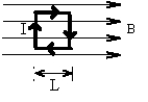
(Multiple Choice)
5.0/5 (82)
(82) A current in a long,straight wire produces a magnetic field.The magnetic field lines:
(Multiple Choice)
4.7/5 (83)
(83) An electron which moves with a speed of 2.5 × 10⁴ m/s parallel to a uniform magnetic field of 0.44 T experiences a force of what magnitude? (e = 1.6 × 10⁻¹⁹ C)
(Multiple Choice)
4.8/5 (89)
(89) A deuteron,with the same charge but twice the mass of a proton,moves with a speed of 1.7 × 10⁵ m/s perpendicular to a uniform magnetic field of 0.36 T.Which of the paths described below would it follow? (qp = 1.6 × 10⁻¹⁹ C and md = 3.34 × 10⁻²⁷ kg)
(Multiple Choice)
4.9/5 (74)
(74) When an electromagnet has an iron core inserted,what happens to the strength of the magnet?
(Multiple Choice)
4.8/5 (69)
(69) A circular current loop is placed in an external magnetic field.How is the torque related to the radius of the loop?
(Multiple Choice)
4.8/5 (79)
(79) If a charged particle is moving in a uniform magnetic field,its path can be:
(Multiple Choice)
4.9/5 (77)
(77) A superconducting wire carries a current of 10 kA.Find the magnetic field at a distance of 2.0 m from the wire.(µ0 = 4π × 10−7 T⋅m/A)
(Multiple Choice)
4.8/5 (67)
(67) Two insulated current-carrying straight wires of equal length are arranged in the lab so that Wire A carries a current northward and Wire B carries a current eastward,the wires crossing at their midpoints separated only by their insulation.Which of the following statements are true?
(Multiple Choice)
4.8/5 (81)
(81) The magnetic domains in a non-magnetized piece of iron are characterized by which orientation?
(Multiple Choice)
4.8/5 (73)
(73) The force exerted on a current-carrying wire located in an external magnetic field is directly proportional to which of the following?
(Multiple Choice)
4.9/5 (75)
(75) A proton and a deuteron are moving with equal velocities perpendicular to a uniform magnetic field.A deuteron has the same charge as the proton but has twice its mass.The ratio of the acceleration of the proton to that of the deuteron is:
(Multiple Choice)
4.8/5 (78)
(78) Geophysicists today generally attribute the existence of the Earth's magnetic field to which of the following?
(Multiple Choice)
4.8/5 (72)
(72) A proton moving at a speed of 3.2 × 10⁶ m/s cuts across the lines of a magnetic field at an angle of 61°.The strength of the field is 0.63 × 10⁻⁴ T.What is the magnitude of the force acting on the proton? (qp = 1.6 × 10⁻¹⁹ C)
(Multiple Choice)
4.9/5 (90)
(90) An electron moves through a region of crossed electric and magnetic fields.The electric field E = 3381 V/m and is directed straight down.The magnetic field B = 0.77 T and is directed to the left.For what velocity v of the electron into the paper will the electric force exactly cancel the magnetic force? 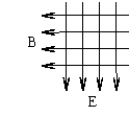
(Multiple Choice)
4.9/5 (74)
(74) 
Filters
- Essay(0)
- Multiple Choice(0)
- Short Answer(0)
- True False(0)
- Matching(0)