



 Chat with AI
Exam 14: Chemical Equilibrium

Exam 1: Chemistry and Measurement111 Questions
Exam 2: Atoms, molecules, and Ions149 Questions
Exam 3: Calculations With Chemical Formulas and Equations139 Questions
Exam 4: Chemical Reactions159 Questions
Exam 5: The Gaseous State104 Questions
Exam 6: Thermochemistry119 Questions
Exam 7: Quantum Theory of the Atom68 Questions
Exam 8: Electron Configurations and Periodicity100 Questions
Exam 9: Ionic and Covalent Bonding125 Questions
Exam 10: Molecular Geometry and Chemical Bonding Theory101 Questions
Exam 11: States of Matter; Liquids and Solids123 Questions
Exam 12: Solutions119 Questions
Exam 13: Rates of Reaction113 Questions
Exam 14: Chemical Equilibrium97 Questions
Exam 15: Acids and Bases83 Questions
Exam 16: Acid-Base Equilibria148 Questions
Exam 17: Solubility and Complex-Ion Equilibria115 Questions
Exam 18: Thermodynamics and Equilibrium94 Questions
Exam 19: Electrochemistry122 Questions
Exam 20: Nuclear Chemistry90 Questions
Exam 21: Chemistry of the Main-Group Metals121 Questions
Exam 22: The Transition Elements and Coordination Compounds75 Questions
Exam 23: Organic Chemistry79 Questions
Exam 24: Polymer Materials: Synthetic and Biological56 Questions
Select questions type


The _____ is an economical process for making nitric acid in which nitric oxide is prepared by the oxidation of ammonia.
(Multiple Choice)
4.8/5  (85)
(85) For the equilibrium PCl5(g)  PCl3(g)+ Cl2(g),Kc = 2.0 × 101 at 240°C.If pure PCl5 is placed in a 1.00-L container and allowed to come to equilibrium,and the equilibrium concentration of PCl3(g)is 0.27 M,what is the equilibrium concentration of PCl5(g)?
 (Multiple Choice)
4.7/5 (83)
(83) When cobalt chloride is added to pure water,the Co2+ ions hydrate.The hydrated form then reacts with the Cl- ions to set up the equilibrium shown here:
Co(H2O)62+ + 4Cl-  CoCl42- + 6H2O
(pink)
(blue)
Which statement accurately describes the change that the system will undergo if water is added?
CoCl42- + 6H2O
(pink)
(blue)
Which statement accurately describes the change that the system will undergo if water is added? (Multiple Choice)
4.7/5 (99)
(99) Carbon tetrachloride may react with oxygen to produce chlorine and carbonyl chloride.
2CCl4(g)+ O2(g)  2COCl2(g)+ 2Cl2(g); Kc = 9.9 × 1051
What is Kc for the following equilibrium?
COCl2(g)+ Cl2(g)
 CCl4(g)+ 1/2O2(g)
2COCl2(g)+ 2Cl2(g); Kc = 9.9 × 1051
What is Kc for the following equilibrium?
COCl2(g)+ Cl2(g)
CCl4(g)+ 1/2O2(g) (Multiple Choice)
4.9/5 (87)
(87) What is the reaction quotient (Q)for the equilibrium
TlSCN(s)  Tl+(aq)+ SCN-(aq)
When 0.1837 L of
 M Tl+ is combined with 0.1335 L of
 M SCN- in the presence of an excess of TlSCN(s)?
Tl+(aq)+ SCN-(aq)
When 0.1837 L of
M Tl+ is combined with 0.1335 L of
M SCN- in the presence of an excess of TlSCN(s)? (Multiple Choice)
4.8/5 (90)
(90) For the reaction Br2(g)+ Cl2(g)  2BrCl(g),at equilibrium,it is found that the concentrations of Br2,Cl2,and BrCl are 0.484 M,0.105 M,and 1.24 × 10⁻³ M,respectively.What is the value of Kc?
 (Multiple Choice)
4.8/5 (95)
(95) At 800 K,Kc for the following equilibrium is 4.2 × 10⁻³.
2HgO(s)  2Hg(l)+ O2(g)
Suppose 82.3 g of mercury (II)oxide is placed in a sealed 2.50-L vessel at 800 K.What is the partial pressure of oxygen gas at equilibrium? (R = 0.0821 L ∙ atm/(K ∙ mol))
2Hg(l)+ O2(g)
Suppose 82.3 g of mercury (II)oxide is placed in a sealed 2.50-L vessel at 800 K.What is the partial pressure of oxygen gas at equilibrium? (R = 0.0821 L ∙ atm/(K ∙ mol)) (Multiple Choice)
4.9/5 (83)
(83) Which of the following statements is incorrect concerning the addition of a catalyst to an equilibrium reaction system?
(Multiple Choice)
4.7/5 (81)
(81) A sample of ammonia gas was allowed to come to equilibrium at 400 K.
2NH3(g)  N2(g)+ 3H2(g)
At equilibrium,it was found that the concentration of H2 was 0.0484 M,the concentration of N2 was 0.0161 M,and the concentration of NH3 was 0.295 M.What was the initial concentration of ammonia?
N2(g)+ 3H2(g)
At equilibrium,it was found that the concentration of H2 was 0.0484 M,the concentration of N2 was 0.0161 M,and the concentration of NH3 was 0.295 M.What was the initial concentration of ammonia? (Multiple Choice)
4.8/5 (93)
(93) For the following reaction system at equilibrium,which one of the changes below would cause the equilibrium to shift to the right?
Br2(g)+ 2NO(g)  2NOBr(g); ΔH° = -30 kJ
 (Multiple Choice)
4.8/5 (70)
(70) When cobalt chloride is added to pure water,the Co2+ ions hydrate.The hydrated form then reacts with the Cl- ions to set up the equilibrium shown here:
Co(H2O)62+ + 4Cl-  CoCl42- + 6H2O
(pink)
(blue)
Which statement describes the change that the system will undergo if potassium chloride is added?
CoCl42- + 6H2O
(pink)
(blue)
Which statement describes the change that the system will undergo if potassium chloride is added? (Multiple Choice)
4.9/5 (76)
(76) A sample of ammonia gas was allowed to come to equilibrium at 400 K.
2NH3(g)  N2(g)+ 3H2(g)
At equilibrium,it was found that the concentration of H2 was 0.0372 M,the concentration of N2 was 0.0124 M,and the concentration of NH3 was 0.175 M.What is Kp for this equilibrium? (R = 0.0821 L ∙ atm/(K ∙ mol))
N2(g)+ 3H2(g)
At equilibrium,it was found that the concentration of H2 was 0.0372 M,the concentration of N2 was 0.0124 M,and the concentration of NH3 was 0.175 M.What is Kp for this equilibrium? (R = 0.0821 L ∙ atm/(K ∙ mol)) (Multiple Choice)
5.0/5 (90)
(90) When gaseous carbon monoxide and hydrogen are combined in a sealed vessel and heated they will eventually form an equilbrium mixture of reactants and products according to the balanced chemical equilibrium below.
CO(g)+ 3H2(g)  CH4(g)+ H2O(g)
In one such reaction 3 moles of one reactant were combined with 1 mole of the other reactant in a fixed volume vessel and heated to 1200 K.Analysis of the reaction mixture at various times gave the results below.Which component of the reaction mixture is represented by curve B?
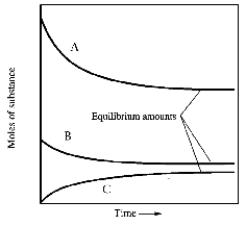
CH4(g)+ H2O(g)
In one such reaction 3 moles of one reactant were combined with 1 mole of the other reactant in a fixed volume vessel and heated to 1200 K.Analysis of the reaction mixture at various times gave the results below.Which component of the reaction mixture is represented by curve B? (Multiple Choice)
4.9/5 (83)
(83) The following equilibrium is established in a sealed,rigid container.How could the partial pressure of SO2 at equilibrium be increased?
SO2Cl2(g)  SO2(g)+ Cl2(g); ΔH = +67 kJ
 (Multiple Choice)
4.9/5 (67)
(67) A sample of ammonia gas was allowed to come to equilibrium at 400 K.
2NH3(g)  N2(g)+ 3H2(g)
At equilibrium,it was found that the concentration of H2 was 0.0551 M,the concentration of N2 was 0.0183 M,and the concentration of NH3 was 0.383 M.What is Kc for this equilibrium?
N2(g)+ 3H2(g)
At equilibrium,it was found that the concentration of H2 was 0.0551 M,the concentration of N2 was 0.0183 M,and the concentration of NH3 was 0.383 M.What is Kc for this equilibrium? (Multiple Choice)
4.8/5 (80)
(80) Consider the following reaction:
2HF(g)  H2(g)+ F2(g)(Kc = 1.00 × 10⁻²)
Given that 1.00 mol of HF(g),0.200 mol of H2(g),and 0.750 mol of F2(g)are mixed in a 5.00-L flask,determine the reaction quotient,Q.
H2(g)+ F2(g)(Kc = 1.00 × 10⁻²)
Given that 1.00 mol of HF(g),0.200 mol of H2(g),and 0.750 mol of F2(g)are mixed in a 5.00-L flask,determine the reaction quotient,Q. (Multiple Choice)
4.9/5 (82)
(82) For the reaction 2HI(g)  H2(g)+ I2(g),Kc = 0.290 at 400 K.If the initial concentrations of HI,H2,and I2 are all 1.50 × 10⁻³ M at 400 K,which one of the following statements is correct?
 (Multiple Choice)
4.8/5 (75)
(75) A 35.00-L vessel at 700 K initially contains HI(g)at a pressure of 5.80 atm; at equilibrium,it is found that the partial pressure of H2(g)is 0.56 atm.What is the partial pressure of HI(g)at equilibrium?
2HI(g)  H2(g)+ I2(g)
 (Multiple Choice)
4.9/5 (88)
(88) Consider the following equilibrium:
CO2(g)+ C(graphite)  2CO(g); ΔH = 172.5 kJ
The equilibrium constant for this reaction will
2CO(g); ΔH = 172.5 kJ
The equilibrium constant for this reaction will (Multiple Choice)
4.9/5 (86)
(86) In which of the following reactions does an instantaneous increase in the volume of the reaction vessel favor formation of the products?
(Multiple Choice)
4.8/5 (64)
(64) 
Filters
- Essay(0)
- Multiple Choice(0)
- Short Answer(0)
- True False(0)
- Matching(0)