



 Chat with AI
Exam 8: Designing Pay Levels, mix, and Pay Structures

Exam 1: The Pay Model93 Questions
Exam 2: Strategy: The Totality of Decisions84 Questions
Exam 3: Defining Internal Alignment95 Questions
Exam 4: Job Analysis88 Questions
Exam 5: Job-Based Structures and Job Evaluation92 Questions
Exam 6: Person-Based Structures85 Questions
Exam 7: Defining Competitiveness95 Questions
Exam 8: Designing Pay Levels, mix, and Pay Structures91 Questions
Exam 9: Pay-For-Performance: the Evidence93 Questions
Exam 10: Pay-For-Performance Plans90 Questions
Exam 11: Performance Appraisals94 Questions
Exam 12: The Benefit Determination Process89 Questions
Exam 13: Benefit Options87 Questions
Exam 14: Compensation of Special Groups80 Questions
Exam 15: Union Role in Wage and Salary Administration85 Questions
Exam 16: International Pay Systems86 Questions
Exam 17: Government and Legal Issues in Compensation91 Questions
Exam 18: Management: Making It Work93 Questions
Select questions type


Pay ranges for top-level management positions are commonly larger than those other professional and midlevel managerial positions.

Free
(True/False)
4.8/5  (93)
(93) Correct Answer: Verified
True
Which of the following is true regarding the Employment Cost Index (ECI)?
Free
(Multiple Choice)
5.0/5 (85)
(85) Correct Answer:Verified
VerifiedD
The second major decision in pay-level determination is _____.
Free
(Multiple Choice)
4.9/5 (69)
(69) Correct Answer:Verified
VerifiedB
Flat rates,in which pay is the same regardless of performance or seniority,are often used in skill-based pay systems and in unionized employers.
(True/False)
4.8/5 (81)
(81) Paying jobs of different functions different rates within a pay band is called ____.
(Multiple Choice)
4.9/5 (80)
(80) Turnover and organizational revenues are examples of survey data collected to gather competitive intelligence.
(True/False)
4.9/5 (76)
(76) What is a survey? What purpose does it serve in terms of compensation?
(Essay)
4.9/5 (79)
(79) Explain the low-high approach in selecting jobs for inclusion in a compensation survey.
(Essay)
4.8/5 (84)
(84) A job structure is anchored by the organization's
external competitive position and reflected in its pay-policy line.
(True/False)
5.0/5 (76)
(76) Identifying pay survey participants by company name is considered price fixing under the Sherman Act.
(True/False)
4.7/5 (84)
(84) The most common measure of variation in pay surveys is the standard deviation.
(True/False)
4.8/5 (78)
(78) In the regression equation,y = a + bx,job evaluation points are _____.
(Multiple Choice)
4.8/5 (85)
(85) Explain the difference between standard deviation and quartiles and percentiles.
(Essay)
4.8/5 (68)
(68) A pure market pricing strategy tends to ignore internal alignment.
(True/False)
4.9/5 (75)
(75) Job structure is to ________ as pay structure is to pay-policy line.
(Multiple Choice)
4.9/5 (68)
(68) All of the following are examples of potential anomalies except _____.
(Multiple Choice)
4.8/5 (92)
(92) You work in a midsize organization and have just conducted a wage survey.Five midsize companies have provided wage data for a particular job.Here are the numbers. 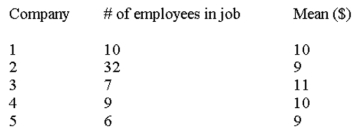 Which of the following statistics will be the most accurate reflection of the market rate?
 (Multiple Choice)
5.0/5 (79)
(79) A segmented labor supply requires multiple labor market comparisons.
(True/False)
4.9/5 (87)
(87) Pay surveys collect total number of employees for the purpose of_______ _____
(Multiple Choice)
4.8/5 (89)
(89) The process of multiplying survey data by some factor judged to reflect the difference between a survey benchmark job and a company job is called _____.
(Multiple Choice)
4.9/5 (85)
(85) 
Filters
- Essay(0)
- Multiple Choice(0)
- Short Answer(0)
- True False(0)
- Matching(0)