



 Chat with AI
Exam 11: Cash Flows and Other Topics in Capital Budgeting

Exam 1: An Introduction to the Foundations of Financial Management137 Questions
Exam 2: The Financial Markets and Interest Rates152 Questions
Exam 3: Understanding Financial Statements and Cash Flows117 Questions
Exam 4: Evaluating a Firms Financial Performance147 Questions
Exam 5: The Time Value of Money162 Questions
Exam 6: The Meaning and Measurement of Risk and Return147 Questions
Exam 7: The Valuation and Characteristics of Bonds145 Questions
Exam 8: The Valuation and Characteristics of Stock128 Questions
Exam 9: The Cost of Capital130 Questions
Exam 10: Capital-Budgeting Techniques and Practice153 Questions
Exam 11: Cash Flows and Other Topics in Capital Budgeting154 Questions
Exam 12: Determining the Financing Mix150 Questions
Exam 13: Dividend Policy and Internal Financing164 Questions
Exam 14: Short-Term Financial Planning141 Questions
Exam 15: Working-Capital Management158 Questions
Exam 16: International Business Finance109 Questions
Exam 17: Cash,receivables,and Inventory Management179 Questions
Select questions type


Which of the following are included in the terminal cash flow?
(Multiple Choice)
4.9/5  (84)
(84) J.B.Corporation is considering the purchase of equipment that has an invoice price of $450,000.The equipment was recommended by a consulting firm that did an analysis for J.B.Corporation.J.B.paid the consulting firm $12,000 for its report.The cost of shipping and installation is $50,000.The equipment will be depreciated on a straight-line basis over its useful life of 10 years,assuming no salvage value.The equipment will replace existing assets that have a current book value of $100,000 and which could be sold for $150,000.Additional net working capital of $15,000 will be required to maintain the equipment and to support higher sales.J.B.'s marginal tax rate is 40%.Calculate the initial outlay required to fund this project.
(Essay)
4.8/5 (94)
(94) Since stockholders are able to reduce their exposure to risk by efficiently diversifying their holdings of securities,there is no reason for individual firms to seek diversification of their holdings of assets.
(True/False)
4.8/5 (83)
(83) TRL,Inc.has spent $2,000,000 in nonrefundable engineering fees in contemplation of building a convention center and the additional costs to complete the project are $18,000,000.The present value of all benefits the center will produce in its lifetime are $19,000,000,so TRL should not build the convention center.
(True/False)
4.8/5 (80)
(80) Increasing depreciation expense results in a decrease of the incremental after-tax free cash flow.
(True/False)
4.8/5 (86)
(86) In a replacement decision,the initial outlay is equal to the cost of the new asset less the reduction in depreciation from elimination of the old asset.
(True/False)
4.9/5 (83)
(83) In measuring cash flows we are interested only in the incremental or incremental after-tax cash flows that are attributed to the investment proposal being evaluated.
(True/False)
4.7/5 (88)
(88) Terminal cash flows are always positive because they result from the shutting down of a project with the sale of any assets with remaining value.
(True/False)
5.0/5 (78)
(78) QRW Corp.needs to replace an old lathe with a new,more efficient model.The old lathe was purchased for $50,000 nine years ago and has a current book value of $5,000.(The old machine is being depreciated on a straight-line basis over a ten-year useful life.)The new lathe costs $100,000.It will cost the company $10,000 to get the new lathe to the factory and get it installed.The old machine will be sold as scrap metal for $2,000.The new machine is also being depreciated on a straight-line basis over ten years.Sales are expected to increase by $8,000 per year while operating expenses are expected to decrease by $12,000 per year.QRW's marginal tax rate is 40%.Additional working capital of $3,000 is required to maintain the new machine and higher sales level.The initial outlay for the new machine is
(Multiple Choice)
4.8/5 (83)
(83) A small,family-owned corporation would be more likely to use the contribution-to-firm risk criteria rather than the systematic risk to evaluate capital budgeting projects.
(True/False)
4.9/5 (74)
(74) Increases in working capital needs should be included as part of the initial outlay of a project,but decreases in working capital for a project should not be considered because they are not guaranteed.
(True/False)
4.8/5 (73)
(73) Trinitron,Inc.purchased a new molding machine for $85,000.The company paid $8,000 for shipping and another $7,000 to get the machine integrated with the company's existing assets.Trinitron must maintain a supply of special lubricating oil just in case the machine breaks down.The company purchased a supply of oil for $4,000.The machine is to be depreciated on a straight-line basis over its expected useful life of 8 years.What will depreciation expense be during the first year?
(Multiple Choice)
4.9/5 (88)
(88) KLE Holdings is considering a capital budgeting project with a life of 7 years that requires an initial outlay of $277,400.The probability distribution for annual incremental cash flows is as follows: 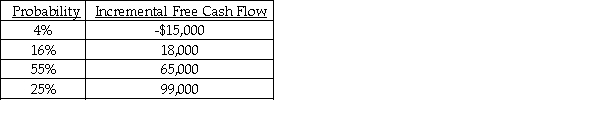 a.The risk-adjusted required rate of return for this project is 12%.Calculate the risk-adjusted net present value of the project and the project's IRR.
b.Should the project be accepted?
a.The risk-adjusted required rate of return for this project is 12%.Calculate the risk-adjusted net present value of the project and the project's IRR.
b.Should the project be accepted? (Essay)
4.9/5 (89)
(89) You are analyzing the purchase of new equipment.Since you are not an expert on this type of equipment,you hire a consulting firm to make recommendations.The consultant charged you $1,500 and recommended the purchase of the latest model from ACME Corp.of America.The equipment costs $80,000,and it will cost another $10,000 to modify it for special use by your firm.The equipment will be depreciated on a straight-line basis over six years with no salvage value.You expect the equipment will be sold after three years for $28,000.Use of the equipment will require an increase in your company's net working capital of $4,000,but this $4,000 will be recovered at the end of year three.The use of the equipment will have no effect on revenues,but it is expected to save the firm $50,000 per year in before-tax operating costs.Your company's marginal tax rate is 35%.What is the incremental free cash flow for the first year of the project?
(Multiple Choice)
4.8/5 (84)
(84) A project's standing alone risk allows for diversification within a sole firm.
(True/False)
4.7/5 (74)
(74) Accounting profits are used to make capital budgeting decisions because generally accepted accounting principles ensure that profits are the best measure of a company's economic activity.
(True/False)
4.9/5 (87)
(87) If a project uses an asset the corporation already owns,the cost of that asset for capital budgeting purposes is zero to reflect the advantage the project has over projects that require the purchase of new assets.
(True/False)
4.7/5 (78)
(78) Hershey's expects to sell $2 million of its new candy bar,although $200,000 of this amount would have been spent on its existing candy bar.The $2 million is the appropriate cash inflow for the new candy bar project,while the $200,000 will be counted against the return on the old candy bar.
(True/False)
4.8/5 (70)
(70) The guiding rule in deciding if a free cash flow is incremental is to look at the company with,versus without,the new project.
(True/False)
4.8/5 (71)
(71) A major corporation is considering a capital budgeting project that involves the development of a new technology.The controller estimates the net present value to be negative,yet argues that the company should invest in the project.Which of the following statements is MOST correct?
(Multiple Choice)
4.7/5 (69)
(69) 
Filters
- Essay(0)
- Multiple Choice(0)
- Short Answer(0)
- True False(0)
- Matching(0)