



 Chat with AI
Exam 10: Capital-Budgeting Techniques and Practice

Exam 1: An Introduction to the Foundations of Financial Management137 Questions
Exam 2: The Financial Markets and Interest Rates152 Questions
Exam 3: Understanding Financial Statements and Cash Flows117 Questions
Exam 4: Evaluating a Firms Financial Performance147 Questions
Exam 5: The Time Value of Money162 Questions
Exam 6: The Meaning and Measurement of Risk and Return147 Questions
Exam 7: The Valuation and Characteristics of Bonds145 Questions
Exam 8: The Valuation and Characteristics of Stock128 Questions
Exam 9: The Cost of Capital130 Questions
Exam 10: Capital-Budgeting Techniques and Practice153 Questions
Exam 11: Cash Flows and Other Topics in Capital Budgeting154 Questions
Exam 12: Determining the Financing Mix150 Questions
Exam 13: Dividend Policy and Internal Financing164 Questions
Exam 14: Short-Term Financial Planning141 Questions
Exam 15: Working-Capital Management158 Questions
Exam 16: International Business Finance109 Questions
Exam 17: Cash,receivables,and Inventory Management179 Questions
Select questions type


NPV may be calculated on an Excel spreadsheet simply by entering the project's free cash flows into Excel's NPV function.

Free
(True/False)
4.9/5  (98)
(98) Correct Answer: Verified
False
The payback period ignores the time value of money and therefore should not be used as a screening device for the selection of capital budgeting projects.
Free
(True/False)
4.8/5 (64)
(64) Correct Answer:Verified
VerifiedFalse
A capital budgeting project has a net present value of $30,000 and a modified internal rate of return of 15%.The project's required rate of return is 13%.The internal rate of return is
Free
(Multiple Choice)
4.8/5 (66)
(66) Correct Answer:Verified
VerifiedD
A project's IRR is analogous to the concept of the yield to maturity for bonds.
(True/False)
4.8/5 (91)
(91) Lithium,Inc.is considering two mutually exclusive projects,A and B.Project A costs $95,000 and is expected to generate $65,000 in year one and $75,000 in year two.Project B costs $120,000 and is expected to generate $64,000 in year one,$67,000 in year two,$56,000 in year three,and $45,000 in year four.Lithium,Inc.'s required rate of return for these projects is 10%.The equivalent annual annuity amount for project B,rounded to the nearest dollar,is
(Multiple Choice)
4.8/5 (94)
(94) Lithium,Inc.is considering two mutually exclusive projects,A and B.Project A costs $95,000 and is expected to generate $65,000 in year one and $75,000 in year two.Project B costs $120,000 and is expected to generate $64,000 in year one,$67,000 in year two,$56,000 in year three,and $45,000 in year four.Lithium,Inc.'s required rate of return for these projects is 10%.Which project would you recommend using the replacement chain method to evaluate the projects with different lives?
(Multiple Choice)
4.9/5 (76)
(76) Lithium,Inc.is considering two mutually exclusive projects,A and B.Project A costs $95,000 and is expected to generate $65,000 in year one and $75,000 in year two.Project B costs $120,000 and is expected to generate $64,000 in year one,$67,000 in year two,$56,000 in year three,and $45,000 in year four.Lithium,Inc.'s required rate of return for these projects is 10%.The internal rate of return for Project A is
(Multiple Choice)
4.9/5 (83)
(83) Southeast Compositions,Inc.is considering a project with the following cash flows: Initial Outlay = $126,000 Cash Flows: Year 1 = $44,000 Year 2 = $59,000 Year 3 = $64,000 Compute the net present value of this project if the company's discount rate is 14%.
(Multiple Choice)
4.8/5 (69)
(69) A major disadvantage of the discounted payback period is the arbitrariness of the process used to select the maximum desired payback period.
(True/False)
4.8/5 (69)
(69) Raindrip Corp.can purchase a new machine for $1,875,000 that will provide an annual net cash flow of $650,000 per year for five years.The machine will be sold for $120,000 after taxes at the end of year five.What is the net present value of the machine if the required rate of return is 13.5%.
(Multiple Choice)
4.7/5 (76)
(76) Two projects that have the same cost and the same expected cash flows will have the same net present value.
(True/False)
4.9/5 (78)
(78) Consider two mutually exclusive projects X and Y with identical initial outlays of $600,000 and useful lives of 5 years.Project X is expected to produce an after-tax cash flow of $180,000 each year.Project Y is expected to generate a single after-tax net cash flow of $1,015,000 in year 5.The discount rate is 14 percent.
a.Calculate the net present value for each project.
b.Calculate the IRR for each project.
c.What decision should you make regarding these projects?
(Essay)
4.8/5 (77)
(77) Kingston Corp.is considering a new machine that requires an initial investment of $480,000 installed,and has a useful life of 8 years.The expected annual after-tax cash flows for the machine are $89,000 for each of the 8 years and nothing thereafter.
a.Calculate the net present value of the machine if the required rate of return is 11 percent.
b.Calculate the IRR of this project.
c.Should Kingston accept the project (assume that it is independent and not subject to any capital rationing constraint)? Explain your answer.
(Essay)
4.9/5 (95)
(95) Any project deemed acceptable using the discounted payback period will also be acceptable if using the traditional payback period.
(True/False)
4.7/5 (86)
(86) DYI Construction Co.is considering a new inventory system that will cost $750,000.The system is expected to generate positive cash flows over the next four years in the amounts of $350,000 in year one,$325,000 in year two,$150,000 in year three,and $180,000 in year four.DYI's required rate of return is 8%.What is the internal rate of return of this project?
(Multiple Choice)
4.8/5 (75)
(75) The Dickerson PR Firm is considering two mutually exclusive projects with useful lives of 3 and 6 years.The after-tax cash flows for projects S and L are listed below. 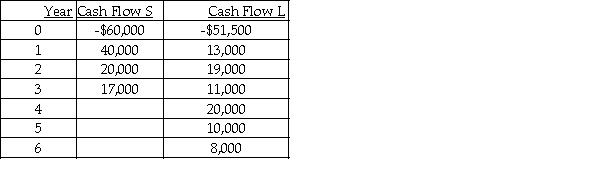 Calculate the equivalent annual annuity for each project assuming a required return of 15%.What decision should be made?
 (Essay)
4.9/5 (90)
(90) The Bolster Company is considering two mutually exclusive projects: 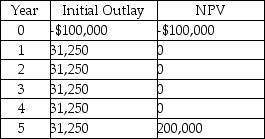 The required rate of return on these projects is 12 percent.
a.What is each project's payback period?
b.What is each project's discounted payback period?
c.What is each project's net present value?
d.What is each project's internal rate of return?
e.Fully explain the results of your analysis.Which project do you prefer,and why?
The required rate of return on these projects is 12 percent.
a.What is each project's payback period?
b.What is each project's discounted payback period?
c.What is each project's net present value?
d.What is each project's internal rate of return?
e.Fully explain the results of your analysis.Which project do you prefer,and why? (Essay)
4.7/5 (82)
(82) The Net Present Value (or NPV)criteria for capital budgeting decisions assumes that expected future cash flows are reinvested at ________,and the Internal Rate of Return (or IRR)criteria assumes that expected future cash flows are reinvested at ________.
(Multiple Choice)
5.0/5 (91)
(91) You are considering investing in a project with the following year-end after-tax cash flows: Year 1: $57,000 Year 2: $72,000 Year 3: $78,000 If the initial outlay for the project is $185,000,compute the project's internal rate of return.
(Multiple Choice)
4.9/5 (77)
(77) 
Filters
- Essay(0)
- Multiple Choice(0)
- Short Answer(0)
- True False(0)
- Matching(0)