



 Chat with AI
Exam 4: Evaluating a Firms Financial Performance

Exam 1: An Introduction to the Foundations of Financial Management137 Questions
Exam 2: The Financial Markets and Interest Rates152 Questions
Exam 3: Understanding Financial Statements and Cash Flows117 Questions
Exam 4: Evaluating a Firms Financial Performance147 Questions
Exam 5: The Time Value of Money162 Questions
Exam 6: The Meaning and Measurement of Risk and Return147 Questions
Exam 7: The Valuation and Characteristics of Bonds145 Questions
Exam 8: The Valuation and Characteristics of Stock128 Questions
Exam 9: The Cost of Capital130 Questions
Exam 10: Capital-Budgeting Techniques and Practice153 Questions
Exam 11: Cash Flows and Other Topics in Capital Budgeting154 Questions
Exam 12: Determining the Financing Mix150 Questions
Exam 13: Dividend Policy and Internal Financing164 Questions
Exam 14: Short-Term Financial Planning141 Questions
Exam 15: Working-Capital Management158 Questions
Exam 16: International Business Finance109 Questions
Exam 17: Cash,receivables,and Inventory Management179 Questions
Select questions type


All of the following will improve a firm's liquidity position EXCEPT
(Multiple Choice)
4.8/5  (71)
(71) Williams Inc.has a current ratio equal to 3,a quick ratio equal to 1.8,and total current assets of $6 million.Williams' inventory balance is
(Multiple Choice)
4.7/5 (85)
(85) Standard Inc.has an annual interest expense of $40,000.If Standard's times-interest-earned ratio is 3.0,what is Standard's Earnings Before Taxes (EBT)?
(Multiple Choice)
4.8/5 (72)
(72) The computation of return on equity,or ROE,does not include retained earnings as part of common equity because retained earnings includes all net income for the company since its inception and analysts are trying to calculate the return for just the current year.
(True/False)
4.9/5 (80)
(80) Financial ratios are often reported by industry or line of business because differences in the type of business can make ratio comparisons uninformative or even misleading.
(True/False)
4.8/5 (81)
(81) An inventory turnover ratio of 7.2 compared to an industry average of 5.1 is likely to indicate that
(Multiple Choice)
4.7/5 (89)
(89) Please refer to Table 4-3 for the following questions.
Table 4-3
Emery Corporation
 -Based on the information in Table 4-3,the average collection period is
 (Multiple Choice)
4.9/5 (65)
(65) It is commonly accepted that the industry average for a ratio is the ideal goal for a financial manager to achieve.
(True/False)
4.9/5 (67)
(67) Please refer to Table 4-2 for the following questions.
Table 4-2
Drummond Company
Balance Sheet
 -Based on the information in Table 4-2,the times interest earned ratio is
 (Multiple Choice)
4.9/5 (77)
(77) Ratios that examine profit relative to investment are useful in evaluating the overall effectiveness of the firm's management.
(True/False)
4.9/5 (99)
(99) Operating profits or EBIT is used to measure a firm's profits on assets because it does not include the firm's cost of debt financing.
(True/False)
4.8/5 (84)
(84) The current ratio of a firm would equal its quick ratio whenever
(Multiple Choice)
4.7/5 (77)
(77) Please refer to Table 4-1 for the following questions.
Table 4-1
Stewart Company
Balance Sheet
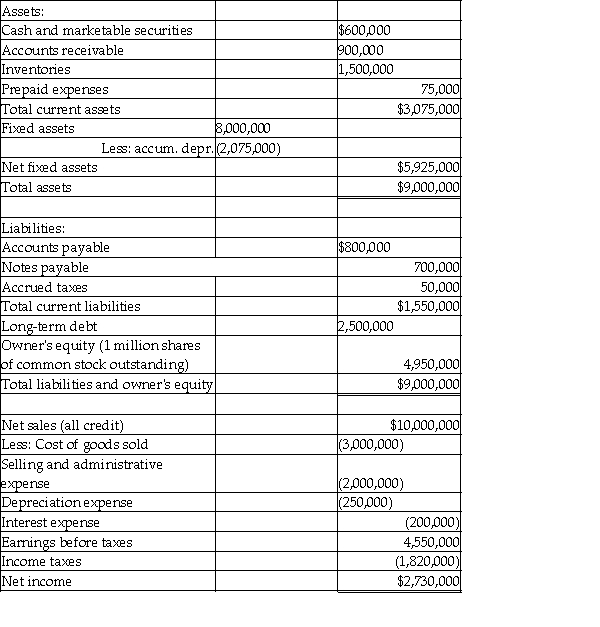 -Based on the information in Table 4-1,the inventory turnover ratio is
 (Multiple Choice)
5.0/5 (77)
(77) Which of the following is true if a firm wishes to collect its accounts faster by imposing stricter credit terms on its customers?
(Multiple Choice)
4.8/5 (98)
(98) Please refer to Table 4-2 for the following questions.
Table 4-2
Drummond Company
Balance Sheet
-Based on the information in Table 4-2,the average collection period is
-Based on the information in Table 4-2,the average collection period is (Multiple Choice)
4.8/5 (78)
(78) Financial ratios that are higher than industry averages may indicate problems that are as detrimental to the firm as ratios that are too low.
(True/False)
4.9/5 (67)
(67) Denver Systems has total assets of $1,000,000; common equity of $400,000; a gross profit of $800,000; total operating expenses of $620,000; interest expense of $20,000; income taxes of $74,000; and preferred dividends of $30,000.What is Denver Systems' return on equity?
(Multiple Choice)
4.8/5 (70)
(70) Total asset turnover is equal to accounts receivable turnover plus inventory turnover plus fixed asset turnover.
(True/False)
4.9/5 (83)
(83) 
Filters
- Essay(0)
- Multiple Choice(0)
- Short Answer(0)
- True False(0)
- Matching(0)