



 Chat with AI
Exam 24: Strategic Thinking and Game Theory

Exam 1: Introduction10 Questions
Exam 2: A Consumers Economic Circumstances24 Questions
Exam 3: Economic Circumstances in Labor and Financial Markets12 Questions
Exam 4: Tastes and Indifference Curves15 Questions
Exam 5: Different Types of Tastes18 Questions
Exam 6: Doing the Best We Can17 Questions
Exam 7: Income and Substitution Effects in Consumer Goods Markets22 Questions
Exam 8: Wealth and Substitution Effects in Labor and Capital Markets16 Questions
Exam 9: Demand for Goods and Supply of Labor and Capital22 Questions
Exam 10: Consumer Surplus and Deadweight Loss20 Questions
Exam 11: One Input and One Output: a Short-Run Producer Model29 Questions
Exam 12: Production With Multiple Inputs30 Questions
Exam 13: Production Decisions in the Short and Long Run24 Questions
Exam 14: Competitive Market Equilibrium18 Questions
Exam 15: The Invisible Hand and the First Welfare Theorem18 Questions
Exam 16: General Equilibrium21 Questions
Exam 17: Choice and Markets in the Presence of Risk18 Questions
Exam 18: Elasticities, Price-Distorting Policies, and Non-Price Rationing21 Questions
Exam 19: Distortionary Taxes and Subsidies26 Questions
Exam 20: Prices and Distortions Across Markets18 Questions
Exam 21: Externalities in Competitive Markets23 Questions
Exam 22: Asymmetric Information in Competitive Markets22 Questions
Exam 23: Monopoly32 Questions
Exam 24: Strategic Thinking and Game Theory34 Questions
Exam 25: Oligopoly19 Questions
Exam 26: Product Differentiation and Innovation in Markets13 Questions
Exam 27: Public Goods19 Questions
Exam 28: Governments and Politics17 Questions
Exam 29: What Is Good Challenges From Psychology and Philosophy20 Questions
Select questions type


If a separating equilibrium is played in a signaling game,the receiver will "update" his beliefs during the game.
(True/False)
4.7/5  (84)
(84) In a simultaneous move,incomplete information game in which player 1 is unsure of which of two types player 2 is,player 1's strategy must include an action for each possible type that player 2 might be,but player 2 only needs to pick one action since he knows what type he is.
(True/False)
4.8/5 (80)
(80) If a player's strategy in a sequential game is to choose an action that stops the game early on,it is unnecessary to specify that player's plans for moves later on in the game when it would have been his turn to move again.
(True/False)
4.9/5 (87)
(87) Suppose a player can play 2 possible actions and has 5 possible decision nodes in a sequential game.Then he has 10 possible strategies he can play.
(True/False)
4.8/5 (75)
(75) Consider the following sequential move game: 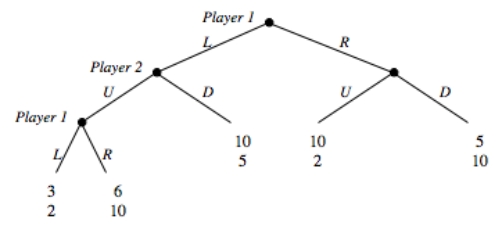 a.What are the subgame perfect equilibrium strategies in this game?
b.List all possible strategies for the two players.
c.Illustrate this game in a payoff matrix.
d.Indicate the Nash equilibria in the payoff matrix from (c).
e.What makes some of the Nash equilibria not subgame perfect?
a.What are the subgame perfect equilibrium strategies in this game?
b.List all possible strategies for the two players.
c.Illustrate this game in a payoff matrix.
d.Indicate the Nash equilibria in the payoff matrix from (c).
e.What makes some of the Nash equilibria not subgame perfect? (Essay)
5.0/5 (84)
(84) Non-credible threats that are made in a Nash equilibrium (that is not subgame perfect)of a sequential game cannot be made in the first stage by the player who begins the game.
(True/False)
5.0/5 (93)
(93) If a pooling equilibrium is played in a signaling game,beliefs about the sender type can take on any form along the branch of the game tree that is not played in equilibrium,but on the branch that is played,beliefs are identical to the probability distribution with which "nature" assigned types to the sender.
(True/False)
4.9/5 (87)
(87) If players discount the future sufficiently,cooperation in infinitely repeated Prisoners' Dilemma games cannot emerge as a subgame perfect equilibrium.
(True/False)
5.0/5 (88)
(88) Suppose a player in a sequential game has 5 potential decision nodes,with 2 possible actions at each node.Then he has 25 possible pure strategies.
(True/False)
4.7/5 (78)
(78) If all players in a game have a dominant strategy,then there can only be one pure strategy Nash equilibrium to the game.
(True/False)
4.9/5 (71)
(71) In a Bayesian incomplete information game,a "belief" is represented as the probability you place on your opponent playing one strategy versus another.
(True/False)
4.9/5 (88)
(88) If everyone has a dominant strategy in a simultaneous move game,then the action that is played by that strategy is played in all stages of any finitely repeated version of that game in any subgame perfect equilibrium.
(True/False)
4.9/5 (88)
(88) A mixed strategy in which positive probability is placed on more than one action can be a best response to another player's strategy only if the expected payoff from playing the pure strategies (over which the individual is mixing)is the same.
(True/False)
4.9/5 (85)
(85) In any subgame perfect equilibrium to an infinitely repeated Prisoners' Dilemma game,the players will end up cooperating.
(True/False)
4.8/5 (88)
(88) 
Filters
- Essay(0)
- Multiple Choice(0)
- Short Answer(0)
- True False(0)
- Matching(0)