



 Chat with AI
Exam 7: Income and Substitution Effects in Consumer Goods Markets


Suppose you collect stamps and coins for the sheer fun of it.Currently,your collection contains both.For purposes of this problem,suppose that stamps all sell for one price and coins all sell for another,and both are normal goods.
a.Begin by illustrating your current budget constraint (with stamps on the horizontal and coins on the vertical)as well as the bundle A you currently own.Assume that you have done the best you can given your circumstances.
b.The stamp industry has recently marketed its product as a safe way of investing and insuring against inflation.As a result,the price of stamps has been driven up since you chose your current bundle.Show how this changes your budget constraint given that you can buy and sell both stamps and coins --- and assuming you have no additional funds to spend on your collections.
c.Are you happy about the stamp industry's marketing campaign? In what way will you adjust your collection?
d.After a while (and after you have made your desired adjustments),it turns out that the marketing campaign only produced a temporary "bubble" in the stamp market --- and prices fall back to what they were before.Are you happy when the bubble bursts? Will you have more or fewer coins and stamps than you had before the marketing campaign started?
e.True or False: For collectors that collect to satisfy their passion (rather than as an investment strategy),volatility in prices is good.

 (92)
 Verified
a. 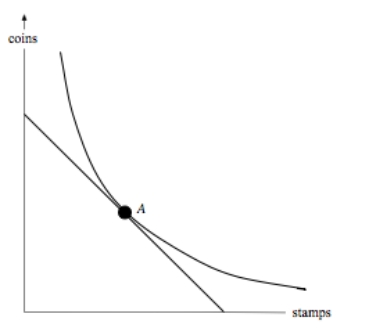
b.This changes the budget to the dashed budget in the second graph.
c.A portion of the new dashed budget lies above the original indifference curve --- implying that there are now bundles available that are preferred to the original bundle A.So you are happy about the marketing campaign.All of these bundles have more coins and fewer stamps --- so you will end up selling stamps and buying coins. 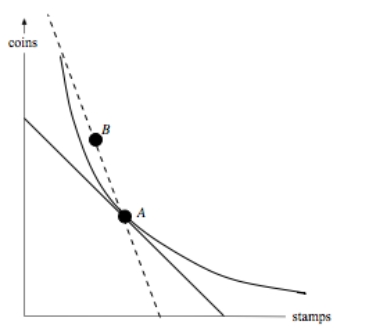
d.When the bubble bursts,we are at bundle B --- and the new budget now passes through B with a shallower slope.Again,new bundles emerge that lie above the indifference curve that contains B --- implying you are happy about the bubble bursting.All of the potentially more preferred bundles contain more stamps and fewer shirts.Since we know stamps and coins are both normal goods,we know that bundle C where you end up will have more stamps and more coins than you had at A.(This is because the original and final budgets both have the same slope.) 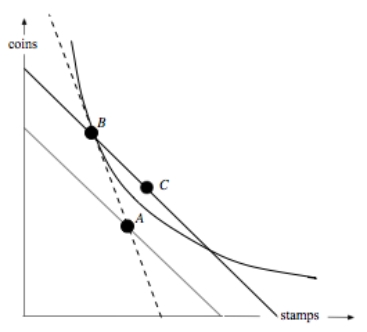 e.This is true --- price fluctuations open up new bundles that are preferred,as items that have become relatively more expensive are sold to purchase items that have become relatively cheaper,
Bottles of Coca-Cola and equally-sized bottles of Pepsi Cola are perfect substitutes for a consumer,but a bottle of Coke costs 10 cents less than bottles of Pepsi.The income effect of a 15 cent increase in the price of Pepsi will be for the consumer to drink less cola.
(70) VerifiedFalse
The price of peaches goes up and I observe you buying fewer strawberries.This implies strawberries must be a normal good.
(89) VerifiedTrue
Suppose the only two goods you care about in the world are French wine (x)and Cuban cigars (y)and your utility function is given by u(x,y)=xy.You have no income,and the only thing in the world you possess is a large box you have just inherited from your rich uncle who passed away last week (of liver and lung cancer.)You open the box,and much to your liking,you find it contains 9 bottles of fine French wine and 3 boxes of exquisite Cuban cigars.Currently,the wine sells for $1 per bottle,and the cigars sell for $9 per box.Just as you receive the inheritance,you read the headline: "President Lifts Embargo - Price of Cuban Cigars Falls to $4 per Box!"
a.Determine the income (or wealth)and substitution effects of a decrease of the price of cigars from 9 to 4.(Assume fractions of bottles and cigars can be bought.)
b.Are cigars a normal or inferior good for you?
c.How much would you have been willing to pay the President in order not to lift the embargo?
(91) Suppose your tastes are defined by the utility function .
a.Suppose your income is $1,000,the price of
is 1 and the price of
is
.Set up your utility maximization problem.
b.Derive the quantity of
you will consume.
c.What happens to your consumption of
if
increases?
d.Now suppose that your and my tastes are captured by the utility function
,with the parameter
different for you than it is for me.When
increases,you consume more
than before and I consume less.What range of
is consistent with your behavior,and what range is consistent with mine? Use your answer to (b)to explain.
(71) A change in the price of one good cannot leave utility unchanged unless the price change is accompanies by a change in income.
(89) Every luxury good is a normal good but not every normal good is a luxury.
(83) Quasilinear goods are borderline goods between the set of normal and the set of inferior goods.
(82) The price of peaches goes up and I observe you buying more strawberries.This implies that strawberries must be an inferior good.
(84) Every Giffen good is a necessity but not every interior good is a necessity.
(80) Bag of chips and bottles of salsa are perfect complements for consumer who eats only chips and salsa,but a bottle of salsa costs $1 more than a bag of chips.The income effect of a 50 cent increase in the price of a bag of chips will be fore the consumer to eat fewer chips and less salsa.
(77) The price of peaches goes up and I observe you buying more strawberries.This implies strawberries must be a normal good.
(82) Suppose a relatively low income family has a monthly budget of $1,000 to allocate between food and a non-food composite good.In this problem,assume food is aggregated into a "composite food" good that is modeled on the horizontal axis,and the non-food composite good is denominated in "dollars of other consumption".The price of food is $10 per unit.Suppose further that this family's tastes exhibit kinks in indifference curves,with one such indifference curve graphed below.  a.Draw the family's budget constraint and label the optimal consumption bundle.
b.Due to unexpected droughts,the price of food rises to $20.A cash subsidy S that leaves our family with the same level of happiness as it enjoyed prior to the price increase is proposed.How much would this subsidy cost for this family?
c.An alternative proposal suggests a price subsidy s that lowers the price of food for this family from $20 to ($20-s),with s set sufficiently high to allow the family to reach its original utility level.
d.Yet a third proposal suggests a price subsidy that leaves in tact the new price of $20 for the first 20 units of food bought by the family but then lowers the price for this family to $(20-s')while also making the family just as happy as it was before.How high does s' have to be to accomplish this?
e.If cost is all you care about,how would you rank these three policies? What if you care about food consumption for this family and believe a policy is better if it results in more food consumption?
a.Draw the family's budget constraint and label the optimal consumption bundle.
b.Due to unexpected droughts,the price of food rises to $20.A cash subsidy S that leaves our family with the same level of happiness as it enjoyed prior to the price increase is proposed.How much would this subsidy cost for this family?
c.An alternative proposal suggests a price subsidy s that lowers the price of food for this family from $20 to ($20-s),with s set sufficiently high to allow the family to reach its original utility level.
d.Yet a third proposal suggests a price subsidy that leaves in tact the new price of $20 for the first 20 units of food bought by the family but then lowers the price for this family to $(20-s')while also making the family just as happy as it was before.How high does s' have to be to accomplish this?
e.If cost is all you care about,how would you rank these three policies? What if you care about food consumption for this family and believe a policy is better if it results in more food consumption? (64) At most museums,you can either buy a year-long membership that gives you free access to the museum any time,or you can pay a daily fee every time you visit.(Assume for purposes of this exercise that everyone can in principle afford the year-long membership.)
a.
Those who choose to pay the daily fees all place the same value on their marginal museum visit.
b.
We cannot tell how much value anyone places on the marginal museum visit because we cannot compare utility across individuals.
c.
If someone is indifferent between the two options,she will go to the museum at least as much if she chooses the year-long membership than if she does not.
d.
Both (a)and (c)are true.
e.
Both (b)and (c)are true.
(85) Except for the case of Giffen goods,the substitution effect always tells us that a consumer will consume less (or at least no more)of a good whose price has increased.
(97) Wholesale clubs charge a fixed monthly fee but then offer goods at discount prices.For purposes of this question,suppose a wholesale club and a supermarket offer the same composite grocery item,with the supermarket charging no fixed fee but a higher price for the item.(Assume no corner solutions.)
a.
Anyone shopping at the wholesale club places less value on the marginal item bought than anyone shopping at the supermarket.
b.
Anyone indifferent between the two stores buys more (or at least no less)if she chooses the wholesale club.
c.
We cannot predict how much value different individuals place on the marginal item in each store because we cannot measure utility objectively.
d.
Both (a)and (b)are true.
e.
Both (b)and (c)are true.
(62) Currently.the price of consuming housing is lowered by the fact that home mortgage interest is tax deductible.Suppose the government proposed to eliminate this implicit subsidy of your housing consumption,raising the price from to .At the same time,the government lowers the tax on other consumption,lowering the price from to .
a.Write down your original budget constraint assuming the consumer has income I.
b.Suppose the utility function
captures your tastes,and suppose
,
,
,
and
.Write out the utility maximization problem for this consumer prior to any policy change.
c.How much housing and other goods will this consumer consume prior to any policy change?
d.How much would this consumer be willing to pay to get the policy change implemented?
(71) 
Filters
- Essay(0)
- Multiple Choice(0)
- Short Answer(0)
- True False(0)
- Matching(0)