



 Chat with AI
Exam 10: Gases and the Atmosphere

Exam 1: The Nature of Chemistry68 Questions
Exam 2: Atoms and Elements66 Questions
Exam 3: Chemical Compounds65 Questions
Exam 4: Quantities of Reactants and Products65 Questions
Exam 5: Chemical Reactions66 Questions
Exam 6: Energy and Chemical Reactions55 Questions
Exam 7: Electron Configurations and the Periodic Table64 Questions
Exam 8: Covalent Bonding67 Questions
Exam 9: Molecular Structure53 Questions
Exam 10: Gases and the Atmosphere57 Questions
Exam 11: Liquids, Solids, and Materials46 Questions
Exam 12: Chemical Kinetics: Rates of Reactions66 Questions
Exam 13: Chemical Equilibrium57 Questions
Exam 14: The Chemistry of Solutes and Solutions57 Questions
Exam 15: Acids and Bases62 Questions
Exam 16: Additional Aqueous Equilibria52 Questions
Exam 17: Thermodynamics: Directionality of Chemical Reactions56 Questions
Exam 18: Electrochemistry and Its Applications54 Questions
Exam 19: Nuclear Chemistry53 Questions
Select questions type


What is the molar mass of an unknown gas if 3.7 g of the gas occupies 450 mL at 20.0°C and 2.0 atm? The value of R = 0.0821 L atm mol-1 K-1.
(Multiple Choice)
4.9/5  (83)
(83) At 20°C, a sample of gas has a volume of 2.51 L at 795 torr. What is the new pressure (in atm) if the volume is increased to 6.46 L at the same temperature?
(Multiple Choice)
5.0/5 (66)
(66) A balloon filled with gas is heated from 30.0°C to 197.0°C at constant pressure. If the original volume of the balloon was 1.560 L, what is the volume (in L) of the gas after heating?
(Multiple Choice)
4.9/5 (73)
(73) What happens to a helium balloon at a party on a hot day if the balloon was filled on a cold morning?
(Multiple Choice)
4.8/5 (77)
(77) Determine the volume (in L) of Cl2(g) required to carry out the following reaction at 794 torr and 625°C using 15.0 g of Fe. The value of R = 0.0821 L atm mol-1 K-1. 
(Multiple Choice)
4.9/5 (82)
(82) A 5.00 L flask contains 3.50 g of sulfur trioxide, 2.45 g of carbon monoxide, and 3.99 g of argon all at 35°C. What is the pressure (in atm) in the flask?
(Multiple Choice)
4.9/5 (79)
(79) Under what conditions do real gases most closely approximate the behavior of ideal gases?
(Multiple Choice)
4.7/5 (64)
(64) Suppose that 1.00 gram of each of the three inert gases, Ne, Ar, Kr, are combined in a 1.00-L flask at 25.0°C. Determine the partial pressures of each of the three gases in the flask in torr. Ne Ar Kr Total
(Multiple Choice)
4.8/5 (89)
(89) The following is the reaction that occurs in automobile airbags: 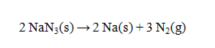 How many grams of sodium azide (NaN3) are required to produce 19.00 L of N2 at 293K and 775 mm Hg? R = 0.0821 L atm mol-1 K-1.
 (Multiple Choice)
4.8/5 (83)
(83) If 7.63 g of an unknown gas occupies 79.1 mL at 25.02°C and 7.55 atm of pressure, what is the molar mass of the gas? The value of R = 0.0821 L atm mol-1 K-1.
(Multiple Choice)
4.8/5 (87)
(87) If a 2.0-liter sample of gas experiences a decrease in pressure from 1.74 atm to 0.555 atm at 25°C, what is the resulting volume (in L) at 25°C?
(Multiple Choice)
4.9/5 (75)
(75) Which two assumptions of the Kinetic-Molecular Theory need to be altered to account for the behavior of real gases?
I. gas molecules have no volume
II. gas molecules move in random motion
III. gas molecules undergo no attractive or repulsive force toward one another
IV. gas molecules undergo perfectly elastic collision
(Multiple Choice)
4.9/5 (69)
(69) What is the pressure (in atm) exerted by a 2.00 mole sample of gas that occupies 2.50 L at 307.15 K? The value of R = 0.0821 L atm mol-1 K-1.
(Multiple Choice)
4.8/5 (68)
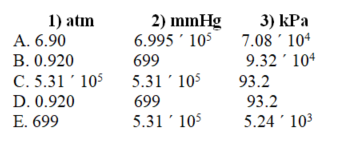
(68) 
What conditions are referred to as standard temperature and pressure (STP) for gas behavior?
(Multiple Choice)
5.0/5 (81)
(81) 
Filters
- Essay(0)
- Multiple Choice(0)
- Short Answer(0)
- True False(0)
- Matching(0)