



 Chat with AI
Exam 11: Liquids, Solids, and Materials

Exam 1: The Nature of Chemistry68 Questions
Exam 2: Atoms and Elements66 Questions
Exam 3: Chemical Compounds65 Questions
Exam 4: Quantities of Reactants and Products65 Questions
Exam 5: Chemical Reactions66 Questions
Exam 6: Energy and Chemical Reactions55 Questions
Exam 7: Electron Configurations and the Periodic Table64 Questions
Exam 8: Covalent Bonding67 Questions
Exam 9: Molecular Structure53 Questions
Exam 10: Gases and the Atmosphere57 Questions
Exam 11: Liquids, Solids, and Materials46 Questions
Exam 12: Chemical Kinetics: Rates of Reactions66 Questions
Exam 13: Chemical Equilibrium57 Questions
Exam 14: The Chemistry of Solutes and Solutions57 Questions
Exam 15: Acids and Bases62 Questions
Exam 16: Additional Aqueous Equilibria52 Questions
Exam 17: Thermodynamics: Directionality of Chemical Reactions56 Questions
Exam 18: Electrochemistry and Its Applications54 Questions
Exam 19: Nuclear Chemistry53 Questions
Select questions type


In an ionic compound such as NaCl, which consists of a fcc lattice of chloride ions, each sodium ion has ____ chloride ions surrounding it as nearest neighbors.
(Multiple Choice)
4.9/5  (86)
(86) A diatomic element is a shiny purple solid at room temperature that sublimes upon gentle heating. It is slightly soluble in water and considerably more soluble in alcohol. It does not conduct electricity as a solid, liquid or solution. This solid can best be classified as
(Multiple Choice)
4.9/5 (70)
(70) Which are properties of all metals (except Hg)?
I. Good conductors of heat and electricity
II. Easily formed into sheets or wires
III. Shiny
IV. Chemically unreactive
V. Soluble in water
(Multiple Choice)
4.8/5 (83)
(83) In body-centered cubic unit cells, ____ of the atom in the center of the unit cell is counted as part of that unit cell.
(Multiple Choice)
4.8/5 (86)
(86) Viscosity of a liquid ____ as temperature decreases because ____.
(Multiple Choice)
4.9/5 (86)
(86) In face-centered cubic unit cells, ____ of the atom on each face of the unit cell is counted as part of that unit cell.
(Multiple Choice)
4.8/5 (81)
(81) Which description of the Clausius-Clapeyron equation is false?
(Multiple Choice)
4.8/5 (83)
(83) Exhibit 11-1 For the following question(s), consider the graphic below: 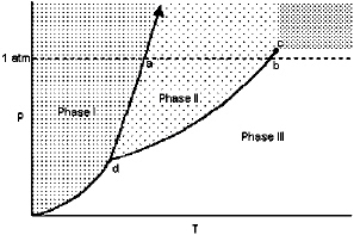 Refer to Exhibit 11-1. The transition from Phase I to Phase III is called
 (Multiple Choice)
4.7/5 (85)
(85) What is the correct order for the surface tension of the following substances?
(Multiple Choice)
4.8/5 (83)
(83) Exhibit 11-1 For the following question(s), consider the graphic below: 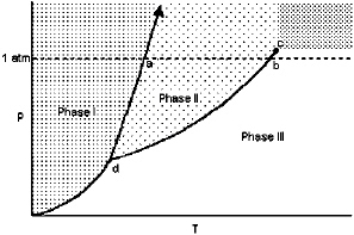 Refer to Exhibit 11-1. The temperature at point d is the
 (Multiple Choice)
4.9/5 (84)
(84) Exhibit 11-1 For the following question(s), consider the graphic below: 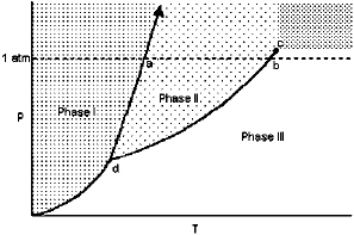 Refer to Exhibit 11-1. The temperature at point c is the
 (Multiple Choice)
4.9/5 (93)
(93) Exhibit 11-1 For the following question(s), consider the graphic below: 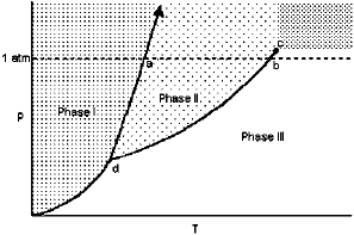 Refer to Exhibit 11-1. At a constant pressure of 1 atmosphere, the transition from Phase III to Phase II is
 (Multiple Choice)
4.8/5 (78)
(78) Which statement about heat of vaporization and heat of condensation is correct?
(Multiple Choice)
4.9/5 (69)
(69) The best explanation for the existence of a meniscus observed when water is placed in a glass tube of small diameter is
(Multiple Choice)
4.9/5 (75)
(75) 
Filters
- Essay(0)
- Multiple Choice(0)
- Short Answer(0)
- True False(0)
- Matching(0)