



 Chat with AI
Exam 18: Electrochemistry and Its Applications

Exam 1: The Nature of Chemistry68 Questions
Exam 2: Atoms and Elements66 Questions
Exam 3: Chemical Compounds65 Questions
Exam 4: Quantities of Reactants and Products65 Questions
Exam 5: Chemical Reactions66 Questions
Exam 6: Energy and Chemical Reactions55 Questions
Exam 7: Electron Configurations and the Periodic Table64 Questions
Exam 8: Covalent Bonding67 Questions
Exam 9: Molecular Structure53 Questions
Exam 10: Gases and the Atmosphere57 Questions
Exam 11: Liquids, Solids, and Materials46 Questions
Exam 12: Chemical Kinetics: Rates of Reactions66 Questions
Exam 13: Chemical Equilibrium57 Questions
Exam 14: The Chemistry of Solutes and Solutions57 Questions
Exam 15: Acids and Bases62 Questions
Exam 16: Additional Aqueous Equilibria52 Questions
Exam 17: Thermodynamics: Directionality of Chemical Reactions56 Questions
Exam 18: Electrochemistry and Its Applications54 Questions
Exam 19: Nuclear Chemistry53 Questions
Select questions type


The study of the relationships between electron flow and redox reactions is called
(Multiple Choice)
4.7/5  (88)
(88) In the reaction shown below, ____ is the oxidizing agent and ____ the reducing agent. 
(Multiple Choice)
4.8/5 (68)
(68) Calculate the value of Ecell for a zinc-platinum electrochemical cell when the concentration of Pt2+(aq) is 0.050 M and the concentration of Zn2+(aq) is 1.1 M. E cell = 1.96 V under standard conditions. Pt is the less active metal.
(Multiple Choice)
4.9/5 (77)
(77) Exhibit 18-2 Use this list of half-reactions to answer the following question(s).
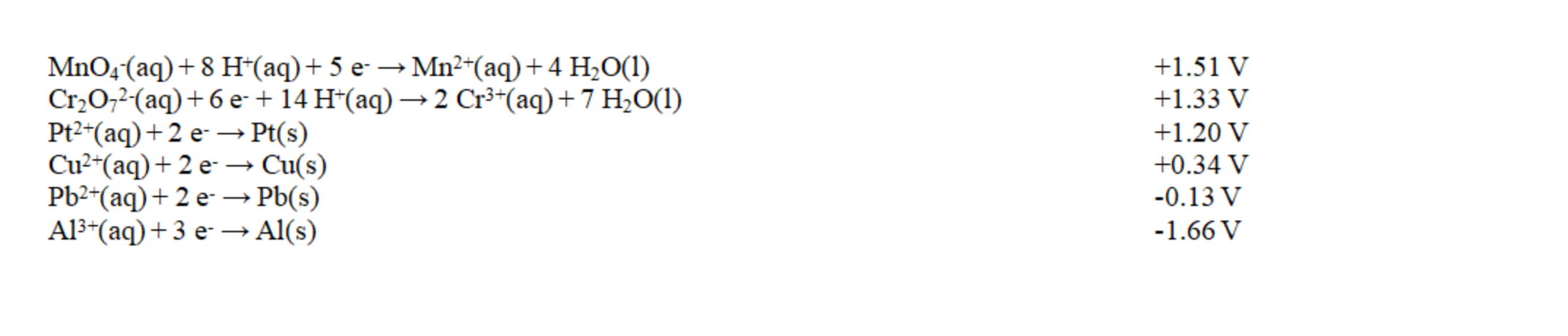 Refer to Exhibit 18-2. The strongest reducing agent in the table is
 (Multiple Choice)
4.8/5 (78)
(78) Exhibit 18-2 Use this list of half-reactions to answer the following question(s).
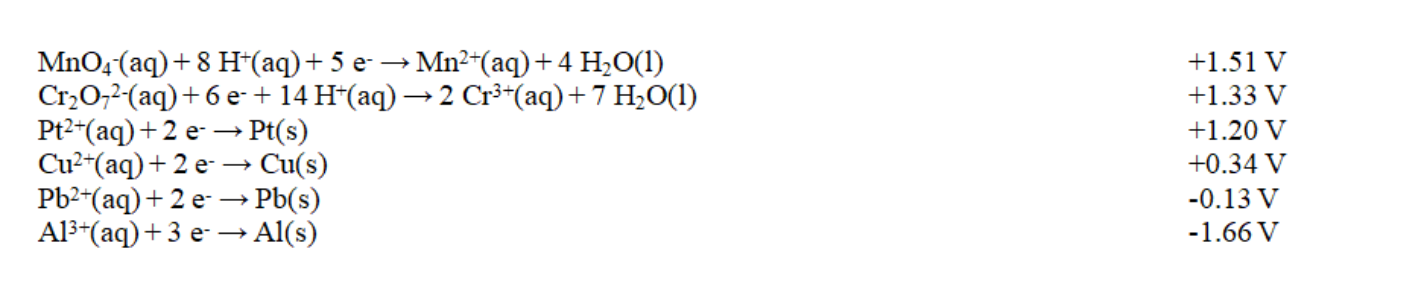 Refer to Exhibit 18-2. The potential for the product-favored reaction involving aluminum and copper metals, Al3+(aq) and Cu2+(aq), is
 (Multiple Choice)
4.8/5 (73)
(73) The relationship between Gibbs free energy and E cell is DG =
(Multiple Choice)
4.9/5 (81)
(81) Explain, with reference to the Nernst equation, how it is possible for a cell to have a positive cell potential under standard conditions, but a negative cell potential under other conditions.
(Essay)
4.9/5 (85)
(85) Balance the following redox equation.
 The oxidation process is clearly
 (Essay)
4.8/5 (78)
(78) The value of E cell for an aluminum-nickel electrochemical cell is +1.41 V at 25 C. Calculate the value of DG for this cell under standard conditions.
(Multiple Choice)
5.0/5 (77)
(77) A secondary cell is one which ____; this is possible because ____.
(Multiple Choice)
4.8/5 (74)
(74) Which statement about lead storage batteries is not correct?
(Multiple Choice)
4.9/5 (73)
(73) Which compound contains the atom with the highest oxidation number?
(Multiple Choice)
4.9/5 (99)
(99) 
Filters
- Essay(0)
- Multiple Choice(0)
- Short Answer(0)
- True False(0)
- Matching(0)