



 Chat with AI
Exam 6: Energy and Chemical Reactions

Exam 1: The Nature of Chemistry68 Questions
Exam 2: Atoms and Elements66 Questions
Exam 3: Chemical Compounds65 Questions
Exam 4: Quantities of Reactants and Products65 Questions
Exam 5: Chemical Reactions66 Questions
Exam 6: Energy and Chemical Reactions55 Questions
Exam 7: Electron Configurations and the Periodic Table64 Questions
Exam 8: Covalent Bonding67 Questions
Exam 9: Molecular Structure53 Questions
Exam 10: Gases and the Atmosphere57 Questions
Exam 11: Liquids, Solids, and Materials46 Questions
Exam 12: Chemical Kinetics: Rates of Reactions66 Questions
Exam 13: Chemical Equilibrium57 Questions
Exam 14: The Chemistry of Solutes and Solutions57 Questions
Exam 15: Acids and Bases62 Questions
Exam 16: Additional Aqueous Equilibria52 Questions
Exam 17: Thermodynamics: Directionality of Chemical Reactions56 Questions
Exam 18: Electrochemistry and Its Applications54 Questions
Exam 19: Nuclear Chemistry53 Questions
Select questions type


Which term refers to a quantity of heat transferred at constant pressure?
(Multiple Choice)
4.8/5  (73)
(73) A bomb calorimeter has a heat capacity of 675 J/°C and contains 925 g of water. If the combustion of 0.500 mole of a hydrocarbon increases the temperature of the calorimeter from 24.26°C to 53.88°C, determine the enthalpy change per mole of hydrocarbon. The specific heat of water = 4.184 J g-1 °C-1.
(Multiple Choice)
4.9/5 (87)
(87) Heating a 25.0 g sample of each substance below with 375 J of energy will cause which substance to have the greatest increase in temperature?
(Multiple Choice)
4.7/5 (75)
(75) The standard enthalpies of formation for several substances are given below:  Determine the heat of vaporization for H2O and C2H5OH.
 (Multiple Choice)
4.8/5 (77)
(77) Determine the heat of reaction for the process 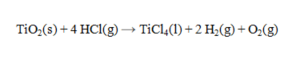 using the information given below:

using the information given below:
(Multiple Choice)
4.9/5 (81)
(81) Determine if each of the four situations below describes kinetic or potential energy.
I. the bonds in propane molecules
II. a reservoir of water behind a dam
III. water molecules colliding into each other
IV. the electrical current in a light bulb that is turned on
(Multiple Choice)
4.7/5 (80)
(80) According to the First Law of Thermodynamics, the total _____________ of the universe is constant.
(Short Answer)
4.9/5 (82)
(82) Enthalpy change is equal to heat transfer at constant _______________.
(Short Answer)
4.9/5 (67)
(67) 
Which property can be used to distinguish one substance from another substance?
(Multiple Choice)
4.9/5 (96)
(96) Heating a 50.0 g sample of iron (specific heat = 0.451 J g-1 °C-1) raises its temperature from 25.0°C to 79.4°C. How much energy was required to heat the sample?
(Multiple Choice)
4.7/5 (62)
(62) What is the molar heat capacity of table salt, NaCl (specific heat = 0.88 J g-1 °C-1)?
(Multiple Choice)
4.8/5 (89)
(89) 
Filters
- Essay(0)
- Multiple Choice(0)
- Short Answer(0)
- True False(0)
- Matching(0)