



 Chat with AI
Exam 2: Entrepreneurial Intentions and Corporate Entrepreneurship

Exam 1: Entrepreneurship and the Entrepreneurial Mind-Set49 Questions
Exam 2: Entrepreneurial Intentions and Corporate Entrepreneurship48 Questions
Exam 3: Entrepreneurial Strategy: Generating and Exploiting New Entries93 Questions
Exam 4: Creativity and the Business Idea87 Questions
Exam 5: Identifying and Analyzing Domestic and International Opportunities73 Questions
Exam 6: Intellectual Property and Other Legal Issues for the Entrepreneur76 Questions
Exam 7: The Business Plan: Creating and Starting the Venture89 Questions
Exam 8: The Marketing Plan89 Questions
Exam 9: The Organizational Plan91 Questions
Exam 10: The Financial Plan88 Questions
Exam 11: Sources of Capital97 Questions
Exam 12: Informal Risk Capital, venture Capital, and Going Public102 Questions
Exam 13: Strategies for Growth and Managing the Implication of Growth82 Questions
Exam 14: Accessing Resources for Growth From External Sources90 Questions
Exam 15: Succession Planning and Strategies for Harvesting and Ending the Venture71 Questions
Select questions type


When would an entrepreneur be pronounced to have recovered from the grief of a lost business?
(Multiple Choice)
4.9/5  (86)
(86) In an encouraging climate for corporate entrepreneurship,rewards should be based on the attainment of established performance goals.
(True/False)
4.7/5 (82)
(82) Discuss three major ways in which managerial and entrepreneurial decision making differs.
Eight areas of difference students can choose from:
1.strategic orientation
2.commitment to opportunity
3.commitment of resources
4.control of resources
5.management structure
6.reward philosophy
7.growth orientation
8.entrepreneurial culture
Basic differences in each dimension:
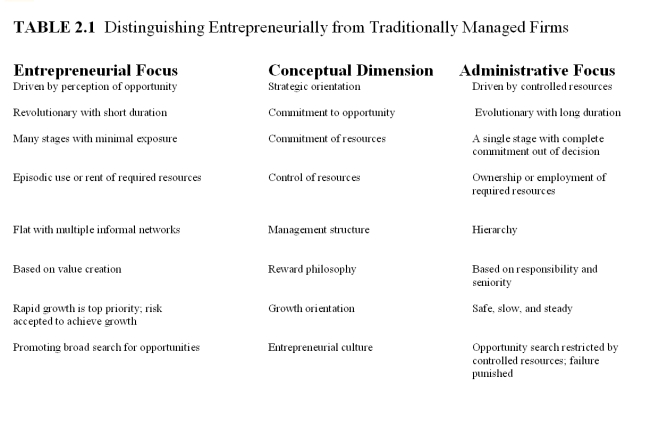 Source:This table is taken from T.Brown,P.Davidsson,and J.Wiklund,"An Operationalization of Stevenson's Conceptualization of Entrepreneurship as Opportunity-Based Firm Behavior," Strategic Management Journal 22 (2001).
 (Not Answered)
This question doesn't have any answer yet
Corporate ventures are totally independent units,hence the equity portion of the compensation is particularly difficult to handle.
(True/False)
4.9/5 (66)
(66) Which of the following would NOT occur in the second stage of establishing corporate entrepreneurship in an organization?
(Multiple Choice)
4.9/5 (79)
(79) The typical corporate culture has a climate and a reward system that favor activist decision making.
(True/False)
4.9/5 (80)
(80) Entrepreneurs focus on how to minimize resources needed whereas traditional firms focus on accumulating resources.
(True/False)
4.9/5 (87)
(87) A sufficient time for top management to be committed to corporate entrepreneurship is:
(Multiple Choice)
4.9/5 (77)
(77) Why is loss-orientation physically and mentally exhausting?
(Multiple Choice)
4.9/5 (89)
(89) Robert Mondavi Winery was the first Californian to produce and market premium wines that were expected to compete with European wines.
(True/False)
4.8/5 (79)
(79) Most managers in a corporation are capable of being successful corporate entrepreneurs with the correct training.
(True/False)
4.8/5 (65)
(65) In encouraging a culture for corporate entrepreneurship,using older,proven,technology is recommended in order to increase stability in the organization.
(True/False)
4.9/5 (70)
(70) New product development falls under which of the four major components of corporate entrepreneurship?
(Multiple Choice)
4.9/5 (69)
(69) Which company,discussed in our text as an example of corporate entrepreneurship,created the independent business unit concept?
(Multiple Choice)
4.8/5 (77)
(77) In the loss-orientation process of grief recovery,when are painful memories likely to dominate most?
(Multiple Choice)
5.0/5 (91)
(91) Why does restoration-orientation have adverse effects on an individual's health?
(Multiple Choice)
4.8/5 (79)
(79) Robert Mondavi came up with all of the following process innovations except:
(Multiple Choice)
4.8/5 (80)
(80) Which of the following is true about corporate entrepreneurship?
(Multiple Choice)
4.8/5 (77)
(77) The corporate entrepreneur to have the ability to encourage teamwork and use a multidisciplined approach,which violates organizational practices and structures taught in most business schools.
(True/False)
4.9/5 (85)
(85) 
Filters
- Essay(0)
- Multiple Choice(0)
- Short Answer(0)
- True False(0)
- Matching(0)