



 Chat with AI
Exam 6: Variable Costing and Analysis

Exam 1: Managerial Accounting Concepts and Principles250 Questions
Exam 2: Job Order Costing and Analysis217 Questions
Exam 3: Process Costing and Analysis230 Questions
Exam 4: Activity Based Costing and Analysis220 Questions
Exam 5: Cost Behavior Cost-Volume-Profit Analysis247 Questions
Exam 6: Variable Costing and Analysis201 Questions
Exam 7: Master Budgets and Performance Planning213 Questions
Exam 8: Flexible Budgets and Standard Costs222 Questions
Exam 9: Performance Measurement and Responsibility Accounting208 Questions
Exam 10: Relevant Costing for Managerial Decisions117 Questions
Exam 11: Capital Budgeting and Investment Analysis159 Questions
Exam 12: Reporting Cash Flows239 Questions
Exam 13: Analysis of Financial Statements233 Questions
Exam 14: Time Value of Money84 Questions
Exam 15: Analyzing for Business Transactions250 Questions
Exam 16: Partnership Accounting179 Questions
Select questions type


Under variable costing, fixed manufacturing overhead is expensed at the time the units are produced. Under absorption costing, fixed manufacturing overhead is expensed at the time the units are sold.
(True/False)
4.9/5  (82)
(82) Under variable costing, product costs consist of direct labor, direct materials, and fixed overhead.
(True/False)
4.9/5 (80)
(80) When units produced exceed the units sold, income under absorption costing is higher than income under variable costing.
(True/False)
4.8/5 (78)
(78) Brush Industries reports the following information for May:  Calculate the gross margin for May under absorption costing.
 (Multiple Choice)
4.9/5 (68)
(68) The variable costing income statement classifies costs based on cost behavior rather than function.
(True/False)
4.9/5 (67)
(67) Clear Company reports the following information for its first year of operations: 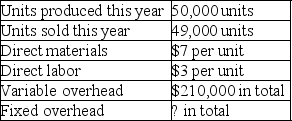 If the company's cost per unit of finished goods using absorption costing is $19.30, what is total fixed overhead?
 (Multiple Choice)
4.8/5 (73)
(73) Reported income is identical under absorption costing and variable costing when the units produced ________ the units sold.
(Short Answer)
4.7/5 (81)
(81) Assume a company sells a given product for $33.28 per unit. How many units must the company sell to break-even if variable selling costs are $1.40 per unit, variable production costs are $23.56 per unit, and total fixed costs are $2,080,000?
(Essay)
4.9/5 (76)
(76) Which of the following statements is true regarding variable costing?
(Multiple Choice)
4.8/5 (80)
(80) Chance, Inc. sold 3,000 units of its product at a price of $72 per unit. Total variable cost per unit is $51, consisting of $32 in variable production cost and $19 in variable selling and administrative cost. Compute the manufacturing margin for the company under variable costing.
(Multiple Choice)
4.9/5 (73)
(73) A company reports the following information regarding its production cost:
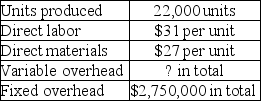 Required: Perform the following independent calculations.
a. Compute total variable overhead cost if the production cost per unit under variable costing is $240.
b. Compute total variable overhead cost if the production cost per unit under absorption costing is $240.
Required: Perform the following independent calculations.
a. Compute total variable overhead cost if the production cost per unit under variable costing is $240.
b. Compute total variable overhead cost if the production cost per unit under absorption costing is $240. (Essay)
4.8/5 (70)
(70) Given Advanced Company's data, compute cost per unit of finished goods under variable costing.
(Multiple Choice)
4.9/5 (83)
(83) Lukin Corporation reports the following first year production cost information.
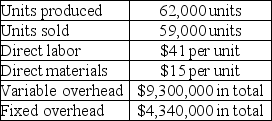 a. Compute production cost per unit under variable costing.
b. Compute production cost per unit under absorption costing.
c. Determine the cost of ending inventory using variable costing.
d. Determine the cost of ending inventory using absorption costing.
a. Compute production cost per unit under variable costing.
b. Compute production cost per unit under absorption costing.
c. Determine the cost of ending inventory using variable costing.
d. Determine the cost of ending inventory using absorption costing. (Essay)
4.8/5 (75)
(75) How will net income under variable costing compare to net income under absorption costing in the following three situations? Explain briefly the cause of any differences.
(a) Units produced equal units sold
(b) Units produced exceed units sold
(c) Units produced are less than units sold
(Essay)
4.9/5 (88)
(88) Anchovy, Inc., a producer of frozen pizzas, began operations this year. During this year, the company produced 16,000 cases of pizza and sold 15,000. At year-end, the company reported the following income statement using absorption costing:
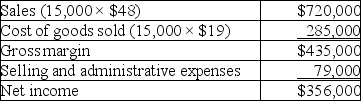 Production costs per case total $19, which consists of $15.50 in variable production costs and $3.50 in fixed production costs (based on the 16,000 units produced). Eight percent of total selling and administrative expenses are variable. Compute net income under variable costing.
 (Essay)
4.8/5 (85)
(85) Maloney Co. provided the following information for the year 20X1:
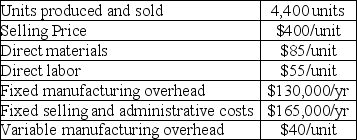 There are no beginning inventories. Prepare an income statement using the variable costing format.
 (Essay)
4.8/5 (74)
(74) Given the Scavenger Company data, what is net income using absorption costing?
(Multiple Choice)
4.8/5 (69)
(69) ________ and ________ are product costs that can be directly traced to the product.
(Essay)
4.7/5 (86)
(86) Blackbird, Incorporated reports the following information regarding its production cost:
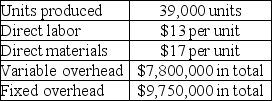 a. Compute production cost per unit under variable costing.
b. Compute production cost per unit under absorption costing.
a. Compute production cost per unit under variable costing.
b. Compute production cost per unit under absorption costing. (Essay)
4.9/5 (73)
(73) Assume a company had the following production costs:
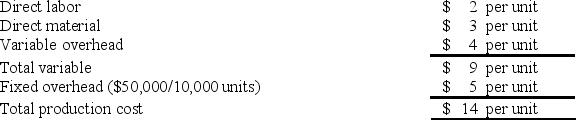 Under absorption costing, the total product cost per unit when 4,000 units are produced would be $22.50.
 (True/False)
4.9/5 (81)
(81) 
Filters
- Essay(0)
- Multiple Choice(0)
- Short Answer(0)
- True False(0)
- Matching(0)