



 Chat with AI
Exam 12: Reporting Cash Flows

Exam 1: Managerial Accounting Concepts and Principles250 Questions
Exam 2: Job Order Costing and Analysis217 Questions
Exam 3: Process Costing and Analysis230 Questions
Exam 4: Activity Based Costing and Analysis220 Questions
Exam 5: Cost Behavior Cost-Volume-Profit Analysis247 Questions
Exam 6: Variable Costing and Analysis201 Questions
Exam 7: Master Budgets and Performance Planning213 Questions
Exam 8: Flexible Budgets and Standard Costs222 Questions
Exam 9: Performance Measurement and Responsibility Accounting208 Questions
Exam 10: Relevant Costing for Managerial Decisions117 Questions
Exam 11: Capital Budgeting and Investment Analysis159 Questions
Exam 12: Reporting Cash Flows239 Questions
Exam 13: Analysis of Financial Statements233 Questions
Exam 14: Time Value of Money84 Questions
Exam 15: Analyzing for Business Transactions250 Questions
Exam 16: Partnership Accounting179 Questions
Select questions type


For each of the following separate cases, use the information provided to calculate the missing cash inflow or cash outflow using the direct method.
(a) (b) (c) Accounts receivable balances: Beginning of year End of year Sales revenue (all on credit) Cash received from customers Accounts payable balances: Beginning of year End of year. Merchandise inventory balances: Beginning of year End of year Cost of goods sold Cash paid for merchandise inventory Interest payable balances: Beginning of year End of year Interest expense Cash paid for interest \ 60,000 57,000 375,000 underline \ 42,000 45,000 50,000 47,500 250,000 \ 7,500 9,200 35,000 underline
(Essay)
4.7/5  (73)
(73) Explain how cash flows from investing and financing activities are determined.
(Essay)
4.9/5 (75)
(75) Which one of the following is representative of typical cash flows from operating activities?
(Multiple Choice)
4.9/5 (84)
(84) A company reported operating cash flows in Year 1 of $33,100 and $26,220 in Year 2. Its average total assets in Year 1 were $262,000 and $313,000 in Year 2. Calculate the cash flow on total assets ratio for both years. Comment on the results.
(Essay)
4.9/5 (76)
(76) Based on the following income statement and balance sheet for Bankowski Corporation, determine the cash flows from operating activities using the indirect method.
Sales \ 504,000 Cost of goods sold \ 327,600 Depreciation expense 33,000 Other operating expenses (486,100) Other gains (losses): Gain on sale of equipment Income before taxes 23,100 Net income tax expense 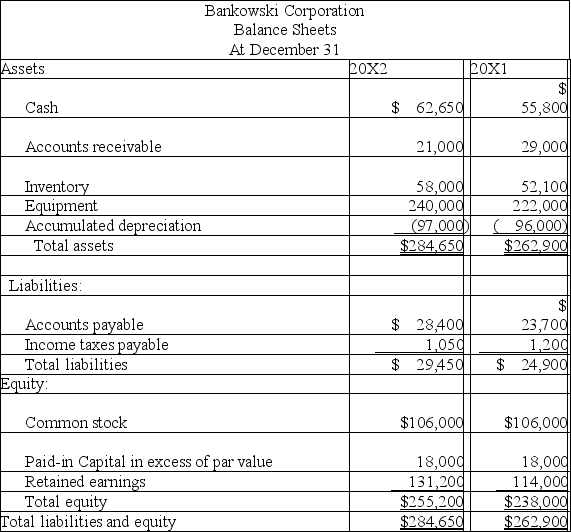
(Essay)
4.9/5 (69)
(69) Explain the purpose and format of the statement of cash flows. Also describe its relevance to decision makers.
(Essay)
5.0/5 (71)
(71) A company reported net income of $318,000, operating cash flows of $218,000, total cash flows of $184,000, and average total assets of $898,000. Calculate its cash flow on total assets ratio.
(Essay)
4.8/5 (90)
(90) Use the following calendar-year information to prepare Adam Company's statement of cash flows using the direct method.
Cash paid to purchase machinery \ 124,000 Cash paid for merchandise inventory 220,000 Cash paid for operating expenses 280,000 Cash paid for interest 4,000 Cash received for interest 10,000 Cash proceeds from sale of land 100,000 Cash balance at beginning of year 15,000 Cash balance at end of year 77,000 Cash borrowed on a short-term note 25,000 Cash dividends paid 24,000 Cash received from stock issuance 57,000 Cash collections from customers 522,000
(Essay)
4.9/5 (87)
(87) Use the following income statement and information about changes in noncash current assets and liabilities to (1) prepare only the cash flows from operating activities section of the statement of cash flows using the indirect method and (2) compute the company's cash flow on total assets ratio for the year assuming that average total assets are $525,250.
Davey Company Income Statement For Year Ended December 31 Sales \ 880,000 Grost of goods sold Gross profit \ 393,000 Operating expenses: Salaries expense \ 144,000 Rent expense 76,000 Depreciation expense 45,000 Amortization expense 22,000 Utilities expenses Income from operations \9 4,000 Loss on sale of equipment Income before taxes \8 0,000 Income tax expense Net Income
Changes in current asset and current liability accounts for the year that relate to operations follow.
Increase in accounts receivable \ 32,000 Increase in accounts payable (all accounts payable transactions are for inventory) 13,500 Decrease in prepaid expenses 9,200 Decrease in merchandise inventory 14,000 Decrease in long-term notes payable 20,000
(Essay)
4.9/5 (59)
(59) Describe the format of the statement of cash flows, including the reporting of significant noncash investing and financing activities.
(Essay)
4.9/5 (76)
(76) The purchase of stock in another company is classified as a financing activity.
(True/False)
4.9/5 (71)
(71) When using a spreadsheet to prepare the statement of cash flows, an increase in accounts payable is entered in the Analysis of Changes columns with a debit in the statement of cash flows section and a credit in the balance sheet section.
(True/False)
4.8/5 (91)
(91) A corporation reported average total assets in Year 1 of $397,350 and $440,800 in Year 2. Its net operating cash flow for Year 1 was $35,667 and $35,790 for Year 2. Calculate the cash flow on total assets ratio for both years. Comment on the results.
(Essay)
4.9/5 (80)
(80) When preparing the operating activities section of the statement of cash flows using the direct method, non-operating losses are added to net income.
(True/False)
4.9/5 (82)
(82) When using the indirect method to calculate and report the net cash provided or used by operating activities, net income is adjusted for all but which of the following?
(Multiple Choice)
4.8/5 (67)
(67) Financing activities include (a) the purchase and sale of long-term assets, (b) the purchase and sale of short-term investments, and (c) lending and collecting on loans.
(True/False)
4.9/5 (73)
(73) Use the following information to calculate cash paid for income taxes: Income tax expense $50,000
Income tax payable, January 1 9,000 Income tax payable, December 31 7,000
(Multiple Choice)
4.8/5 (77)
(77) A company had average total assets of $1,660,000, total cash flows of $1,320,000, cash flows from operations of $205,000, and cash flows from financing of $750,000. The cash flow on total assets ratio equals:
(Multiple Choice)
4.7/5 (66)
(66) 
Filters
- Essay(0)
- Multiple Choice(0)
- Short Answer(0)
- True False(0)
- Matching(0)