



 Chat with AI
Exam 16: Mixtures

Exam 1: Patterns of Motion and Equilibrium126 Questions
Exam 2: Newtons Laws of Motion127 Questions
Exam 3: Momentum and Energy181 Questions
Exam 4: Gravity, Projectiles, and Satellites147 Questions
Exam 5: Fluid Mechanics148 Questions
Exam 6: Thermal Energy and Thermodynamics113 Questions
Exam 7: Heat Transfer and Change of Phase158 Questions
Exam 8: Static and Current Electricity178 Questions
Exam 9: Magnetism and Electromagnetic Induction130 Questions
Exam 10: Waves and Sound146 Questions
Exam 11: Light163 Questions
Exam 12: Atoms and the Periodic Table137 Questions
Exam 13: The Atomic Nucleus and Radioactivity127 Questions
Exam 14: Elements of Chemistry69 Questions
Exam 15: How Atoms Bond and Molecules Attract150 Questions
Exam 16: Mixtures141 Questions
Exam 17: How Chemicals React120 Questions
Exam 18: Two Classes of Chemical Reactions177 Questions
Exam 19: Organic Compounds96 Questions
Exam 20: Rocks and Minerals169 Questions
Exam 21: Plate Tectonics and Earths Interior181 Questions
Exam 22: Shaping Earths Surface180 Questions
Exam 23: Geologic Time - Reading the Rock Record167 Questions
Exam 24: The Oceans, Atmosphere, and Climatic Effects188 Questions
Exam 25: Driving Forces of Weather166 Questions
Exam 26: The Solar System108 Questions
Exam 27: Stars and Galaxies107 Questions
Exam 28: The Structure of Space and Time73 Questions
Exam 29: Prologue: The Nature of Science22 Questions
Select questions type


What happens when the molecule-to-molecule attractions in the solute are comparable to those in the solvent?
(Multiple Choice)
4.8/5  (80)
(80) Each circle represents an atom.Which of the following boxes contains an element? A compound? A mixture? 
(Multiple Choice)
4.8/5 (98)
(98) Someone argues that he or she doesn't drink tap water because it contains thousands of molecules of some impurity in each glass.How would you respond in defense of the water's purity,if it indeed does contain thousands of molecules of some impurity per glass?
(Multiple Choice)
4.9/5 (87)
(87) 
If nitrogen, N2 ,were pumped into your lungs at high pressure,what would happen to its solubility in your blood stream?
(Multiple Choice)
4.9/5 (84)
(84) How would you classify the following material? coffee (with milk)
(Multiple Choice)
4.7/5 (69)
(69) Which of the following best describes a two-molar sucrose solution?
(Multiple Choice)
4.8/5 (77)
(77) Which of the following would cost the least to purify by reverse osmosis?
(Multiple Choice)
4.9/5 (74)
(74) If you filter sea water to remove all of the particles you would be left with a clear
(Multiple Choice)
4.8/5 (97)
(97) Account for the observation that ethyl alcohol, OH,dissolves readily in water but dimethyl ether,C OC ,which has the same number and kinds of atoms,does not. 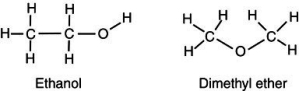
(Multiple Choice)
4.8/5 (68)
(68) If the solubility of a compound is 30 grams per liter,how much solid is left undissolved if you mix 30 g of the compound in 0.33 L of solution?
(Multiple Choice)
4.8/5 (84)
(84) Many solvents expand to occupy greater volumes with increasing temperature.What happens to the concentration of a solution made with such a solvent as its temperature is increased?
(Multiple Choice)
5.0/5 (71)
(71) Which of the following statements does not describes the similarity between soaps and detergents?
(Multiple Choice)
4.9/5 (78)
(78) Fatty acid molecules can align to form a barrier called a bilipid layer,shown below.In this schematic,the ionic end of the fatty acid is shown as a circle and the nonpolar chain is shown as a squiggly line. 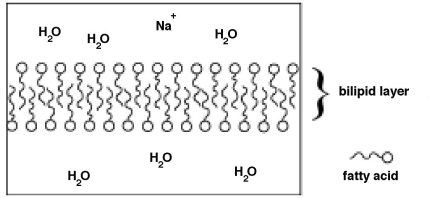 From the schematic above: why do nonpolar molecules have a difficult time passing through the bilipid layer?
 (Multiple Choice)
4.8/5 (92)
(92) What is the molarity when water is added to 2 moles of sodium chloride to make 0.5 liter of solution?
(Multiple Choice)
4.9/5 (75)
(75) 
Filters
- Essay(0)
- Multiple Choice(0)
- Short Answer(0)
- True False(0)
- Matching(0)