



 Chat with AI
Exam 13: Performance Evaluation and Risk Management

Exam 1: A Brief History of Risk and Return100 Questions
Exam 2: The Investment Process98 Questions
Exam 3: Overview of Security Types94 Questions
Exam 4: Mutual Funds and Other Investment Companies101 Questions
Exam 5: The Stock Market104 Questions
Exam 6: Common Stock Valuation102 Questions
Exam 7: Stock Price Behavior and Market Efficiency82 Questions
Exam 8: Behavioral Finance and the Psychology of Investing84 Questions
Exam 9: Interest Rates100 Questions
Exam 10: Bond Prices and Yields95 Questions
Exam 11: Diversification and Risky Asset Allocation84 Questions
Exam 12: Return, Risk, and the Security Market Line84 Questions
Exam 13: Performance Evaluation and Risk Management91 Questions
Exam 14: Futures Contracts97 Questions
Exam 15: Stock Options100 Questions
Exam 16: Option Valuation72 Questions
Exam 17: Projecting Cash Flow and Earnings100 Questions
Exam 18: Corporate and Government Bonds107 Questions
Exam 19: Global Economic Activity and Industry Analysis70 Questions
Exam 20: Mortgage-Backed Securities92 Questions
Select questions type


The Value-at-Risk measure assumes which one of the following?
(Multiple Choice)
4.8/5  (65)
(65) A stock has a return of 16.9 percent,a standard deviation of 11.7 percent,and a beta of 1.50.The risk-free rate is 2.65 percent and the market risk premium is 8.45 percent.What is the Jensen-Treynor alpha of this stock?
(Multiple Choice)
5.0/5 (89)
(89) A portfolio consists of the following two funds. 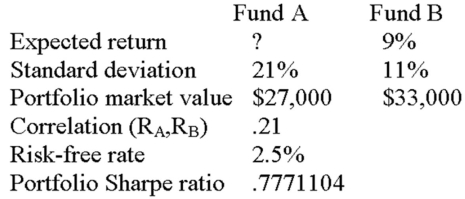 What is the expected return on fund A?
 (Multiple Choice)
4.8/5 (73)
(73) The Sharpe ratio measures a security's return relative to which one of the following?
(Multiple Choice)
4.9/5 (92)
(92) Which metric describes the percentage of a fund's movement which can be explained by movements in the market?
(Multiple Choice)
4.8/5 (75)
(75) Which of the following are related to VaR analysis?
I.beta
II.standard deviation
III.expected return
IV.time
(Multiple Choice)
4.8/5 (78)
(78) A fund has an alpha of 0.73 percent and a tracking error of 4.9 percent.What is the fund's information ratio?
(Multiple Choice)
4.8/5 (77)
(77) Your portfolio actually earned 6.2 percent for the year.You were expecting to earn 8.6 percent based on the CAPM formula.What is Jensen's alpha if the portfolio standard deviation is 12.1 percent and the beta is .93?
(Multiple Choice)
4.8/5 (72)
(72) You are comparing three securities and discover they all have identical Treynor ratios.Given this information,which one of the following must be true regarding these three securities?
(Multiple Choice)
4.8/5 (66)
(66) A portfolio has an average return of 12.4 percent,a standard deviation of 15.8 percent,and a beta of 1.35.The risk-free rate is 2.6 percent.What is the Sharpe ratio?
(Multiple Choice)
4.7/5 (87)
(87) Explain the similarities and differences between the Sharpe and Treynor ratios.Also,explain the most appropriate application for each.
(Essay)
4.9/5 (87)
(87) A stock has an annual standard deviation of 14.1 percent and an expected annual return of 11.5 percent.What is the smallest expected loss for the next 6 months given a probability of 2.5 percent?
(Multiple Choice)
4.8/5 (80)
(80) Lester has a portfolio with an average return of 12.8 percent and a standard deviation of 9.1 percent.He has a one percent probability of losing _____ percent or more in any given year. 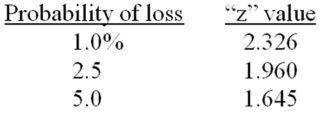
(Multiple Choice)
4.9/5 (91)
(91) Which one of the following concerns a money manager's control over investment risks,particularly potential short-run losses?
(Multiple Choice)
4.8/5 (90)
(90) A portfolio consists of the following two funds. 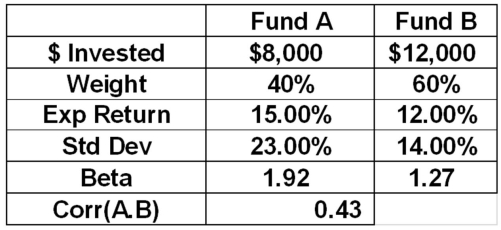 What is the Sharpe ratio of the portfolio?
 (Multiple Choice)
4.9/5 (86)
(86) Which metric measures how volatile a fund's returns are relative to its benchmark?
(Multiple Choice)
4.9/5 (77)
(77) Which one of the following measures returns in relation to total risk?
(Multiple Choice)
4.8/5 (81)
(81) A portfolio has a standard deviation of 15.8 percent and an average return of 14.2 percent.What loss is associated with a 2.5 percent probability? 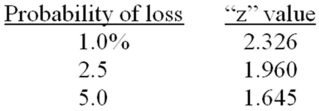
(Multiple Choice)
4.8/5 (64)
(64) Your portfolio has a beta of 1.17,a standard deviation of 14.3 percent,and an expected return of 12.5 percent.The market return is 11.3 percent and the risk-free rate is 3.1 percent.What is the Treynor ratio?
(Multiple Choice)
4.9/5 (86)
(86) Your portfolio has an expected return of 14.2 percent,a beta of 1.31,and a standard deviation of 15.3 percent.The U.S.Treasury bill rate is 3.48 percent.What is the Sharpe ratio of your portfolio?
(Multiple Choice)
4.8/5 (82)
(82) 
Filters
- Essay(0)
- Multiple Choice(0)
- Short Answer(0)
- True False(0)
- Matching(0)