



 Chat with AI
Exam 13: Performance Evaluation and Risk Management

Exam 1: A Brief History of Risk and Return100 Questions
Exam 2: The Investment Process98 Questions
Exam 3: Overview of Security Types94 Questions
Exam 4: Mutual Funds and Other Investment Companies101 Questions
Exam 5: The Stock Market104 Questions
Exam 6: Common Stock Valuation102 Questions
Exam 7: Stock Price Behavior and Market Efficiency82 Questions
Exam 8: Behavioral Finance and the Psychology of Investing84 Questions
Exam 9: Interest Rates100 Questions
Exam 10: Bond Prices and Yields95 Questions
Exam 11: Diversification and Risky Asset Allocation84 Questions
Exam 12: Return, Risk, and the Security Market Line84 Questions
Exam 13: Performance Evaluation and Risk Management91 Questions
Exam 14: Futures Contracts97 Questions
Exam 15: Stock Options100 Questions
Exam 16: Option Valuation72 Questions
Exam 17: Projecting Cash Flow and Earnings100 Questions
Exam 18: Corporate and Government Bonds107 Questions
Exam 19: Global Economic Activity and Industry Analysis70 Questions
Exam 20: Mortgage-Backed Securities92 Questions
Select questions type


Your portfolio has a standard deviation of 12.3 percent and an average return of 9.6 percent.You have a 5 percent probability of losing _____ percent or more in any given year. 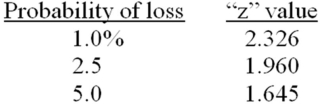
(Multiple Choice)
4.7/5  (72)
(72) Which of the following measures should be used to determine if a security should be included in a master portfolio?
I.Sharpe ratio
II.Treynor ratio
III.Jensen's alpha
(Multiple Choice)
4.9/5 (76)
(76) Which of the following should generally only be used to evaluate relatively diversified portfolios rather than individual securities?
I.Sharpe ratio
II.Treynor ratio
III.Jensen's alpha
(Multiple Choice)
4.8/5 (68)
(68) Which one of the following correctly states the VaR for a 3-year period with a 2.5 percent probability?
(Multiple Choice)
4.8/5 (76)
(76) A portfolio has a beta of 1.52 and an actual return of 13.7 percent.The risk-free rate is 2.7 percent and the market risk premium is 7.8 percent.What is the value of Jensen's alpha?
(Multiple Choice)
4.8/5 (78)
(78) Which one of the following is the best indication that a security is correctly priced according to the Capital Asset Pricing Model?
(Multiple Choice)
4.8/5 (78)
(78) A portfolio has an average return of 9.7 percent,a standard deviation of 8.6 percent,and a beta of .72.The risk-free rate is 2.1 percent.What is the Treynor ratio?
(Multiple Choice)
4.9/5 (71)
(71) Tony brags that his portfolio's rate of return is "beating the market".Which one of the following would best substantiate his claim?
(Multiple Choice)
4.7/5 (84)
(84) Which one of the following is probably the best measure of the performance of a well-diversified portfolio?
(Multiple Choice)
4.9/5 (80)
(80) A portfolio has a Jensen's alpha of 0.82 percent,a beta of 1.40,and a CAPM expected return of 13.7 percent.The risk-free rate is 2.5 percent.What is the actual return of the portfolio?
(Multiple Choice)
5.0/5 (76)
(76) Which one of the following is a statistical model,defined by its mean and standard deviation,that is used to assess probabilities?
(Multiple Choice)
4.7/5 (87)
(87) A portfolio has an actual return of 15.17 percent,a beta of .85,and a standard deviation of 7.2 percent.The market return is 13.4 percent and the risk-free rate is 2.8 percent.What is the portfolio's Jensen's alpha?
(Multiple Choice)
4.9/5 (63)
(63) Which one of the following is measured by the Jensen-Treynor alpha?
(Multiple Choice)
4.9/5 (78)
(78) Which one of the following Value-at-Risk measures would be most appropriate for a portfolio designed for a very risk-adverse investor?
(Multiple Choice)
4.9/5 (91)
(91) The Sharpe ratio is best used to evaluate which one of the following?
(Multiple Choice)
4.9/5 (88)
(88) Which one of the following statements is correct in relation to a security that has a negative Jensen's alpha?
(Multiple Choice)
4.9/5 (77)
(77) Angie owns a portfolio which has an expected annual return of 11.70 percent.What is the two-year expected return on her portfolio?
(Multiple Choice)
4.7/5 (78)
(78) The one-year standard deviation of your portfolio is 14.8 percent.What is the two-year standard deviation?
(Multiple Choice)
4.9/5 (83)
(83) A portfolio has a variance of .0165,a beta of 1.05,and an expected return of 12.65 percent.What is the Sharpe ratio if the expected risk-free rate is 3.4 percent?
(Multiple Choice)
4.8/5 (74)
(74) 
Filters
- Essay(0)
- Multiple Choice(0)
- Short Answer(0)
- True False(0)
- Matching(0)