



 Chat with AI
Exam 29: Relativity

Exam 1: Introduction to Physics100 Questions
Exam 2: One-Dimensional Kinematics112 Questions
Exam 3: Vectors in Physics82 Questions
Exam 4: Two-Dimensional Kinematics95 Questions
Exam 5: Newtons Laws of Motion101 Questions
Exam 6: Applications of Newtons Laws105 Questions
Exam 7: Work and Kinetic Energy92 Questions
Exam 8: Potential Energy and Conservation of Energy99 Questions
Exam 9: Linear Momentum and Collisions102 Questions
Exam 10: Rotational Kinematics and Energy102 Questions
Exam 11: Rotational Dynamics and Static Equilibrium97 Questions
Exam 12: Gravity94 Questions
Exam 13: Oscillations About Equilibrium102 Questions
Exam 14: Waves and Sound104 Questions
Exam 15: Fluids107 Questions
Exam 16: Temperature and Heat103 Questions
Exam 17: Phases and Phase Changes100 Questions
Exam 18: The Laws of Thermodynamics97 Questions
Exam 19: Electric Charges, Forces, and Fields88 Questions
Exam 20: Electric Potential and Electric Potential Energy99 Questions
Exam 21: Electric Current and Direct-Current Circuits99 Questions
Exam 22: Magnetism101 Questions
Exam 23: Magnetic Flux and Faradays Law of Induction99 Questions
Exam 24: Alternating-Current Circuits93 Questions
Exam 25: Electromagnetic Waves90 Questions
Exam 26: Geometrical Optics92 Questions
Exam 27: Optical Instruments102 Questions
Exam 28: Physical Optics: Interference and Diffraction93 Questions
Exam 29: Relativity100 Questions
Exam 30: Quantum Physics100 Questions
Exam 31: Atomic Physics75 Questions
Exam 32: Nuclear Physics and Nuclear Radiation89 Questions
Select questions type


State the Constancy fo the Speed of Light postulate of special relativity.
(Essay)
4.9/5  (69)
(69) How fast would you have to travel in order to reach a star that is 50 light-years away from Earth when you are 40 years older than you were when you left Earth? One light-year is the distance light travels in one year.
(Multiple Choice)
4.8/5 (66)
(66) According to Einstein's theory of general relativity, it is impossible to perform an experiment in a local environment that will enable us to decide whether we are accelerating or in a gravitational field.
(True/False)
4.9/5 (82)
(82) To what radius would the Sun have to be condensed in order for it to become a black hole? The mass of the Sun is 1.99 × 1030 kg and G = 6.67 × 10⁻¹¹ Nm2/kg2.
(Multiple Choice)
4.9/5 (70)
(70) A spaceship carrying a light clock moves at a speed of 0.960c relative to an observer on Earth. Relative to a frame of reference that is fixed with respect to Earth, how long does it take the clock on the ship to advance 1.00 s?
(Multiple Choice)
4.9/5 (75)
(75) FIGURE 29-1 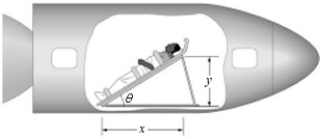 -An astronaut is resting on a bed inclined at an angle above the floor of a spaceship, as shown in Figure 29-1. From the point of view of an observer who sees the spaceship moving to the right with a speed approaching c, the angle the bed makes with the floor
 (Multiple Choice)
4.9/5 (86)
(86) Two spaceships approach Earth from opposite directions. One has a speed of 0.21c and the other a speed of 0.34c, both relative to Earth. What is the speed of one spaceship relative to the other?
(Multiple Choice)
4.8/5 (70)
(70) A spaceship approaches Earth with a speed 0.50c. A passenger in the spaceship measures his heartbeat as 70 beats per minute. What is his heartbeat rate according to an observer that is at rest relative to Earth?
(Multiple Choice)
4.9/5 (82)
(82) From the Earth, they see the Enterprise approaching at 0.800c and the Klingons approaching from the opposite direction at 0.900c. From the Enterprise, the crew sees the Klingon ship approaching at what speed?
(Essay)
4.9/5 (68)
(68) Einstein's theory of general relativity applies to accelerated frames of reference.
(True/False)
4.8/5 (82)
(82) A particle is moving with a certain speed. Its speed and energy are being measured with respect to Earth. When the particle's speed doubles, the energy increases by a factor of 4. What was the original speed of the particle?
(Multiple Choice)
4.8/5 (99)
(99) How fast must something be traveling if its mass increases by 10%?
(Short Answer)
4.8/5 (93)
(93) FIGURE 29-1
-An object moves in a direction parallel to its length with a velocity that approaches the velocity of light. The length of this object, as measured by a stationary observer,
-An object moves in a direction parallel to its length with a velocity that approaches the velocity of light. The length of this object, as measured by a stationary observer, (Multiple Choice)
4.9/5 (71)
(71) The atomic bomb that was dropped on Nagasaki in 1945 killed 140,000 people, helping to end World War II on the next day. It released energy equivalent to that of 20,000 tons of TNT explosive. How much mass was converted to energy when this took place?
(1000 tons ⇔ 4.3 × 10¹² J) (Incidentally, modern H-bombs have energy yields 1000 times as much!)
(Short Answer)
4.7/5 (85)
(85) A satellite, initially at rest in deep space, separates into two pieces, which move away from each other. One piece has a rest mass of 190 kg and moves away with a speed 0.280c, and the second piece moves in the opposite direction with a speed 0.600c. What is the rest mass of the second piece?
(Multiple Choice)
4.9/5 (79)
(79) Astronaut Sarah leaves Earth in a spaceship at a speed of 0.280c relative to Earth. Sarah's destination is a star system 12.5 light-years away (one light-year is the distance light travels in one year). According to Sarah, how far did she travel during the trip?
(Multiple Choice)
4.8/5 (72)
(72) A spaceship, traveling at 0.560c towards a stationary enemy station, shoots a projectile towards the station with a speed of 0.100c relative to the spaceship. What is the speed of the projectile relative to the station?
(Multiple Choice)
4.9/5 (70)
(70) At what speed is the mass of an electron double its rest mass?
(Multiple Choice)
4.8/5 (83)
(83) At what speed, relative to the frame of the observer making the measurement, is the length of a meter stick 0.60 m?
(Multiple Choice)
4.8/5 (82)
(82) 
Filters
- Essay(0)
- Multiple Choice(0)
- Short Answer(0)
- True False(0)
- Matching(0)