



 Chat with AI
Exam 29: Relativity

Exam 1: Introduction to Physics100 Questions
Exam 2: One-Dimensional Kinematics112 Questions
Exam 3: Vectors in Physics82 Questions
Exam 4: Two-Dimensional Kinematics95 Questions
Exam 5: Newtons Laws of Motion101 Questions
Exam 6: Applications of Newtons Laws105 Questions
Exam 7: Work and Kinetic Energy92 Questions
Exam 8: Potential Energy and Conservation of Energy99 Questions
Exam 9: Linear Momentum and Collisions102 Questions
Exam 10: Rotational Kinematics and Energy102 Questions
Exam 11: Rotational Dynamics and Static Equilibrium97 Questions
Exam 12: Gravity94 Questions
Exam 13: Oscillations About Equilibrium102 Questions
Exam 14: Waves and Sound104 Questions
Exam 15: Fluids107 Questions
Exam 16: Temperature and Heat103 Questions
Exam 17: Phases and Phase Changes100 Questions
Exam 18: The Laws of Thermodynamics97 Questions
Exam 19: Electric Charges, Forces, and Fields88 Questions
Exam 20: Electric Potential and Electric Potential Energy99 Questions
Exam 21: Electric Current and Direct-Current Circuits99 Questions
Exam 22: Magnetism101 Questions
Exam 23: Magnetic Flux and Faradays Law of Induction99 Questions
Exam 24: Alternating-Current Circuits93 Questions
Exam 25: Electromagnetic Waves90 Questions
Exam 26: Geometrical Optics92 Questions
Exam 27: Optical Instruments102 Questions
Exam 28: Physical Optics: Interference and Diffraction93 Questions
Exam 29: Relativity100 Questions
Exam 30: Quantum Physics100 Questions
Exam 31: Atomic Physics75 Questions
Exam 32: Nuclear Physics and Nuclear Radiation89 Questions
Select questions type


A spaceship, traveling at 0.100c away from a stationary enemy station, shoots a projectile towards the station, with a speed of 0.560c relative to the spaceship. What is the speed of the projectile relative to the station?
(Multiple Choice)
4.8/5  (74)
(74) A spaceship traveling at constant speed away from the Sun crosses the orbit of Earth and later crosses the orbit of Mars. What is the distance between these two events in the spaceship frame of reference?
The radius of Earth's orbit is 150 × 109 m and that of Mars is 228 × 109 m.
(Short Answer)
4.8/5 (72)
(72) A satellite with a rest mass of 200 kg and a speed of 0.800c and a second satellite with a rest mass of 100 kg and a speed of 0.600c are traveling toward each other in deep space. The satellites collide and stick together. What is the rest mass of the combined object after the collision?
(Multiple Choice)
4.9/5 (70)
(70) A 30-year-old astronaut goes off on a long term mission in a spacecraft that travels at speeds close to that of light. The mission lasts exactly 20 years as measured on Earth. Biologically speaking, the astronaut's age would be
(Multiple Choice)
4.8/5 (72)
(72) The kinetic energy of a particle is 3 times its rest energy. What is the speed of the particle?
(Multiple Choice)
4.8/5 (64)
(64) An electron has a relativistic momentum of 1.1 × 10⁻²¹ kg-m/s. What fraction of its total energy is its kinetic energy?
(Short Answer)
4.8/5 (83)
(83) The special theory of relativity sets a limit on speed. Does it set a limit on momentum?
(Multiple Choice)
4.9/5 (84)
(84) According to Einstein's theory of general relativity, a ray of light bends in a gravitational field.
(True/False)
4.9/5 (86)
(86) A spaceship enters the solar system moving toward the Sun at a constant speed relative to the Sun. By its own clock, the time elapsed between the time it crosses the orbit of Jupiter and the time it crosses the orbit of Mars is 50.0 minutes. As measured in the coordinate system of the Sun, how long did it take for the spaceship to travel that distance? The radius of the orbit of Jupiter is 778 × 109 m, and that of the orbit of Mars is 228 × 109 m.
(Multiple Choice)
4.9/5 (86)
(86) You are a passenger on a spaceship. As the speed of the spaceship increases, you would observe
(Multiple Choice)
4.9/5 (73)
(73) How fast would a rocket ship have to move to contract to half of its proper length (as observed by a stationary object)?
(Short Answer)
4.9/5 (67)
(67) A starship is built to plans that state it is to be constructed 100. meters long. It is launched and as it coasts by the Earth, it is seen to be shortened to 5.48 meters long.
(a) How fast is it moving?
(b) The ship's crew measure the length of the ship to be how long?
(Short Answer)
4.8/5 (74)
(74) FIGURE 29-1 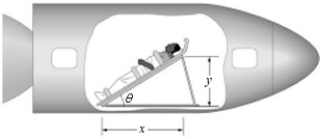 -An object moves in a direction parallel to its length with a velocity that approaches the velocity of light. The width of this object, as measured by a stationary observer,
 (Multiple Choice)
4.9/5 (77)
(77) A satellite, initially at rest in deep space, separates into two pieces, which move away from each other. One piece has a rest mass of 190 kg and moves away with a speed 0.500c, and the second piece has a rest mass of 250 kg and moves in the opposite direction. What is the speed of the second piece?
(Multiple Choice)
4.9/5 (86)
(86) A moving object's mass is twice its rest mass. Its length (in the direction of travel) must therefore be
(Multiple Choice)
4.8/5 (76)
(76) A black hole is a star whose gravitational field is so strong that light cannot escape from it.
(True/False)
4.8/5 (87)
(87) As the velocity of an inertial frame of reference increases with respect to a stationary observer, Einstein's theory of special relativity predicts that the length of an object, measured in the dimension parallel to the motion of the reference frame, will
(Multiple Choice)
5.0/5 (91)
(91) Two spaceships, each 100 m long in its own rest frame, approach Earth from opposite directions, each with a speed 0.50c relative to Earth. As measured by a passenger in one of the spaceships, how long is the other spaceship?
(Multiple Choice)
4.8/5 (83)
(83) 
Filters
- Essay(0)
- Multiple Choice(0)
- Short Answer(0)
- True False(0)
- Matching(0)