



 Chat with AI
Exam 18: The Laws of Thermodynamics

Exam 1: Introduction to Physics100 Questions
Exam 2: One-Dimensional Kinematics112 Questions
Exam 3: Vectors in Physics82 Questions
Exam 4: Two-Dimensional Kinematics95 Questions
Exam 5: Newtons Laws of Motion101 Questions
Exam 6: Applications of Newtons Laws105 Questions
Exam 7: Work and Kinetic Energy92 Questions
Exam 8: Potential Energy and Conservation of Energy99 Questions
Exam 9: Linear Momentum and Collisions102 Questions
Exam 10: Rotational Kinematics and Energy102 Questions
Exam 11: Rotational Dynamics and Static Equilibrium97 Questions
Exam 12: Gravity94 Questions
Exam 13: Oscillations About Equilibrium102 Questions
Exam 14: Waves and Sound104 Questions
Exam 15: Fluids107 Questions
Exam 16: Temperature and Heat103 Questions
Exam 17: Phases and Phase Changes100 Questions
Exam 18: The Laws of Thermodynamics97 Questions
Exam 19: Electric Charges, Forces, and Fields88 Questions
Exam 20: Electric Potential and Electric Potential Energy99 Questions
Exam 21: Electric Current and Direct-Current Circuits99 Questions
Exam 22: Magnetism101 Questions
Exam 23: Magnetic Flux and Faradays Law of Induction99 Questions
Exam 24: Alternating-Current Circuits93 Questions
Exam 25: Electromagnetic Waves90 Questions
Exam 26: Geometrical Optics92 Questions
Exam 27: Optical Instruments102 Questions
Exam 28: Physical Optics: Interference and Diffraction93 Questions
Exam 29: Relativity100 Questions
Exam 30: Quantum Physics100 Questions
Exam 31: Atomic Physics75 Questions
Exam 32: Nuclear Physics and Nuclear Radiation89 Questions
Select questions type


The entropy of a system remains constant during an adiabatic change even if the change is irreversible.
(True/False)
4.9/5  (72)
(72) Which of the following is a statement of the third law of thermodynamics?
(Multiple Choice)
4.7/5 (82)
(82) An athlete doing push-ups performs 650 kJ of work and loses 425 kJ of heat. What is the change in the internal energy of the athlete?
(Multiple Choice)
5.0/5 (74)
(74) A certain ideal gas has a value of γ = 4/3. What is its molar specific heat at constant pressure?
(Multiple Choice)
4.9/5 (80)
(80) A monatomic ideal gas is compressed adiabatically to one-third of its initial volume. The resulting pressure will be
(Multiple Choice)
4.8/5 (75)
(75) FIGURE 18-1 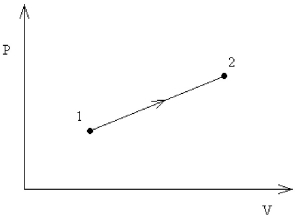 -An ideal monatomic gas undergoes the reversible expansion shown in Figure 18-1, where V2 = 5V1 and P2 = 3P1. What is the change in internal energy of the gas in this process, in terms of the initial pressure and volume?
 (Multiple Choice)
4.7/5 (76)
(76) Two identical samples of a monatomic gas are initially at pressure P and occupy volume V. You perform two experiments which will both lead to the gas samples being compressed to final volumes one-third as large as their initial volumes. In one of the experiments you make the gas undergo an isothermal compression. In the second you make the gas undergo an adiabatic compression. It is correct to say that:
(Multiple Choice)
4.9/5 (71)
(71) An inventor tries to sell you his new engine which takes in 40. Joules of heat at 87°C on each cycle, expels 30. Joules at 27°C, and does 10. Joules of work. Why are you not fooled, and can have him prosecuted as a fraud?
(Essay)
4.8/5 (78)
(78) A reversible engine takes in 555. Joules per second and exhausts 482. watts.
(a) How much power does it produce?
(b) What is its efficiency?
(c) If operated in reverse as a refrigerator, what would be its COP?
(Short Answer)
4.9/5 (71)
(71) In the first law of thermodynamics, Q is the heat gained by the system, that is, Q is positive if the system gains heat.
(True/False)
4.8/5 (74)
(74) 3.0 moles of gas expand from an initial volume of 0.040 m3 to a final volume of 0.085 m3 while the temperature of the gas is kept fixed at 300 K. How much work is done by the system?
(Multiple Choice)
4.7/5 (87)
(87) A 40.0-L container is divided into two equal parts by a rubber membrane. One half of the container has 1.80 moles of an ideal monatomic gas at 270 K, and the other half is a vacuum. The container does not allow any gas to escape but is free to exchange heat with the surroundings. The membrane breaks, the gas expands isothermally and eventually the gas reaches a new equilibrium condition occupying the entire volume. What is the change in entropy of the gas?
(Multiple Choice)
4.8/5 (80)
(80) A heat engine absorbs 64 kcal of heat each cycle and exhausts 42 kcal.
(a) Calculate the efficiency each cycle.
(b) Calculate the work done each cycle.
(Short Answer)
4.9/5 (75)
(75) An ideal monatomic gas undergoes a reversible expansion to 1.5 times its original volume. In which of these processes does the gas perform the least amount of work?
(Multiple Choice)
4.8/5 (77)
(77) 
Filters
- Essay(0)
- Multiple Choice(0)
- Short Answer(0)
- True False(0)
- Matching(0)