



 Chat with AI
Exam 18: The Laws of Thermodynamics

Exam 1: Introduction to Physics100 Questions
Exam 2: One-Dimensional Kinematics112 Questions
Exam 3: Vectors in Physics82 Questions
Exam 4: Two-Dimensional Kinematics95 Questions
Exam 5: Newtons Laws of Motion101 Questions
Exam 6: Applications of Newtons Laws105 Questions
Exam 7: Work and Kinetic Energy92 Questions
Exam 8: Potential Energy and Conservation of Energy99 Questions
Exam 9: Linear Momentum and Collisions102 Questions
Exam 10: Rotational Kinematics and Energy102 Questions
Exam 11: Rotational Dynamics and Static Equilibrium97 Questions
Exam 12: Gravity94 Questions
Exam 13: Oscillations About Equilibrium102 Questions
Exam 14: Waves and Sound104 Questions
Exam 15: Fluids107 Questions
Exam 16: Temperature and Heat103 Questions
Exam 17: Phases and Phase Changes100 Questions
Exam 18: The Laws of Thermodynamics97 Questions
Exam 19: Electric Charges, Forces, and Fields88 Questions
Exam 20: Electric Potential and Electric Potential Energy99 Questions
Exam 21: Electric Current and Direct-Current Circuits99 Questions
Exam 22: Magnetism101 Questions
Exam 23: Magnetic Flux and Faradays Law of Induction99 Questions
Exam 24: Alternating-Current Circuits93 Questions
Exam 25: Electromagnetic Waves90 Questions
Exam 26: Geometrical Optics92 Questions
Exam 27: Optical Instruments102 Questions
Exam 28: Physical Optics: Interference and Diffraction93 Questions
Exam 29: Relativity100 Questions
Exam 30: Quantum Physics100 Questions
Exam 31: Atomic Physics75 Questions
Exam 32: Nuclear Physics and Nuclear Radiation89 Questions
Select questions type


The entropy of the universe remains constant during a reversible adiabatic change.
(True/False)
4.9/5  (75)
(75) An ideal monatomic gas undergoes an isothermal expansion. It is correct to affirm that its entropy
(Multiple Choice)
4.8/5 (73)
(73) A monatomic ideal gas at an initial temperature of 390 K is compressed adiabatically from an initial volume of 120 L to a final volume of 40.0 L. What is the final temperature of the gas?
(Multiple Choice)
4.8/5 (69)
(69) A certain Carnot engine has Th = Tc + 35K, and an efficiency of 20.0%. What is Th?
(Multiple Choice)
5.0/5 (83)
(83) What is the change in entropy of the lead when 2.0 kg of molten lead solidifies?
[Data:
Lv = 207. kcal/kg at 1744.°C; Lf = 5.9 kcal/kg at 328.°C]
(Short Answer)
4.7/5 (70)
(70) 1.50 moles of an ideal monatomic gas are initially at a temperature of 317 K. If the gas gains 2730 J of heat and performs 780 J of work, what is its final temperature?
(Multiple Choice)
5.0/5 (86)
(86) FIGURE 18-3 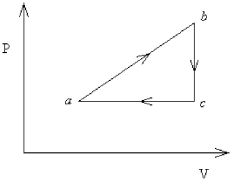 -An ideal gas undergoes the process a→b→c→a shown in Figure 18-3. Pa = Pc = 240 kPa, Vb = Vc = 40 L, Va = 15 L, and Pb = 400 kPa. How much heat is gained by the system in this process?
 (Multiple Choice)
4.9/5 (72)
(72) A monatomic ideal gas is compressed isobarically to one-third of its initial volume. The resulting pressure will be
(Multiple Choice)
4.8/5 (70)
(70) An ideal monatomic gas undergoes a reversible expansion to 1.5 times its original volume. In which of these processes does the gas perform the most work?
(Multiple Choice)
4.9/5 (77)
(77) A monatomic ideal gas expands adiabatically from an initial volume of 72 L and an initial temperature of 350 K until its temperature falls to 290 K. What is the final volume of the gas?
(Multiple Choice)
5.0/5 (75)
(75) 4.00 moles of a monatomic ideal gas at a temperature of 340 K are compressed adiabatically from an initial volume of 70.0 L to a final volume of 30.0 L. What is the final pressure in the gas?
(Multiple Choice)
4.9/5 (79)
(79) FIGURE 18-3
-An ideal gas undergoes the process a→b→c→a shown in Figure 18-3. The heat gained in process a→b is 546 J, while in process b→c the system loses 62 J. In process a→b the system performs 310 J of work, while in process c→a work is done on the system in the amount of 223 J. How much heat is gained by the system in process c→a?
-An ideal gas undergoes the process a→b→c→a shown in Figure 18-3. The heat gained in process a→b is 546 J, while in process b→c the system loses 62 J. In process a→b the system performs 310 J of work, while in process c→a work is done on the system in the amount of 223 J. How much heat is gained by the system in process c→a? (Multiple Choice)
4.9/5 (87)
(87) When objects at different temperatures are brought into thermal contact with one another, the resulting spontaneous flow of heat proceeds from the object with the higher
(Multiple Choice)
4.9/5 (77)
(77) FIGURE 18-1 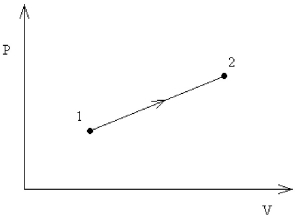 -An ideal monatomic gas undergoes the reversible expansion shown in the Figure 18-1, where V2 = 5V1 and P2 = 3P1. How much heat is gained by the gas in this process, in terms of the initial pressure and volume?
 (Multiple Choice)
4.8/5 (74)
(74) An ideal, reversible heat pump is taking heat from the outside air at -10.0°C and discharging it into the house at 18.0°C. What is the coefficient of performance of this heat pump?
(Multiple Choice)
4.8/5 (86)
(86) A gas expands from an initial volume of 0.040 m3 and an initial pressure of 210 kPa to a final volume of 0.065 m3 while its temperature is kept constant. How much work is done by the system?
(Multiple Choice)
4.9/5 (97)
(97) A refrigerator has a coefficient of performance equal to 4.2. How much work must be done on the refrigerator in order to remove 250 J of heat from the interior?
(Multiple Choice)
4.9/5 (76)
(76) A heat engine has an efficiency of 35.0% and receives 150 J of heat per cycle.
(a) How much work does it perform in each cycle?
(b) How much heat does it exhaust in each cycle?
(Short Answer)
4.9/5 (83)
(83) 
Filters
- Essay(0)
- Multiple Choice(0)
- Short Answer(0)
- True False(0)
- Matching(0)