



 Chat with AI
Exam 8: Potential Energy and Conservation of Energy

Exam 1: Introduction to Physics100 Questions
Exam 2: One-Dimensional Kinematics112 Questions
Exam 3: Vectors in Physics82 Questions
Exam 4: Two-Dimensional Kinematics95 Questions
Exam 5: Newtons Laws of Motion101 Questions
Exam 6: Applications of Newtons Laws105 Questions
Exam 7: Work and Kinetic Energy92 Questions
Exam 8: Potential Energy and Conservation of Energy99 Questions
Exam 9: Linear Momentum and Collisions102 Questions
Exam 10: Rotational Kinematics and Energy102 Questions
Exam 11: Rotational Dynamics and Static Equilibrium97 Questions
Exam 12: Gravity94 Questions
Exam 13: Oscillations About Equilibrium102 Questions
Exam 14: Waves and Sound104 Questions
Exam 15: Fluids107 Questions
Exam 16: Temperature and Heat103 Questions
Exam 17: Phases and Phase Changes100 Questions
Exam 18: The Laws of Thermodynamics97 Questions
Exam 19: Electric Charges, Forces, and Fields88 Questions
Exam 20: Electric Potential and Electric Potential Energy99 Questions
Exam 21: Electric Current and Direct-Current Circuits99 Questions
Exam 22: Magnetism101 Questions
Exam 23: Magnetic Flux and Faradays Law of Induction99 Questions
Exam 24: Alternating-Current Circuits93 Questions
Exam 25: Electromagnetic Waves90 Questions
Exam 26: Geometrical Optics92 Questions
Exam 27: Optical Instruments102 Questions
Exam 28: Physical Optics: Interference and Diffraction93 Questions
Exam 29: Relativity100 Questions
Exam 30: Quantum Physics100 Questions
Exam 31: Atomic Physics75 Questions
Exam 32: Nuclear Physics and Nuclear Radiation89 Questions
Select questions type


FIGURE 8-12 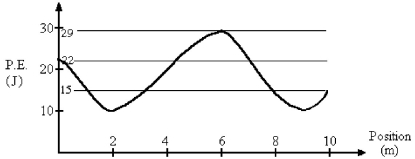 A 2-kg mass is moving along the x axis. The potential energy curve as a function of position is shown in Figure 8-12. The system is conservative. There is no friction.
-Refer to Figure 8-12 If the object is at rest at the origin, what will be its kinetic energy at 10 m along the +x-axis?
A 2-kg mass is moving along the x axis. The potential energy curve as a function of position is shown in Figure 8-12. The system is conservative. There is no friction.
-Refer to Figure 8-12 If the object is at rest at the origin, what will be its kinetic energy at 10 m along the +x-axis? (Multiple Choice)
4.8/5  (89)
(89) A ball falls from the top of a building, through the air (air friction is present), to the ground below. How does the kinetic energy (K) just before striking the ground compare to the potential energy (U) at the top of the building?
(Multiple Choice)
4.8/5 (67)
(67) Block 1 and block 2 have the same mass, m, and are released from the top of two inclined planes of the same height making 30° and 60° angles with the horizontal direction, respectively. If the coefficient of friction is the same in both cases, which of the blocks is going faster when it reaches the bottom of its respective incline?
(Multiple Choice)
4.9/5 (72)
(72) A lightweight object and a very heavy object are sliding with equal speeds along a level frictionless surface. They both slide up the same frictionless hill. Which rises to a greater height?
(Multiple Choice)
4.9/5 (98)
(98) FIGURE 8-10  An object of mass m is at rest on a rough inclined plane with height h, length 8 m, and which makes an angle of 30° with the horizontal. The object is allowed to move and it stops on a rough horizontal surface, at a distance of 4 m from the bottom of the inclined plane, as shown in Figure 8-10. The coefficient of kinetic friction on the inclined plane is 0.4 and g = 10 m/s2.
-Refer to Figure 8-10. What is the coefficient of kinetic friction for the horizontal surface?
An object of mass m is at rest on a rough inclined plane with height h, length 8 m, and which makes an angle of 30° with the horizontal. The object is allowed to move and it stops on a rough horizontal surface, at a distance of 4 m from the bottom of the inclined plane, as shown in Figure 8-10. The coefficient of kinetic friction on the inclined plane is 0.4 and g = 10 m/s2.
-Refer to Figure 8-10. What is the coefficient of kinetic friction for the horizontal surface? (Multiple Choice)
4.9/5 (83)
(83) FIGURE 8-3 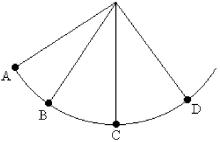 A mass is attached to one end of a string. The other end of the string is attached to a rigid support. The mass is released at A and swings in a vertical arc to points B, C, and D, as shown in Figure 8-3. Neglect air resistance and use g = 10 m/
 .
-Refer to Figure 8-3. At what point does the mass have its highest speed?
A mass is attached to one end of a string. The other end of the string is attached to a rigid support. The mass is released at A and swings in a vertical arc to points B, C, and D, as shown in Figure 8-3. Neglect air resistance and use g = 10 m/ .
-Refer to Figure 8-3. At what point does the mass have its highest speed? (Multiple Choice)
4.8/5 (81)
(81) An object of mass 4.00 kg is sitting at the top of an inclined plane of height h and angle θ with the horizontal. The object slides down the inclined plane and right before it reaches the bottom of the plane, it has speed of 16.0 m/s. Neglect friction and use g = 10.0 m/s2.
(a) What is the height of the inclined plane?
(b) If the height of the inclined plane is raised to 15.0 m, what is the speed of the object right before it reaches the bottom of the inclined plane?
(Short Answer)
4.9/5 (68)
(68) The force acting on an object is said to be conservative if the work done by this force on the object is independent of the path chosen.
(True/False)
4.9/5 (88)
(88) 4.00 J of work is needed to push an object of mass 2.00 kg from point A to point B of the inclined plane as shown in Figure 8-9. The angle of inclination is 30.0° with the horizontal. The height of the plane is h and the coefficient of friction between the object and the plane is 0.400. What is the length of the inclined plane? Use g = 10.0 m/s2.
(Multiple Choice)
4.8/5 (81)
(81) FIGURE 8-9 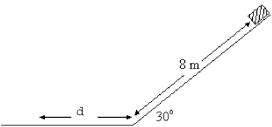 An object with a mass of 10.0 kg is at rest at the top of a frictionless inclined plane of height 8.00 m and an angle of inclination 30.0° with the horizontal. The object is released from this position and it stops at a distance d from the bottom of the inclined plane along a horizontal surface, as shown in Figure 8-9. The coefficient of kinetic friction for the horizontal surface is 0.400 and g = 10.0 m/s2.
-Refer to Figure 8-9. At what horizontal distance from the bottom of the inclined plane will this object stop?
An object with a mass of 10.0 kg is at rest at the top of a frictionless inclined plane of height 8.00 m and an angle of inclination 30.0° with the horizontal. The object is released from this position and it stops at a distance d from the bottom of the inclined plane along a horizontal surface, as shown in Figure 8-9. The coefficient of kinetic friction for the horizontal surface is 0.400 and g = 10.0 m/s2.
-Refer to Figure 8-9. At what horizontal distance from the bottom of the inclined plane will this object stop? (Multiple Choice)
5.0/5 (86)
(86) An object of mass m moving with a certain speed has a kinetic energy of 0.0124 J. The object collides with a horizontal spring and compresses it by 0.800 m before it is brought to rest. What is the spring constant of this spring?
(Multiple Choice)
4.7/5 (69)
(69) FIGURE 8-5 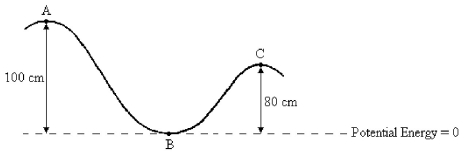 A 2.0-g bead slides along a wire, as shown in Figure 8-5. At point A, the bead is at rest. Neglect friction and use g = 10 m/s2.
-Refer to Figure 8-5. What is the kinetic energy of the bead at point A?
A 2.0-g bead slides along a wire, as shown in Figure 8-5. At point A, the bead is at rest. Neglect friction and use g = 10 m/s2.
-Refer to Figure 8-5. What is the kinetic energy of the bead at point A? (Multiple Choice)
4.8/5 (71)
(71) Two blocks of masses m1 and m2 are released from the top of two frictionless inclined planes of the same height making 30° and 60° angles with the horizontal direction, respectively. Which of the blocks is going faster when it reaches the bottom of its respective incline?
(Multiple Choice)
4.7/5 (90)
(90) FIGURE 8-7 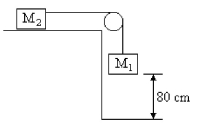 Two masses M1 = 2.0 kg and M2 = 4.0 kg are attached by a string as shown in Figure 8-7. M1 falls vertically down and M2 moves on a frictionless surface. Initially the system is at rest. Use g = 10 m/s2.
-Refer to Figure 8-7. What is the potential energy of the mass M1 just before it touches the ground?
Two masses M1 = 2.0 kg and M2 = 4.0 kg are attached by a string as shown in Figure 8-7. M1 falls vertically down and M2 moves on a frictionless surface. Initially the system is at rest. Use g = 10 m/s2.
-Refer to Figure 8-7. What is the potential energy of the mass M1 just before it touches the ground? (Multiple Choice)
4.8/5 (81)
(81) A 50.0-kg skier starting from rest travels 200 m down a hill that has a 20.0° slope. When the skier reaches the bottom of the hill, her speed is 30.0 m/s.
(a) How much work is done by friction as the skier comes down the hill?
(b) What is the magnitude of the friction force if the skier travels directly down the hill?
(Short Answer)
4.8/5 (77)
(77) FIGURE 8-4 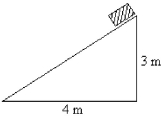 An object of mass 2 kg is held at the top of a triangular wedge as shown in Figure 8-4, and then released. The reference level for potential energy is at the base of the triangle. Neglect friction and use g = 10 m/s2.
-Refer to Figure 8-4. What is the speed of the object just before it reaches the bottom of the wedge?
An object of mass 2 kg is held at the top of a triangular wedge as shown in Figure 8-4, and then released. The reference level for potential energy is at the base of the triangle. Neglect friction and use g = 10 m/s2.
-Refer to Figure 8-4. What is the speed of the object just before it reaches the bottom of the wedge? (Multiple Choice)
4.9/5 (82)
(82) You and your friend want to go to the top of the Eiffel Tower. Your friend takes the elevator straight up. You decide to walk up the spiral stairway, taking longer to do so. Compare the gravitational potential energy (U) of you and your friend, after you both reach the top.
(Multiple Choice)
4.8/5 (78)
(78) On a certain planet an object of mass m is moving with an initial speed of 4 m/s. It comes to rest after traveling a horizontal distance of 10 m. If the coefficient of kinetic friction between the object and the surface is 0.2, what is the value of g on that planet?
(Multiple Choice)
4.8/5 (97)
(97) 
Filters
- Essay(0)
- Multiple Choice(0)
- Short Answer(0)
- True False(0)
- Matching(0)