



 Chat with AI
Exam 8: Potential Energy and Conservation of Energy

Exam 1: Introduction to Physics100 Questions
Exam 2: One-Dimensional Kinematics112 Questions
Exam 3: Vectors in Physics82 Questions
Exam 4: Two-Dimensional Kinematics95 Questions
Exam 5: Newtons Laws of Motion101 Questions
Exam 6: Applications of Newtons Laws105 Questions
Exam 7: Work and Kinetic Energy92 Questions
Exam 8: Potential Energy and Conservation of Energy99 Questions
Exam 9: Linear Momentum and Collisions102 Questions
Exam 10: Rotational Kinematics and Energy102 Questions
Exam 11: Rotational Dynamics and Static Equilibrium97 Questions
Exam 12: Gravity94 Questions
Exam 13: Oscillations About Equilibrium102 Questions
Exam 14: Waves and Sound104 Questions
Exam 15: Fluids107 Questions
Exam 16: Temperature and Heat103 Questions
Exam 17: Phases and Phase Changes100 Questions
Exam 18: The Laws of Thermodynamics97 Questions
Exam 19: Electric Charges, Forces, and Fields88 Questions
Exam 20: Electric Potential and Electric Potential Energy99 Questions
Exam 21: Electric Current and Direct-Current Circuits99 Questions
Exam 22: Magnetism101 Questions
Exam 23: Magnetic Flux and Faradays Law of Induction99 Questions
Exam 24: Alternating-Current Circuits93 Questions
Exam 25: Electromagnetic Waves90 Questions
Exam 26: Geometrical Optics92 Questions
Exam 27: Optical Instruments102 Questions
Exam 28: Physical Optics: Interference and Diffraction93 Questions
Exam 29: Relativity100 Questions
Exam 30: Quantum Physics100 Questions
Exam 31: Atomic Physics75 Questions
Exam 32: Nuclear Physics and Nuclear Radiation89 Questions
Select questions type


FIGURE 8-10  An object of mass m is at rest on a rough inclined plane with height h, length 8 m, and which makes an angle of 30° with the horizontal. The object is allowed to move and it stops on a rough horizontal surface, at a distance of 4 m from the bottom of the inclined plane, as shown in Figure 8-10. The coefficient of kinetic friction on the inclined plane is 0.4 and g = 10 m/s2.
-Refer to Figure 8-10. What is the speed of the object at the bottom of the inclined plane?
An object of mass m is at rest on a rough inclined plane with height h, length 8 m, and which makes an angle of 30° with the horizontal. The object is allowed to move and it stops on a rough horizontal surface, at a distance of 4 m from the bottom of the inclined plane, as shown in Figure 8-10. The coefficient of kinetic friction on the inclined plane is 0.4 and g = 10 m/s2.
-Refer to Figure 8-10. What is the speed of the object at the bottom of the inclined plane? (Multiple Choice)
4.9/5  (82)
(82) FIGURE 8-8  -An object of mass 4 kg starts at rest from the top of a rough inclined plane of height 10 m as shown in Figure 8-8. If the speed of the object at the bottom of the inclined plane is 10 m/s, how much work is done by the force of friction? Use g = 10 m/s2.
 (Multiple Choice)
4.9/5 (83)
(83) FIGURE 8-11 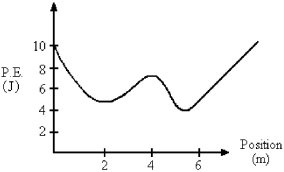 A 2.0 kg mass is moving along the x-axis. The potential energy curve as a function of position is shown in Figure 8-11. The system is conservative. There is no friction.
-Refer to Figure 8-11. If the speed of the object at the origin is 4.0 m/s, what will be its speed at 4.0 m along the +x-axis?
A 2.0 kg mass is moving along the x-axis. The potential energy curve as a function of position is shown in Figure 8-11. The system is conservative. There is no friction.
-Refer to Figure 8-11. If the speed of the object at the origin is 4.0 m/s, what will be its speed at 4.0 m along the +x-axis? (Multiple Choice)
4.8/5 (85)
(85) A ball drops some distance and gains 30 J of kinetic energy. Do not ignore air resistance. How much gravitational potential energy did the ball lose?
(Multiple Choice)
4.8/5 (68)
(68) If work is done on a system by non-conservative forces, the total mechanical energy of a system stays constant.
(True/False)
4.8/5 (69)
(69) FIGURE 8-12  A 2-kg mass is moving along the x axis. The potential energy curve as a function of position is shown in Figure 8-12. The system is conservative. There is no friction.
-Refer to Figure 8-12. If the object is at rest at the origin, what will be its speed at 9.0 m along the +x-axis?
A 2-kg mass is moving along the x axis. The potential energy curve as a function of position is shown in Figure 8-12. The system is conservative. There is no friction.
-Refer to Figure 8-12. If the object is at rest at the origin, what will be its speed at 9.0 m along the +x-axis? (Multiple Choice)
4.8/5 (79)
(79) FIGURE 8-6  A roller coaster of mass 80.0 kg is moving with a speed of 20.0 m/s at position A as shown in Figure 8-6. The vertical height at position A above ground level is 200 m. Neglect friction and use g = 10.0 m/s2.
-What is the total energy of the roller coaster at point A?
A roller coaster of mass 80.0 kg is moving with a speed of 20.0 m/s at position A as shown in Figure 8-6. The vertical height at position A above ground level is 200 m. Neglect friction and use g = 10.0 m/s2.
-What is the total energy of the roller coaster at point A? (Multiple Choice)
5.0/5 (73)
(73) Two inclined planes A and B have the same height but different angles of inclination with the horizontal. An object is released at rest from the top of each of the inclined planes. How does the speed of the object at the bottom of inclined plane A compare with that of the speed at the bottom of inclined plane B?
(Multiple Choice)
4.9/5 (72)
(72) A simple pendulum of length 2.00 m is made with a mass of 2.00 kg. The mass has a speed of 3.00 m/s when the pendulum is 30.0° above its lowest position.
(a) What is the maximum angle away from the lowest position the pendulum will reach?
(b) What is the speed of the mass when the pendulum is 45° above its lowest position?
(Short Answer)
4.8/5 (71)
(71) An object of mass 4 kg is thrown vertically upwards from ground level with an initial speed of 20 m/s. Ignore friction and use g = 10 m/s2. What is the kinetic energy of the object just before it hits the ground?
(Multiple Choice)
4.9/5 (80)
(80) FIGURE 8-5  A 2.0-g bead slides along a wire, as shown in Figure 8-5. At point A, the bead is at rest. Neglect friction and use g = 10 m/s2.
-Refer to Figure 8-5. What is the speed of the bead at point B?
A 2.0-g bead slides along a wire, as shown in Figure 8-5. At point A, the bead is at rest. Neglect friction and use g = 10 m/s2.
-Refer to Figure 8-5. What is the speed of the bead at point B? (Multiple Choice)
5.0/5 (82)
(82) Two identical balls are thrown from the top of a building with the same speed. Ball 1 is thrown horizontally, while ball 2 is thrown at an angle θ above the horizontal. Neglecting air resistance, which ball will have the greatest speed when hitting the ground below?
(Multiple Choice)
4.8/5 (82)
(82) Non-conservative forces can change the mechanical energy of a system.
(True/False)
4.8/5 (77)
(77) An object with a mass of 10 kg is moving along a horizontal surface. At a certain point it has 40 J of kinetic energy. If the coefficient of friction between the object and the surface is 0.40, how far will the object go beyond that point before coming to a stop? Use g = 10 m/s2.
(Multiple Choice)
4.9/5 (70)
(70) FIGURE 8-3  A mass is attached to one end of a string. The other end of the string is attached to a rigid support. The mass is released at A and swings in a vertical arc to points B, C, and D, as shown in Figure 8-3. Neglect air resistance and use g = 10 m/
 .
-Refer to Figure 8-3. At what point does the mass have the most potential energy?
A mass is attached to one end of a string. The other end of the string is attached to a rigid support. The mass is released at A and swings in a vertical arc to points B, C, and D, as shown in Figure 8-3. Neglect air resistance and use g = 10 m/ .
-Refer to Figure 8-3. At what point does the mass have the most potential energy? (Multiple Choice)
4.7/5 (82)
(82) An object of mass m is moving on a horizontal rough surface. At a certain point it has a speed v m/s and it comes to a stop after traveling 32 m. If the coefficient of friction between the object and the surface is 0.40, what is the value of speed v? Use g = 10 m/s2.
(Multiple Choice)
4.8/5 (85)
(85) A golfer misjudges a putt and leaves her ball way short, the ball going only one-third of the way to the hole. If the speed of the ball leaving the putter in the first case was v0 and the force of resistance due to the grass remains the same, what speed should she have given to the ball to make the original putt?
(Multiple Choice)
4.8/5 (80)
(80) A ball drops some distance and loses 30 J of gravitational potential energy. Do not ignore air resistance. How much kinetic energy did the ball gain?
(Multiple Choice)
4.8/5 (81)
(81) Two identical vertical springs S1 and S2 have masses m1 = 400 g and m2 = 800 g attached to them. If m1 causes spring S1 to stretch by 4 cm, what is the ratio of the potential energy of S1 and S2? Use g = 10 m/s2.
(Multiple Choice)
4.7/5 (76)
(76) 
Filters
- Essay(0)
- Multiple Choice(0)
- Short Answer(0)
- True False(0)
- Matching(0)