



 Chat with AI
Exam 11: Expenditure Multipliers

Exam 1: What Is Economics?479 Questions
Exam 2: The Economic Problem440 Questions
Exam 3: Demand and Supply515 Questions
Exam 4: Measuring GDP and Economic Growth395 Questions
Exam 5: Monitoring Jobs and Inflation407 Questions
Exam 6: Economic Growth353 Questions
Exam 7: Finance, Saving, and Investment225 Questions
Exam 8: Money, the Price Level, and Inflation578 Questions
Exam 9: The Exchange Rate and the Balance of Payments492 Questions
Exam 10: Aggregate Supply and Aggregate Demand428 Questions
Exam 11: Expenditure Multipliers469 Questions
Exam 12: The Business Cycle, Inflation, and Deflation410 Questions
Exam 13: Fiscal Policy263 Questions
Exam 14: Monetary Policy227 Questions
Exam 15: International Trade Policy200 Questions
Select questions type


There is a movement along the consumption function if there is ________.
(Multiple Choice)
4.8/5  (80)
(80)  -In the above figure, the marginal propensity to consume equals
 (Multiple Choice)
4.8/5 (69)
(69) In a simple economy with no income taxes or imports, prices are constant and the slope of the AE curve is 0.8. In order to increase real GDP by $500 billion, then
(Multiple Choice)
4.8/5 (78)
(78)  -In the above table, C is consumption expenditure, I is investment, G is government expenditure, X is exports, and M is imports. All entries are in dollars. What is the marginal propensity to consume?
 (Multiple Choice)
4.8/5 (71)
(71)  -Real GDP equals $20 billion and aggregate planned expenditure is $30 billion. There is an unplanned ________ in inventories of ________ and real GDP will ________.
 (Multiple Choice)
4.8/5 (82)
(82) Suppose that the slope of the AE curve is 0.75. Then a $100 decrease in autonomous spending means equilibrium expenditure will
(Multiple Choice)
5.0/5 (88)
(88) 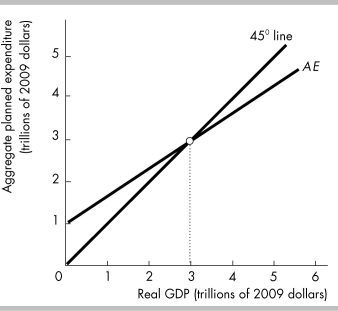 -Suppose the price level is fixed. If investment increases by $1 trillion and the aggregate expenditure curve is shown in the figure above, in response equilibrium expenditure increases by ________.
 (Multiple Choice)
4.9/5 (78)
(78) Suppose the consumption function is given by the equation C = 100 + 0.8YD, where YD is disposable income. What is the marginal propensity to consume?
(Multiple Choice)
4.8/5 (89)
(89) You observe that unplanned inventories are increasing. You predict that there will be ________.
(Multiple Choice)
4.8/5 (88)
(88) When aggregate planned expenditure is less than real GDP, unplanned
(Multiple Choice)
4.7/5 (75)
(75) Which of the following concerning the marginal propensity to consume and the consumption function is TRUE?
I.The larger the marginal propensity to consume, the greater the amount of autonomous consumption.
II.The larger the marginal propensity to consume, the steeper the consumption function.
(Multiple Choice)
4.7/5 (78)
(78) Suppose disposable income increases from $5 trillion to $6 trillion. As a result, consumption expenditure increases from $4 trillion to ________. This result means the MPC equals ________.
(Multiple Choice)
4.9/5 (79)
(79) A fall in the price level shifts the AE curve ________ and ________ equilibrium expenditure.
(Multiple Choice)
4.8/5 (83)
(83) Because the short-run aggregate expenditure model assumes that the price level is ________, its predicted effect of changes in autonomous expenditure on equilibrium output is ________ than the prediction of the AD/SAS model.
(Multiple Choice)
4.8/5 (84)
(84) 
Filters
- Essay(0)
- Multiple Choice(0)
- Short Answer(0)
- True False(0)
- Matching(0)