



 Chat with AI
Exam 6: Economic Growth

Exam 1: What Is Economics?479 Questions
Exam 2: The Economic Problem440 Questions
Exam 3: Demand and Supply515 Questions
Exam 4: Measuring GDP and Economic Growth395 Questions
Exam 5: Monitoring Jobs and Inflation407 Questions
Exam 6: Economic Growth353 Questions
Exam 7: Finance, Saving, and Investment225 Questions
Exam 8: Money, the Price Level, and Inflation578 Questions
Exam 9: The Exchange Rate and the Balance of Payments492 Questions
Exam 10: Aggregate Supply and Aggregate Demand428 Questions
Exam 11: Expenditure Multipliers469 Questions
Exam 12: The Business Cycle, Inflation, and Deflation410 Questions
Exam 13: Fiscal Policy263 Questions
Exam 14: Monetary Policy227 Questions
Exam 15: International Trade Policy200 Questions
Select questions type


An increase in labor productivity ________ the real wage rate and an increase in population ________ the real wage rate.
(Multiple Choice)
4.9/5  (71)
(71) The table below shows data for China.
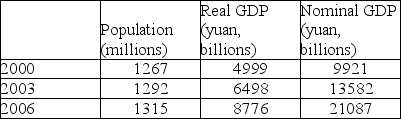 The standard of living between 2003 and 2006 increased by ________.
 (Multiple Choice)
4.9/5 (87)
(87) Over the last 100 years, the average U.S. growth rate in real GDP per person was about
(Multiple Choice)
4.9/5 (77)
(77) Using the Rule of 70, if China's current growth rate of real GDP per person was 7 percent a year, how long would it take the country's real GDP per person to double?
(Multiple Choice)
4.7/5 (82)
(82) Which of the following directly creates growth in labor productivity?
I.Growth in capital per hour of labor
II.Technological change
III.Population growth
(Multiple Choice)
4.7/5 (89)
(89) The real wage rate measures the quantity of goods and services an hour's work will buy.
(True/False)
4.8/5 (67)
(67) According to the law of diminishing returns, an additional unit of
(Multiple Choice)
4.8/5 (82)
(82) "Global Innovation 1000-Money Isn't Everything."
The report by Booz Allen Hamilton Consulting claims that "There is no direct relationship between R&D spending and significant measures of corporate success such as growth, profitability, and shareholder return. ...However, the pace of corporate R&D spending continues to accelerate, as many executives continue to believe that enhanced innovation is required to fuel their future growth.
Www)boozallen.com 10/11/2005
The report provides ________ evidence of the ________.
(Multiple Choice)
5.0/5 (87)
(87) Which theory of economic growth concludes that in the long run real GDP per person will be at its subsistence level?
(Multiple Choice)
4.8/5 (88)
(88) Explain how the labor market and the production function determine potential GDP.
(Essay)
4.8/5 (78)
(78) Which growth theory models growth as a perpetual motion machine?
(Multiple Choice)
4.7/5 (77)
(77) A recent article states that "...gains from two centuries of rapid technological innovation are largely exhausted, and new discoveries lack the same revolutionary quality....{Further}, 80 percent of the growth between 1950 and 1993 came from the new application of old ideas, and these old ideas are now mostly wrung dry."
(The Economist, 03/03/2011)
-The neoclassical growth theory says, in part, that
(Multiple Choice)
4.9/5 (81)
(81) Discuss the aggregate production function. How does the aggregate production function relate to the labor market and potential GDP?
(Essay)
4.7/5 (70)
(70) Convergence of the income gap has been most dramatic between
(Multiple Choice)
4.8/5 (82)
(82) Briefly explain how growth in real GDP differs across economies including the United States, Japan, Africa, Central America, Hong Kong, Korea, and Singapore.
(Essay)
4.8/5 (100)
(100) Which theory of economic growth concludes that growth can continue indefinitely?
(Multiple Choice)
5.0/5 (81)
(81) Hu Tells Leaders China Growth Will Help World Economy
Chinese President Hu Jintao told world leaders that his country "has taken an active part in the international cooperation to deal with the financial crisis'' by providing a "$586 billion economic stimulus, focused on building low-rent housing, roads, railways and airports. The package also allows tax deductions for fixed assets such as machinery to stimulate investment. Farmers will also benefit from more subsidies."
Hu stated that "China is in itself an important contribution to international financial stability and world economic growth.''
Www)bloomberg.com 11/15/2008
China wants to increase investment because this change will
(Multiple Choice)
4.9/5 (83)
(83) Classical growth theory argues that when real GDP per person rises above the subsistence level
(Multiple Choice)
4.8/5 (75)
(75) Over the past 100 years, in the United States the average growth rate of ________ grew at a faster rate than ________.
(Multiple Choice)
5.0/5 (94)
(94) 
Filters
- Essay(0)
- Multiple Choice(0)
- Short Answer(0)
- True False(0)
- Matching(0)