



 Chat with AI
Exam 4: Measuring GDP and Economic Growth

Exam 1: What Is Economics?479 Questions
Exam 2: The Economic Problem440 Questions
Exam 3: Demand and Supply515 Questions
Exam 4: Measuring GDP and Economic Growth395 Questions
Exam 5: Monitoring Jobs and Inflation407 Questions
Exam 6: Economic Growth353 Questions
Exam 7: Finance, Saving, and Investment225 Questions
Exam 8: Money, the Price Level, and Inflation578 Questions
Exam 9: The Exchange Rate and the Balance of Payments492 Questions
Exam 10: Aggregate Supply and Aggregate Demand428 Questions
Exam 11: Expenditure Multipliers469 Questions
Exam 12: The Business Cycle, Inflation, and Deflation410 Questions
Exam 13: Fiscal Policy263 Questions
Exam 14: Monetary Policy227 Questions
Exam 15: International Trade Policy200 Questions
Select questions type


The maximum amount of production that can be produced while avoiding shortages of labor, capital, land, and entrepreneurship that would bring rising inflation is called
(Multiple Choice)
4.9/5  (80)
(80) List and explain the two phases and two turning points of the business cycle.
(Essay)
4.8/5 (79)
(79) "To calculate GDP, economists begin with total income earned and then subtract total expenditure by the four sectors of the economy." Is the previous sentence true or false? Explain your answer.
(Essay)
4.8/5 (73)
(73) According to the article, ________ is expected to increase and add to China's ________ component of GDP.
(Multiple Choice)
4.8/5 (91)
(91) Explain the difference between the capital stock, gross investment, depreciation, and net investment.
(Essay)
4.7/5 (67)
(67) A trend is a general tendency for a variable to increase or decrease over time.
(True/False)
4.8/5 (96)
(96) 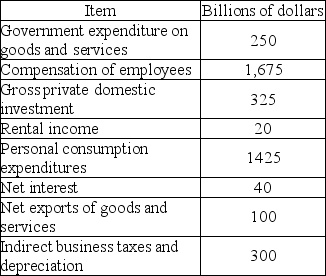 -The above table shows some (but not all)national income accounting data for a hypothetical country. According to these data, the value of GDP is ________ billion.
 (Multiple Choice)
4.8/5 (63)
(63) "Life expectancy is exceptionally high in Japan. Scores for political freedom and civil liberties approach those of peer countries in Europe...equality of opportunity is extremely weak. The country also possesses one of the longer working weeks." Japan's GDP was estimated to be $4.2 trillion (purchasing power parity) and the population was 127.4 million.
"Driven by its attractive climate, Brazil performs substantially better on Life Satisfaction than Material Wealth. High international demand for Brazil's commodities and raw materials has produced a sustained economic expansion since 2004, which in turn has led to job creation, wage growth and relatively low inflation. Brazilians report that they control their own lives to a substantial degree." Brazil's GDP was estimated to be $1.7 trillion (purchasing power parity) and 190 million in 2006.
www.prosperity.com
-According to the information, Japan's real GDP per person
(Multiple Choice)
4.8/5 (92)
(92) 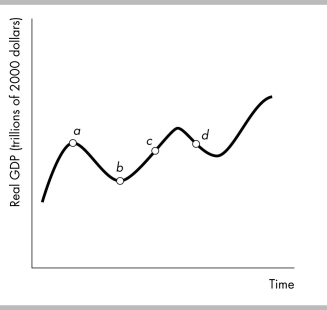 -In the above figure, a recession begins at point ________ and an expansion begins at point ________.
 (Multiple Choice)
4.8/5 (76)
(76) If depreciation exceeds gross investment, net investment is negative.
(True/False)
4.8/5 (86)
(86) What we produce during our working time is ________ as part of GDP and the enjoyment we gain from our leisure time is ________ as part of GDP.
(Multiple Choice)
4.9/5 (85)
(85) If depreciation is less than gross investment, then net investment is
(Multiple Choice)
4.9/5 (72)
(72) Two reasons why valuing goods at their market prices is different than valuing them at their factor costs include
(Multiple Choice)
4.7/5 (74)
(74) "Life expectancy is exceptionally high in Japan. Scores for political freedom and civil liberties approach those of peer countries in Europe...equality of opportunity is extremely weak. The country also possesses one of the longer working weeks." Japan's GDP was estimated to be $4.2 trillion (purchasing power parity) and the population was 127.4 million.
"Driven by its attractive climate, Brazil performs substantially better on Life Satisfaction than Material Wealth. High international demand for Brazil's commodities and raw materials has produced a sustained economic expansion since 2004, which in turn has led to job creation, wage growth and relatively low inflation. Brazilians report that they control their own lives to a substantial degree." Brazil's GDP was estimated to be $1.7 trillion (purchasing power parity) and 190 million in 2006.
www.prosperity.com
-"German economic growth slowed ... Economic growth slowed to 0.3 percent from 0.5 percent. Expansion was driven by exports... (and)household consumption added ...to growth. As unemployment declines and disposable incomes increase, household spending may also gain momentum.
www.bloomberg.com, August 23, 2007
We can conclude that the German economy
(Multiple Choice)
4.8/5 (75)
(75) 
Filters
- Essay(0)
- Multiple Choice(0)
- Short Answer(0)
- True False(0)
- Matching(0)