



 Chat with AI
Exam 14: Liquidity Risk

Exam 1: Why Are Financial Institutions Special67 Questions
Exam 2: The Financial Services Industry: Depository Institutions66 Questions
Exam 3: The Financial Services Industry: Other Financial Institutions56 Questions
Exam 4: Risk of Financial Institutions67 Questions
Exam 5: Interest Rate Risk Measurement: The Repricing Model69 Questions
Exam 6: Interest Rate Risk Measurement: the Duration Model65 Questions
Exam 7: Managing Interest Rate Risk Using Off Balance Sheet Instruments62 Questions
Exam 8: Credit Risk I: Individual Loan Risk65 Questions
Exam 9: Market Risk55 Questions
Exam 10: Credit Risk I: Individual Loan Risk65 Questions
Exam 11: Credit Risk II: Loan Portfolio and Concentration Risk50 Questions
Exam 12: Sovereign Risk65 Questions
Exam 13: Foreign Exchange Risk64 Questions
Exam 14: Liquidity Risk64 Questions
Exam 15: Liability and Liquidity Management65 Questions
Exam 16: Off-Balance-Sheet Activities65 Questions
Exam 17: Technology and Other Operational Risk67 Questions
Exam 18: Capital Management and Adequacy66 Questions
Select questions type


An investment fund that sells a fixed number of shares in the fund to outside investors is called:
(Multiple Choice)
4.8/5  (69)
(69) Trend liquidity planning calculates an FI's liquidity need as the simple difference between the FI's liquid assets and its volatile sources of funds.
(True/False)
5.0/5 (80)
(80) Which of the following is not a component of liquidity planning?
(Multiple Choice)
4.9/5 (84)
(84) Contingent liquidity needs refers to the liquidity needs necessary to:
(Multiple Choice)
4.8/5 (81)
(81) Net deposit drains refer to the amount by which cash withdrawals:
(Multiple Choice)
4.8/5 (89)
(89) The Bank for International Settlements requires FIs to measure their liquidity positions under normal market conditions only.
(True/False)
4.8/5 (94)
(94) APRA requires every FI to hold sufficient liquid assets to meet a name crisis situation.
(True/False)
5.0/5 (78)
(78) The Reserve Bank of Australia (RBA) took a number of temporary actions during the global financial crisis to provide liquidity and avert financial system disturbance. Which of the following were not actions supplied by the RBA?
(Multiple Choice)
4.8/5 (69)
(69) An FI can manage a drain on deposits or an exercise of a loan commitment in two major ways, these being purchased liquidity management and stored liquidity management.
(True/False)
4.8/5 (78)
(78) What are the possible ways that a bank can meet an expected net deposit drain of +4 per cent using purchased liquidity management techniques?
(Multiple Choice)
4.9/5 (77)
(77) Distinguish between liquidity risk arising from the asset-side and the liability-side of the balance sheet.
(Essay)
4.9/5 (71)
(71) Use the following balance sheet (values in thousands of dollars) to answer the question. 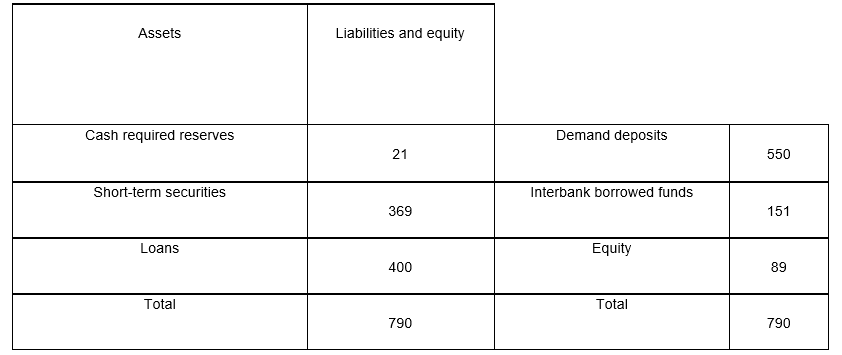 If the bank experiences a $50 000 sudden liquidity drain caused by a loan commitment draw down, what will be the impact on the balance sheet if stored liquidity management techniques are used?
 (Multiple Choice)
4.9/5 (89)
(89) Which of the following is not a potential cause of liquidity risk for a DI?
(Multiple Choice)
4.9/5 (89)
(89) 
Filters
- Essay(0)
- Multiple Choice(0)
- Short Answer(0)
- True False(0)
- Matching(0)