



 Chat with AI
Exam 14: Liquidity Risk

Exam 1: Why Are Financial Institutions Special67 Questions
Exam 2: The Financial Services Industry: Depository Institutions66 Questions
Exam 3: The Financial Services Industry: Other Financial Institutions56 Questions
Exam 4: Risk of Financial Institutions67 Questions
Exam 5: Interest Rate Risk Measurement: The Repricing Model69 Questions
Exam 6: Interest Rate Risk Measurement: the Duration Model65 Questions
Exam 7: Managing Interest Rate Risk Using Off Balance Sheet Instruments62 Questions
Exam 8: Credit Risk I: Individual Loan Risk65 Questions
Exam 9: Market Risk55 Questions
Exam 10: Credit Risk I: Individual Loan Risk65 Questions
Exam 11: Credit Risk II: Loan Portfolio and Concentration Risk50 Questions
Exam 12: Sovereign Risk65 Questions
Exam 13: Foreign Exchange Risk64 Questions
Exam 14: Liquidity Risk64 Questions
Exam 15: Liability and Liquidity Management65 Questions
Exam 16: Off-Balance-Sheet Activities65 Questions
Exam 17: Technology and Other Operational Risk67 Questions
Exam 18: Capital Management and Adequacy66 Questions
Select questions type


Which of the following equations correctly defines an FI's financing requirements?
(Multiple Choice)
4.7/5  (64)
(64) Liquidation of a mutual fund causes assets to be liquidated and funds received to the dispersed to shareholders on a first come, first served basis.
(True/False)
4.9/5 (87)
(87) Which of the following items may expose an FI to liquidity risk?
(Multiple Choice)
4.8/5 (96)
(96) Consider the following situation: an FI holds two assets in equal proportions, these being liquid securities with a fair market value of $200 and housing loans with a fair market value of $800. Further assume that in case of immediate liquidation, the FI would receive $185 for its liquid securities and $700 for its housing loans. What is the FI's liquidity index (round to two decimals)?
(Multiple Choice)
4.8/5 (75)
(75) What are the two main liquidity facilities available to Australian FIs to prevent financial disturbances occurring?
(Multiple Choice)
4.9/5 (82)
(82) Consider the following situation: an FI holds 40 per cent of its assets in liquid securities with a fair market value of $100 and the remaining 60 per cent of its assets in housing loans with a fair market value of $500. Further assume that in case of immediate liquidation, the FI would receive $90 for its liquid securities and $450 for its housing loans. What is the FI's liquidity index (round to two decimals)?
(Multiple Choice)
4.9/5 (72)
(72) Australia has recently developed a market for deposit insurance guarantee that protects deposit accounts.
(True/False)
4.7/5 (78)
(78) Which of the following is a way in which an FI can raise liquidity?
(Multiple Choice)
4.9/5 (73)
(73) An open-end fund is defined as an investment fund that sells:
(Multiple Choice)
4.8/5 (87)
(87) Use the following balance sheet (values in thousands of dollars) to answer the question. 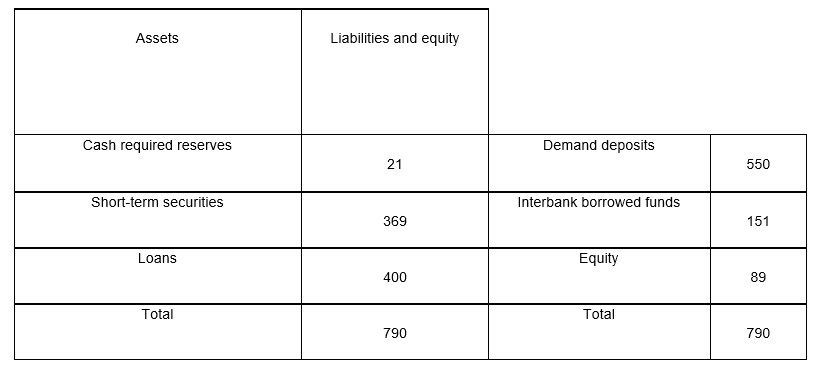 If the bank experiences a $50 000 sudden liquidity drain caused by withdrawal of their demand deposits, what will be the impact on the balance sheet if purchased liquidity management techniques are used?
 (Multiple Choice)
4.9/5 (82)
(82) Discuss the advantages and disadvantages of stored liquidity management and purchased liquidity management. In your opinion, which is the better approach for a DI to adopt?
(Essay)
4.9/5 (78)
(78) As part of the Basel III liquidity reforms the RBA will establish a secure committed liquidity facility.
(Multiple Choice)
4.7/5 (80)
(80) A disadvantage of using asset management to manage an FI's liquidity risk is:
(Multiple Choice)
4.7/5 (78)
(78) The maturity ladder model allows a comparison of cash inflows and cash outflows over a series of specified time periods.
(True/False)
4.8/5 (60)
(60) What are the main components of a liquidity plan? Discuss the vital role such a plan plays in reducing liquidity risk?
(Essay)
4.8/5 (86)
(86) 
Filters
- Essay(0)
- Multiple Choice(0)
- Short Answer(0)
- True False(0)
- Matching(0)