



 Chat with AI
Exam 14: Valuation: Market-Based Approaches

Exam 1: Overview of Financial Reporting, Financial Statement Analysis, and Valuation99 Questions
Exam 2: Asset and Liability Valuation and Income Measurement80 Questions
Exam 3: Income Flows Versus Cash Flows: Understanding the Statement of Cash Flows88 Questions
Exam 4: Profitability Analysis97 Questions
Exam 5: Risk Analysis81 Questions
Exam 6: Financing Activities62 Questions
Exam 7: Investing Activities98 Questions
Exam 8: Operating Activities92 Questions
Exam 9: Accounting Quality64 Questions
Exam 10: Forecasting Financial Statements59 Questions
Exam 11: Risk-Adjusted Expected Rates of Return and the Dividends Valuation Approach52 Questions
Exam 12: Valuation: Cash-Flow-Based Approaches62 Questions
Exam 13: Valuation: Earnings-Based Approaches67 Questions
Exam 14: Valuation: Market-Based Approaches64 Questions
Select questions type


Companies value-to-book and market-to-book ratios may differ due to accounting reasons.An example of an accounting reason that would create a difference is

Free
(Multiple Choice)
4.7/5  (81)
(81) Correct Answer: Verified
B
To estimate security's risk-neutral value we can use the _____________________________________________ and risk-free rates of return.
Free
(Short Answer)
5.0/5 (67)
(67) Correct Answer:Verified
Verifiedresidual income model
Book value per share may not approximate market value per share because:
Free
(Multiple Choice)
4.7/5 (74)
(74) Correct Answer:Verified
VerifiedD
The PEG ratio does not take into account differences in ____________________ and ________________________________________ across firms.
(Essay)
4.9/5 (73)
(73) Which of the following ratios usually reflects investor's opinions of the future prospects for the firm?
(Multiple Choice)
4.8/5 (81)
(81) Wolverwine Company's current stock price is $45 per share and the company's trailing earnings per share were $2.12.Given that analysts are forecasting growth of 14% for Wolverwine,what is the company's PEG ratio?
(Multiple Choice)
4.9/5 (69)
(69) Sometimes a high market-to-book ratio is a result of having __________________________________________________.
(Short Answer)
4.7/5 (88)
(88) The use of P/E ratios in valuation can result in measurement bias.What two items can result in measurement error and why?
(Essay)
4.9/5 (93)
(93) Under the value-to-book model a firm in steady state equilibrium earning ROCE = RE will
(Multiple Choice)
4.8/5 (71)
(71) Assume an analyst is evaluating a firm with $1,000 of book value of common equity and a cost of equity capital equal to 8 percent.Assume that the analyst forecasts that the firm will earn ROCE of 14 percent until year 2016,when the firm will start earning ROCE equal to 8 percent.The company pays no dividends and will not engage in any stock transactions.Use this information to complete the following table and calculate the firm's value-to-book ratio.
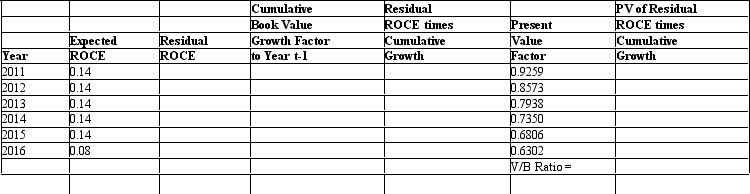
(Essay)
4.9/5 (87)
(87) What is the value of reverse engineering stock prices? How does the process work?
(Essay)
4.9/5 (71)
(71) Economics teaches that,in equilibrium,firms will earn a return equal to the ______________________________.
(Short Answer)
4.8/5 (76)
(76) The price differential,or the amount by which the market has discounted share price for risk,is calculated by
(Multiple Choice)
4.7/5 (77)
(77) Assuming that Ska's cost of equity capital is 14% and it expects to grow earnings at a rate of 8% per year,we would expect Ska's P/E ratio to be
(Multiple Choice)
4.8/5 (83)
(83) The risk of the firm increases the _____________________________________________.
(Short Answer)
4.7/5 (76)
(76) Which of the following is not a reason why price-earnings ratios would differ across firms?
(Multiple Choice)
4.7/5 (82)
(82) In the value-to-book model growth adds value to shareholders only if the growth is ________________________________________.
(Short Answer)
4.9/5 (90)
(90) Discuss how risk and profitability factors cause differences in price-earnings ratios across firms.
(Essay)
4.8/5 (73)
(73) Strictly speaking,the price-earnings ratio assumes that firm value is the
(Multiple Choice)
4.8/5 (85)
(85) 
Filters
- Essay(0)
- Multiple Choice(0)
- Short Answer(0)
- True False(0)
- Matching(0)