



 Chat with AI
Exam 12: Pricing and Advertising

Exam 1: Introduction43 Questions
Exam 2: Supply and Demand225 Questions
Exam 3: A Consumers Constrained Choice130 Questions
Exam 4: Demand123 Questions
Exam 5: Consumer Welfare and Policy Analysis73 Questions
Exam 6: Firms and Production112 Questions
Exam 7: Costs132 Questions
Exam 8: Competitive Firms and Markets112 Questions
Exam 9: Properties and Applications of the Competitive Model101 Questions
Exam 10: General Equilibrium and Economic Welfare109 Questions
Exam 11: Monopoly and Monopsony142 Questions
Exam 12: Pricing and Advertising91 Questions
Exam 13: Game Theory85 Questions
Exam 14: Oligopoly and Monopolistic Competition114 Questions
Exam 15: Factor Markets115 Questions
Exam 16: Uncertainty103 Questions
Exam 17: Property Rights, Externalities, Rivalry, and Exclusion105 Questions
Exam 18: Asymmetric Information85 Questions
Exam 19: Contracts and Moral Hazards79 Questions
Select questions type


Suppose a monopoly produces film and cameras.Consumers demand pictures,which require film and one camera.Two different types of consumers have the following demand for film,
qA = 100 - 10p and qB = 80 - 10p.The monopoly cannot price discriminate in the market for film or the market for cameras,but it can bundle the products.The monopoly produces film at a constant marginal cost of $1 per roll.What price will the monopoly set for film and for cameras?
(Essay)
4.7/5  (79)
(79) 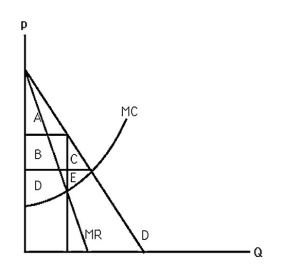 -The above figure shows the market for a particular good.If the market is controlled by a perfect-price-discriminating monopoly,compared to a perfectly competitive market,the change in consumer surplus is
 (Multiple Choice)
4.8/5 (70)
(70) Can a perfectly competitive firm successfully price discriminate? Hint: What does the demand curve look like for a perfectly competitive firm?
(Essay)
4.8/5 (87)
(87) Indoor Life,a TV periodical sells subscriptions (Q)and advertising spaces (N).The demand curve for subscriptions is
p = 50 - 0.002Q - 0.001N2
The magazine has negligible costs of printing and writing (the editor basically sits at home and watches TV),so the production costs are said to be zero.
The advertising is sold in a competitive market.The price advertisers pay (per unit of N)is based on the number of subscriptions the magazine sells times 0.001.Thus the market price for advertising spots can be represented with the equation:
pN = 0.01Q
Compute the optimal number of subscriptions and advertisements for the magazine.
(Essay)
4.9/5 (83)
(83) Coupons represent a form of price discrimination because they offer a low-cost way for firms to
(Multiple Choice)
4.8/5 (77)
(77) Which of the following sellers is most able to perfectly price discriminate?
(Multiple Choice)
4.8/5 (77)
(77) A monopolist's demand curve is given by:
p = 100 + A1/2 - Q
where Q is the quantity of output and A is the quantity of advertising.Suppose the cost of advertising and output is given by:
C(Q,A)= 10Q + A
Determine the profit maximizing quantity of output and advertising.
(Essay)
4.9/5 (95)
(95) Two-part tariffs allow the monopoly firm to capture all of the potential consumer surplus generated by the sale of its product.
(True/False)
4.9/5 (69)
(69) 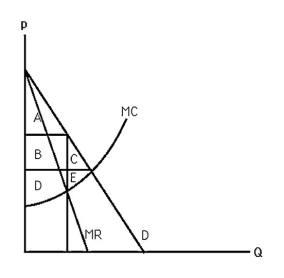 -The above figure shows the market for a given product.Defining welfare as consumer surplus plus producer surplus,calculate the social welfare associated with perfect competition,single-price monopoly,and a perfect-price-discriminating monopoly.Which market structure(s)maximize social welfare?
 (Essay)
5.0/5 (77)
(77) A monopolist will spend resources to advertise its product so long as
(Multiple Choice)
4.8/5 (72)
(72) When a firm has a monopoly in a market and also perfectly price discriminates,total welfare
(Multiple Choice)
4.8/5 (81)
(81) The sales of shoes that include shoelaces is a tie-in sale that most likely
(Multiple Choice)
4.8/5 (94)
(94) A monopoly will NOT be able to perfectly price discriminate if
(Multiple Choice)
4.8/5 (54)
(54) Suppose all individuals are identical,and their monthly demand for Internet access from a certain leading provider can be represented as p = 5 - (1/2)q where p is price in $ per hour and q is hours per month.The firm faces a constant marginal cost of $1.The profit-maximizing two-part tariff yields total revenue of
(Multiple Choice)
4.8/5 (74)
(74) At the current price of a good,Al's consumer surplus equals 15,and Ben's consumer surplus equals 15.By charging a two-part tariff,a monopolist could increase his profit by
(Multiple Choice)
4.9/5 (75)
(75) If the demand for air travel were to change so that business travelers and vacationers have the same price elasticity of demand for air travel,
(Multiple Choice)
4.9/5 (70)
(70) If two markets have the same price elasticity of demand at every price,a monopoly will not practice multimarket price discrimination.
(True/False)
4.9/5 (91)
(91) Suppose all individuals are identical,and their monthly demand for Internet access from a certain leading provider can be represented as p = 5 - (1/2)q where p is price in $ per hour and q is hours per month.The firm faces a constant marginal cost of $1.The profit maximizing two-part tariff yields results in the firm selling
(Multiple Choice)
4.7/5 (88)
(88) 
Filters
- Essay(0)
- Multiple Choice(0)
- Short Answer(0)
- True False(0)
- Matching(0)