



 Chat with AI
Exam 16: Capital Expenditure Decisions

Exam 1: The Changing Role of Managerial Accounting in a Dynamic Business Environment68 Questions
Exam 2: Basic Cost Management Concepts and Accounting for Mass Customization Operations88 Questions
Exam 3: Product Costing and Cost Accumulation in a Batch Production Environment75 Questions
Exam 4: Process Costing and Hybrid Product-Costing Systems78 Questions
Exam 5: Activity-Based Costing and Management102 Questions
Exam 6: Activity Analysis,cost Behavior,and Cost Estimation84 Questions
Exam 18: Appendix I: The Sarbanes-Oxley Act, Internal Controls, and Management Accounting14 Questions
Exam 7: Cost-Volume-Profit Analysis91 Questions
Exam 8: Absorption and Variable Costing58 Questions
Exam 9: Profit Planning and Activity-Based Budgeting91 Questions
Exam 10: Standard Costing,Operational Performance Measures,and the Balanced Scorecard97 Questions
Exam 11: Flexible Budgeting and the Management of Overhead and Support Activity Costs85 Questions
Exam 12: Responsibility Accounting, Quality Control, and Environmental Cost Management91 Questions
Exam 13: Investment Centers and Transfer Pricing85 Questions
Exam 14: Decision Making: Relevant Costs and Benefits85 Questions
Exam 15: Target Costing and Cost Analysis for Pricing Decisions88 Questions
Exam 16: Capital Expenditure Decisions114 Questions
Exam 17: Allocation of Support Activity Costs and Joint Costs77 Questions
Exam 19: compound Interest and the Concept of Present Value24 Questions
Exam 20: Inventory Management14 Questions
Select questions type


A profitability index can be used to rank investment proposals.
Required:
A.Define the profitability index.
A.The profitability index equals the present value of a project's cash inflows divided by the initial investment.
B.Both projects provide a return greater than the hurdle rate and both are acceptable.It is not possible to say which one is better.The profitability index provides a ratio that is not influenced by the size of the project-a limitation of net-present-value (NPV)analysis.Thus,a project that has a greater NPV and a greater profitability index generally will be more attractive than another project against which it is being compared.
B.Two projects are under consideration.Project I has a net present value of $20,000 whereas project II has a net present value of $200,000.Which project is better? Explain.What weakness in a net-present-value analysis does the profitability index address?
(Essay)
4.8/5  (87)
(87) Pinero is considering a $600,000 investment in new equipment that is anticipated to produce the following net cash inflows: 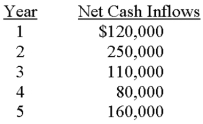 If cash flows occur evenly throughout a year,the equipment's payback period is:
 (Multiple Choice)
4.9/5 (67)
(67) 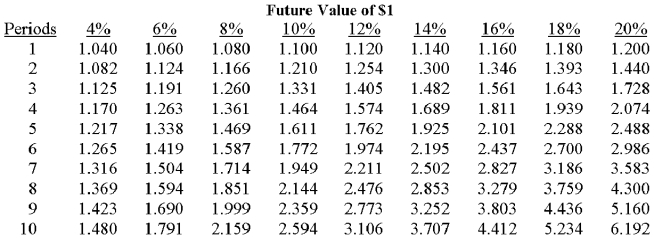
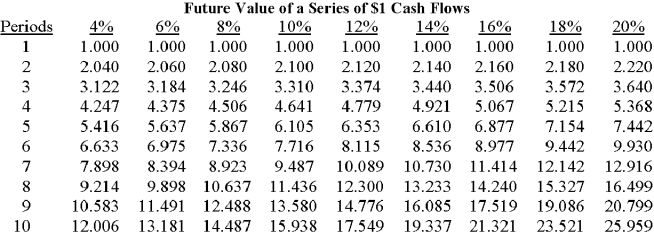
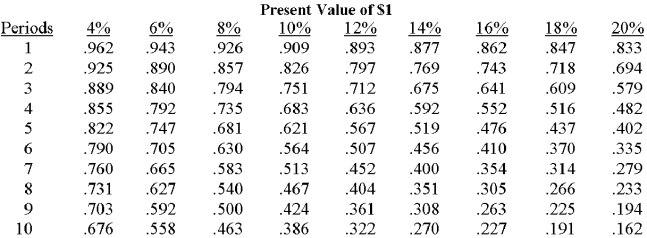
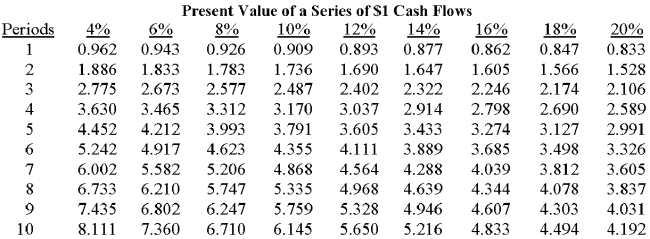 A new machine that costs $172,100 is expected to save annual cash operating costs of $40,000 over each of the next nine years.The machine's internal rate of return is:
 (Multiple Choice)
4.7/5 (84)
(84) The hurdle rate that is used in a net-present-value analysis is the same as the firm's:
(Multiple Choice)
4.9/5 (66)
(66) Consider the following statements about the investment in working capital in a capital budgeting analysis:
I.Working capital often increases as the result of higher balances in accounts receivable or inventory necessary to support a project.
II.Working capital increases are sources of cash and should be included in a discounted-cash-flow analysis.
III.The time 0 cash investment in working capital is included in a discounted-cash-flow analysis as a cash outflow.
Which of the above statements is (are)correct?
(Multiple Choice)
4.8/5 (85)
(85) The Modified Accelerated Cost Recovery System (MACRS)assumes that,on average,assets will be placed in service:
(Multiple Choice)
4.8/5 (77)
(77) A company that is using the internal rate of return (IRR)to evaluate projects should accept a project if the IRR:
(Multiple Choice)
4.8/5 (67)
(67) Schille Company is considering a $5.4 million asset investment that has a four-year service life and a $400,000 salvage value.The investment is expected to produce annual savings in cash operating costs of $860,000 and will require a $250,000 overhaul in year 3,which is fully-deductible for tax purposes.
Schille uses the net-present-value method to analyze investments.Asset investments are depreciated by the straight-line method,ignoring salvage values in related computations.
Required:
A.Asset acquisition: $(5,400,000)
Annual savings in cash operating costs: $860,000
Annual straight-line depreciation: $0
Year 3 overhaul: $(250,000)
Year 4 asset disposal: $400,000
A.Ignoring income taxes,determine the (pre-discounted)cash-flow amounts that would be used in a net-present-value analysis for (1)the asset acquisition,(2)annual savings in cash operating costs,(3)annual straight-line depreciation,(4)the overhaul in year 3,and (5)disposal of the asset in year 4.Note cash outflows in parentheses.
B.Asset acquisition: $(5,400,000)
Annual savings in cash operating costs: $860,000 * 0.7 = $602,000
Depreciation should be:
Year 1: $675,000 x.3 = $202,500
Year 2: $1,350,000 x.3 =$405,000
Year 3: $1,350,000 x.3 =$405,000
Year 4: $1,350,000 x.3 =$405,000
Year 5: $675,000 x.3 = $202,500
Year 3 overhaul: $(250,000)* 0.7 = $(175,000)
Year 4 asset disposal: $5,400,000 - $5,400,000 accumulated depreciation = $0 book value;$0 book value - $400,000 salvage value = $400,000 gain;$400,000 gain * 0.3 = $(120,000)added tax;$400,000 salvage value - $(120,000)added tax = $280,000
B.Repeat requirement "A," assuming the company is subject to a 30% income tax rate.Assume the company depreciates the asset using the optional straight-line methoD.Additionally,it depreciates it over the asset's service life (not its MACRS life).
(Essay)
5.0/5 (76)
(76) Wrikeman evaluates future projects by using the profitability index.The company is currently reviewing five similar projects and must choose one of the following: 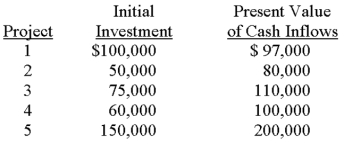 Which project should Wrikeman select if the decision is based entirely on the profitability index?
 (Multiple Choice)
4.8/5 (90)
(90) Paige Company is contemplating the acquisition of a machine that costs $50,000 and promises to reduce annual cash operating costs by $11,000 over each of the next six years.Which of the following is a proper way to evaluate this investment if the company desires a 12% return on all investments?
(Multiple Choice)
4.7/5 (86)
(86) The systematic follow-up on a capital project to see how the project actually turns out is commonly known as:
(Multiple Choice)
4.9/5 (79)
(79) In a net-present-value analysis,the discount rate is often called the:
(Multiple Choice)
4.9/5 (77)
(77) A machine was sold in December 20x3 for $9,000.It was purchased in January 20x1 for $15,000,and depreciation of $12,000 was recorded from the date of purchase through the date of disposal.Assuming a 40% income tax rate,the after-tax cash inflow at the time of sale is:
(Multiple Choice)
4.9/5 (71)
(71) 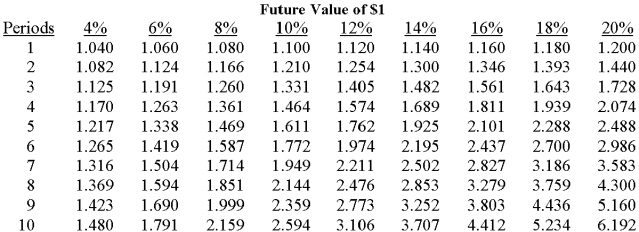
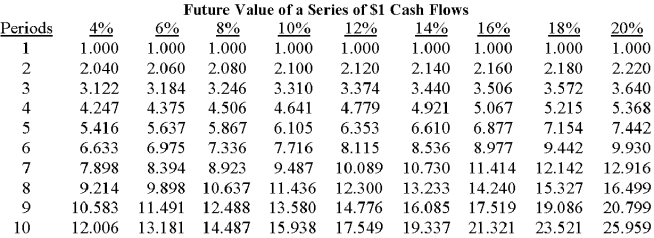
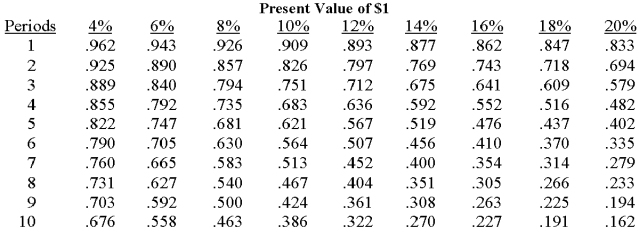
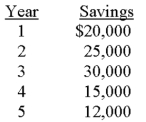
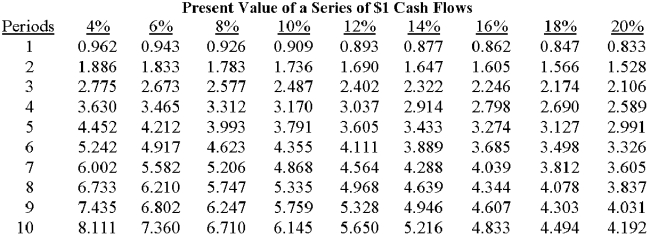 The mayor of Statesville is considering the purchase of a new computer system for the city's tax department.The system costs $75,000 and has an expected life of five years.The mayor estimates the following savings will result if the system is purchased:
 Statesville uses a 10% discount rate for capital-budgeting decisions.
A salesperson from a different computer company claims that his machine,which costs $85,000 and has an estimated service life of four years,will generate annual savings for the city of $32,000.If the discount rate is 10%,the net present value of this system would be:
The mayor of Statesville is considering the purchase of a new computer system for the city's tax department.The system costs $75,000 and has an expected life of five years.The mayor estimates the following savings will result if the system is purchased:
Statesville uses a 10% discount rate for capital-budgeting decisions.
A salesperson from a different computer company claims that his machine,which costs $85,000 and has an estimated service life of four years,will generate annual savings for the city of $32,000.If the discount rate is 10%,the net present value of this system would be: (Multiple Choice)
5.0/5 (75)
(75) The internal rate of return equates the present value of a project's cash inflows with the present value of the cash outflows.
(True/False)
4.8/5 (78)
(78) The payback period can only be used if net cash inflows are uniform throughout a project's life.
(True/False)
4.9/5 (80)
(80) Consider the following statements about taxes and after-tax cash flows:
I.Capital budgeting analyses should incorporate after-tax cash flows rather than before-tax cash flows.
II.Added company revenues will result in lower taxes for a firm.
III.Operating expenses may actually provide a tax benefit for an organization.
Which of the above statements is (are)correct?
(Multiple Choice)
4.8/5 (79)
(79) Hightower Company plans to incur $350,000 of salaries expense if a capital project is implemented.Assuming a 30% tax rate,the salaries should be reflected in the analysis by a:
(Multiple Choice)
4.8/5 (83)
(83) Consider the following statements about the total-cost and the incremental-cost approaches of investment evaluation:
I.Both approaches will yield the same conclusions.
II.Choosing between these approaches is a matter of personal preference.
III.The incremental approach focuses on cost differences between alternatives.
Which of the above statements is (are)true?
(Multiple Choice)
4.9/5 (67)
(67) 
Filters
- Essay(0)
- Multiple Choice(0)
- Short Answer(0)
- True False(0)
- Matching(0)