



 Chat with AI
Exam 17: Allocation of Support Activity Costs and Joint Costs

Exam 1: The Changing Role of Managerial Accounting in a Dynamic Business Environment68 Questions
Exam 2: Basic Cost Management Concepts and Accounting for Mass Customization Operations88 Questions
Exam 3: Product Costing and Cost Accumulation in a Batch Production Environment75 Questions
Exam 4: Process Costing and Hybrid Product-Costing Systems78 Questions
Exam 5: Activity-Based Costing and Management102 Questions
Exam 6: Activity Analysis,cost Behavior,and Cost Estimation84 Questions
Exam 18: Appendix I: The Sarbanes-Oxley Act, Internal Controls, and Management Accounting14 Questions
Exam 7: Cost-Volume-Profit Analysis91 Questions
Exam 8: Absorption and Variable Costing58 Questions
Exam 9: Profit Planning and Activity-Based Budgeting91 Questions
Exam 10: Standard Costing,Operational Performance Measures,and the Balanced Scorecard97 Questions
Exam 11: Flexible Budgeting and the Management of Overhead and Support Activity Costs85 Questions
Exam 12: Responsibility Accounting, Quality Control, and Environmental Cost Management91 Questions
Exam 13: Investment Centers and Transfer Pricing85 Questions
Exam 14: Decision Making: Relevant Costs and Benefits85 Questions
Exam 15: Target Costing and Cost Analysis for Pricing Decisions88 Questions
Exam 16: Capital Expenditure Decisions114 Questions
Exam 17: Allocation of Support Activity Costs and Joint Costs77 Questions
Exam 19: compound Interest and the Concept of Present Value24 Questions
Exam 20: Inventory Management14 Questions
Select questions type


Which of the following methods recognizes the fact that fixed and variable service department costs should be allocated separately?
(Multiple Choice)
4.8/5  (79)
(79) Which of the following choices correctly denotes the data needed to allocate joint costs under the relative-sales-value method? 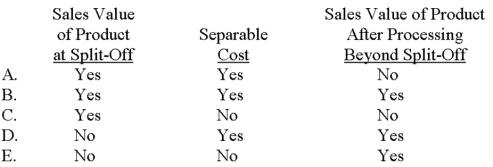
(Multiple Choice)
4.8/5 (65)
(65) Assuming use of the step-down method,over how many square feet would the Building Maintenance cost be allocated (i.e. ,spread)?
(Multiple Choice)
4.8/5 (81)
(81) Madrid has two service departments (General Factory and Human Resources)and two production departments (Machining and Assembly).The company uses the direct method of service-department cost allocation,allocating General Factory cost on the basis of square feet and Human Resources cost on the basis of employees.Budgeted allocation-base and operating data for the four departments follow.
A.Allocate the company's service-department costs to the producing departments.
B.Compute the overhead application rates for Machining and Assembly.
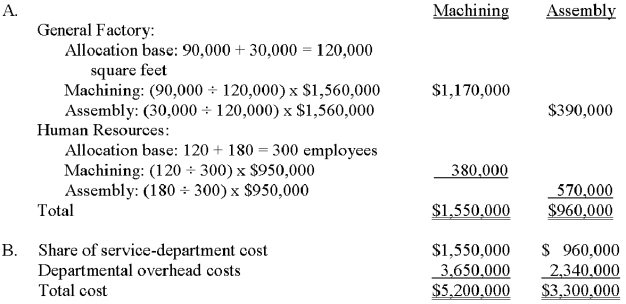 Application rates:
Machining: $5,200,000 / 80,000 machine hours = $65 per MH
Assembly: $3,300,000 / 150,000 labor hours = $22 per LH
Application rates:
Machining: $5,200,000 / 80,000 machine hours = $65 per MH
Assembly: $3,300,000 / 150,000 labor hours = $22 per LH (Essay)
4.8/5 (79)
(79) Using the direct method,the amount of Janitorial Department cost allocated to Sales Department no.2 is:
(Multiple Choice)
4.9/5 (84)
(84) Barry Chemical Company manufactures X-111,X-112,and X-113 from a joint process.The following information is available for the period just ended:
A.Does Barry allocate joint costs by using the physical-units method? Explain.
A.No.X-112 comprises 28% of the total units produced (14,000 / 50,000);however,the product was allocated 23% of the total joint cost ($18,400 / $80,000).Apparently,then,another method is being used.
B.Assume that Barry does not use the physical-units method but instead allocates joint costs by using the relative-sales-value method.Find the four unknowns in the preceding table.
B.X-111 has 40% of the sales value ($104,000 / $260,000),resulting in 40% of the joint cost ($80,000 * 40%),or $32,000.This leaves $29,600 to be allocated to X-113 ($80,000 - $32,000 - $18,400).The sales values follow by using the same percentages that are used in the cost allocation ($18,400 / $80,000 = 23%;$260,000 * 23% = $59,800)and ($29,600/ $80,000 = 37%;$260,000 * 37% = $96,200).

(Essay)
4.9/5 (83)
(83) Seymore uses the step-down method of cost allocation and allocates cost on the basis of employees.Human Resources cost amounts to $1,200,000,and the department provides more service to the firm than Cafeteria.How much Human Resources cost would be allocated to Assembly?
(Multiple Choice)
4.7/5 (75)
(75) Douglas Company,a new firm,manufactures two products,J and K,in a common process.The joint costs amount to $80,000 per batch of finished goods.Each batch results in 20,000 liters of output,of which 80% are J and 20% are K.
The two products are processed beyond the split-off point,with Douglas incurring the following separable costs: J,$2 per liter;K,$5 per liter.After the additional processing,the selling price of J is $12 per liter,and the selling price of K is $15 per liter.
Required:
A.Determine the proper allocation of joint costs if the company uses the net-realizable-value method.
B.Assume that Douglas sold all of its production of K during the current accounting period.Compute K's sales revenue,cost of goods sold,and gross margin.
C.Is the firm's cost-of-goods-sold figure influenced by the choice of a joint-cost allocation method? Briefly explain.
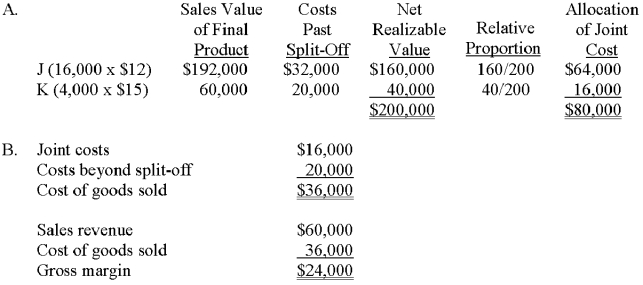 C.Yes.Cost of goods sold is based on both separable costs and joint cost.The choice of an allocation method will influence the amount of joint cost charged to the product.
 (Essay)
4.9/5 (72)
(72) Assuming use of the direct method,over how many square feet would the Building Maintenance cost be allocated (i.e. ,spread)?
(Multiple Choice)
4.8/5 (77)
(77) The process of allocating fixed and variable costs separately is called:
(Multiple Choice)
4.8/5 (72)
(72) Dunwoody Corporation has two service departments (Maintenance and Human Resources)and three production departments (Machining,Assembly,and Finishing).The two service departments service the production departments as well as each other,and studies have shown that Maintenance provides the greater amount of service.On the basis of this information,which of the following cost allocations would likely occur under the step-down method?
(Multiple Choice)
4.9/5 (93)
(93) If the joint production costs are allocated based on the net-realizable-value method,the amount of joint cost assigned to product Y would be:
(Multiple Choice)
4.9/5 (78)
(78) The joint cost allocated to W under the net-realizable-value method would be:
(Multiple Choice)
4.9/5 (78)
(78) The point in a joint production process where each individual product becomes separately identifiable is commonly called the:
(Multiple Choice)
4.9/5 (73)
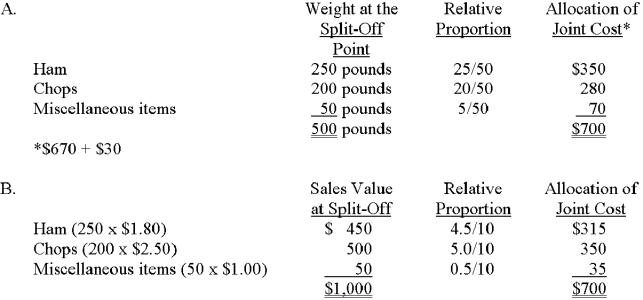
(73) Suppose that one hog yields 250 pounds of ham,200 pounds of chops,and 50 pounds of miscellaneous items.The sales value of ham is $1.80 per pound;chops,$2.50 per pound;and miscellaneous items,$1.00 per pound.The hog costs $670,and processing costs are $30.
Required:
A.Determine the proper allocation of joint costs to the three products by using the physical-units method.
B.Repeat part "B" by using the relative-sales-value method.
(Essay)
4.7/5 (82)
(82) A company that uses activity-based costing would likely allocate costs from activity-cost pools to products and services.
(True/False)
5.0/5 (84)
(84) Eastside Hospital has two service departments (Patient Records and Accounting)and two "production" departments (Internal Medicine and Surgery).Which of the following allocations would likely take place under the reciprocal-services method of cost allocation?
(Multiple Choice)
4.8/5 (89)
(89) 
Filters
- Essay(0)
- Multiple Choice(0)
- Short Answer(0)
- True False(0)
- Matching(0)