



 Chat with AI
Exam 5: Production and Cost

Exam 1: Introduction29 Questions
Exam 2: Economists View of Behavior45 Questions
Exam 3: Exchange and Markets47 Questions
Exam 4: Demand43 Questions
Exam 5: Production and Cost42 Questions
Exam 6: Market Structure45 Questions
Exam 7: Pricing With Market Power46 Questions
Exam 8: Economics of Strategy: Creating and Capturing Value42 Questions
Exam 9: Economics of Strategy: Game Theory35 Questions
Exam 10: Incentive Conflicts and Contracts43 Questions
Exam 11: Organizational Architecture43 Questions
Exam 12: Decision Rights: the Level of Empowerment43 Questions
Exam 13: Decision Rights: Bundling Tasks Into Jobs and Subunits40 Questions
Exam 14: Attracting and Retaining Qualified Employees47 Questions
Exam 15: Incentive Compensation40 Questions
Exam 16: Individual Performance Evaluation37 Questions
Exam 17: Divisional Performance Evaluation35 Questions
Exam 18: Corporate Governance34 Questions
Exam 19: Vertical Integration and Outsourcing43 Questions
Exam 20: Leadership: Motivating Change Within Organizations38 Questions
Exam 21: Understanding the Business Environment: the Economics of Regulation40 Questions
Exam 22: Ethics and Organizational Architecture34 Questions
Exam 23: Organizational Architecture and the Process of Management Innovation41 Questions
Select questions type


Assume your company produces good X using only two inputs,capital (K)and labor (L).Also,assume L is measured on the vertical axis and K on the horizontal one.If the prices of inputs are PK = $30 and PL = 15,and your company is behaving efficiently,what is the slope of the isoquant at the current input mix?

Free
(Multiple Choice)
4.9/5  (71)
(71) Correct Answer: Verified
A
For many corporations,a major portion of the cost of production is fixed in the short run.Should these very large fixed costs be ignored when the executives are making output and pricing decisions? Why?
Free
(Essay)
4.8/5 (94)
(94) Correct Answer:Verified
VerifiedYes,these fixed costs should be ignored when making short-run output and pricing decisions because they do not affect marginal costs or marginal benefits in the short run.In the long run,all costs are variable costs and there are no long-run fixed costs.
Which of the following is a possible limitation in cost estimation?
Free
(Multiple Choice)
4.8/5 (66)
(66) Correct Answer:Verified
VerifiedA
Refer to Figure 5.2.On the graph that shows total costs,what is the level of variable costs when 6 units are produced? 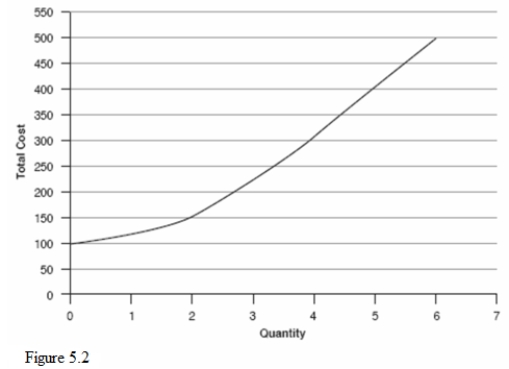
(Multiple Choice)
4.9/5 (88)
(88) A production function of the form Q = 40 L.75 K.20 exhibits ______ in the long run.
(Multiple Choice)
4.9/5 (70)
(70) Which of the following statements about the average total cost curve is false?
(Multiple Choice)
4.9/5 (77)
(77) If a company has a cost curve of TC = 300 + 2Q + Q2 and it produces 300 units per day,then its average (total)cost is
(Multiple Choice)
4.8/5 (83)
(83) Currently,the marginal cost equation for a shoe manufacturing company is given by MC = 10 + 2Q.The market price per pair is $60.How many units should the company produce?
(Essay)
4.8/5 (79)
(79) If a company has significant economies of scale in the long run-assuming a large market -the company will tend to
(Multiple Choice)
4.9/5 (82)
(82) If a company has a cost curve of TC = 300 + 2Q + Q2 and it produces 300 units per day,then its marginal cost is
(Multiple Choice)
4.9/5 (91)
(91) A firm produces 10 widgets that they sell for $15 each.The average variable cost for the production of 10 widgets is $13/unit.The fixed cost for this firm equals $20.What is the value of this firm's profits?
(Multiple Choice)
4.8/5 (74)
(74) Why do economies of scale and learning curve effects look similar when they are graphed? What different concepts do they represent?
(Essay)
4.8/5 (85)
(85) Refer to Table 5.1 and determine which of the following answers is correct. 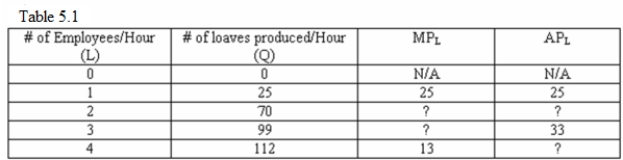
(Multiple Choice)
4.8/5 (87)
(87) Bob owns an auto parts firm.He uses a combination of steel and aluminum to produce his auto parts.All of the following combinations will finish the task on time.Steel costs $15 per unit and the aluminum costs $50 per unit.What combination of steel and aluminum should he use?
(Multiple Choice)
4.8/5 (90)
(90) Can a production function with two factors exhibit increasing returns to scale while at the same time have diminishing returns to each factor?
(Essay)
4.8/5 (71)
(71) 
Filters
- Essay(0)
- Multiple Choice(0)
- Short Answer(0)
- True False(0)
- Matching(0)