



 Chat with AI
Exam 21: Extension 5: Decision Theory

Exam 1: Introduction to Operations Management70 Questions
Exam 2: Competitiveness, Strategy, and Productivity73 Questions
Exam 3: Forecasting164 Questions
Exam 4: Product and Service Design77 Questions
Exam 5: Strategic Capacity Planning for Products and Services103 Questions
Exam 6: Process Selection and Facility Layout151 Questions
Exam 7: Work Design and Measurement151 Questions
Exam 8: Location Planning and Analysis80 Questions
Exam 9: Management of Quality102 Questions
Exam 10: Quality Control141 Questions
Exam 11: Aggregate Planning and Master Scheduling81 Questions
Exam 12: MRP and ERP89 Questions
Exam 13: Inventory Management162 Questions
Exam 14: Jit and Lean Operations88 Questions
Exam 15: Supply Chain Management89 Questions
Exam 16: Scheduling134 Questions
Exam 17: Project Management137 Questions
Exam 18: Management of Waiting Lines81 Questions
Exam 19: Linear Programming105 Questions
Exam 20: Extension 4: Reliability10 Questions
Exam 21: Extension 5: Decision Theory126 Questions
Exam 22: Extension 7: Learning Curves68 Questions
Exam 23: Extension 8: The Transportation Model20 Questions
Exam 24: Extension 10: Acceptance Sampling65 Questions
Exam 25: Extension 14: Maintenance38 Questions
Select questions type


With equally likely states of nature, the alternative that has the largest expected monetary value is:
(Multiple Choice)
4.8/5  (79)
(79) Decision trees, with their predetermined analysis of a situation, are really not useful in making health care decisions since every person is unique.
(True/False)
5.0/5 (86)
(86) The expected monetary value approach is most appropriate when the decision-maker is risk-neutral.
(True/False)
4.9/5 (78)
(78) Determining the average payoff for each alternative and choosing the alternative with the highest average is the approach called:
(Multiple Choice)
4.9/5 (63)
(63) A weakness of the maximin approach is that it loses some information.
(True/False)
4.8/5 (90)
(90) The EVPI indicates an upper limit on the amount a decision-maker should be willing to spend to obtain additional information.
(True/False)
4.9/5 (79)
(79) A tabular presentation that shows the outcome for each decision alternative under the various possible states of nature is called a/an:
(Multiple Choice)
4.8/5 (84)
(84) Graphical sensitivity analysis is used for decision-making under risk.
(True/False)
5.0/5 (86)
(86) If he feels the chances of low, normal, and high precipitation are 30%, 20%, and 50% respectively, what are expected long-run profits for the alternative he will select?
(Multiple Choice)
5.0/5 (78)
(78) If she uses the Laplace criterion, how many new examiners will she decide to hire?
(Multiple Choice)
4.9/5 (70)
(70) If she uses the Laplace criterion, how many beauticians will she decide to hire?
(Multiple Choice)
4.9/5 (83)
(83) If he feels the chances of low, moderate, and high demand are 30%, 30%, and 40% respectively, what is the expected annual profit for the bus that he will decide to purchase?
(Multiple Choice)
4.8/5 (81)
(81) If she uses the maximin criterion, how many new examiners will she decide to hire?
(Multiple Choice)
4.9/5 (92)
(92) 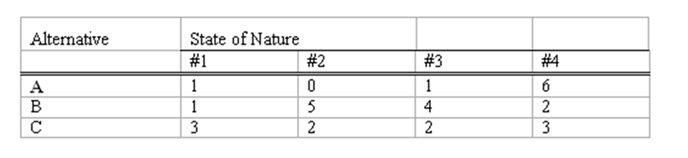 -If you are uncertain which state of nature will occur, and use the maximax criterion, which alternative will you select?
 (Short Answer)
5.0/5 (68)
(68) What is the probability that the economics book would wind up being placed with a smaller publisher?
(Multiple Choice)
4.8/5 (74)
(74) If she uses the maximax criterion, what size outlet will she decide to lease?
(Multiple Choice)
4.8/5 (69)
(69) If she feels there is a 30% chance that demand will be high, what is her expected value of perfect information?
(Multiple Choice)
4.7/5 (72)
(72) A manager has developed the following payoff table that indicates the profits associated with a set of alternatives under two possible states of nature.
(Essay)
4.8/5 (77)
(77) 
Filters
- Essay(0)
- Multiple Choice(0)
- Short Answer(0)
- True False(0)
- Matching(0)