



 Chat with AI
Exam 16: Debt Policy

Exam 1: Goals and Governance of the Corporation112 Questions
Exam 2: Financial Markets and Institutions98 Questions
Exam 3: Accounting and Finance122 Questions
Exam 4: Measuring Corporate Performance118 Questions
Exam 5: The Time Value of Money118 Questions
Exam 6: Valuing Bonds120 Questions
Exam 7: Valuing Stocks142 Questions
Exam 8: Net Present Value and Other Investment Criteria114 Questions
Exam 9: Using Discounted Cash-Flow Analysis to Make Investment Decisions118 Questions
Exam 10: Project Analysis118 Questions
Exam 11: Introduction to Risk,Return,and the Opportunity Cost of Capital115 Questions
Exam 12: Risk,Return,and Capital Budgeting125 Questions
Exam 13: The Weighted-Average Cost of Capital and Company Valuation113 Questions
Exam 14: Introduction to Corporate Financing130 Questions
Exam 15: How Corporations Raise Venture Capital and Issue Securities118 Questions
Exam 16: Debt Policy134 Questions
Exam 17: Payout Policy125 Questions
Exam 18: Long-Term Financial Planning119 Questions
Exam 19: Short-Term Financial Planning120 Questions
Exam 12: Risk, Return, and Capital Budgeting141 Questions
Exam 21: Mergers, Acquisitions, and Corporate Control125 Questions
Exam 22: International Financial Management117 Questions
Exam 23: Options115 Questions
Exam 24: Risk Management118 Questions
Select questions type


The optimal capital structure is met when:

Free
(Multiple Choice)
4.8/5  (76)
(76) Correct Answer: Verified
C
Show how leverage increases financial risk by calculating the EPS and return on shares for a firm with $1 million in 10% debt.The firm also has 50,000 shares outstanding that sell for $40 each.Three states of the economy are possible: a slump under which the firm would have operating income of $150,000,a normal state under which the firm will earn $420,000,and a boom under which the firm will earn $600,000.The firm pays no taxes.
Free
(Essay)
4.8/5 (77)
(77) Correct Answer:Verified
Verified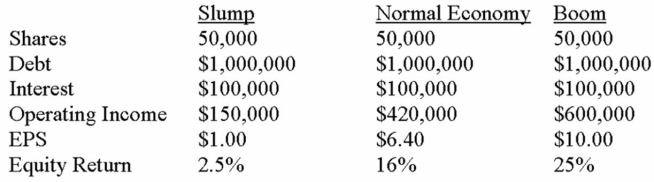
With a tax rate of 35%,calculate the WACC for a firm that pays 10% on its debt,requires an 18% rate of return on its equity,and finances 45% of assets with debt.
(Multiple Choice)
4.8/5 (88)
(88) Debt financing affects neither the business risk nor the financial risk of the firm.
(True/False)
4.8/5 (79)
(79) MM's proposition I states that the required rate of return on equity increases as the firm's debt-equity ratio increases.
(True/False)
4.8/5 (76)
(76) What is the proportion of debt financing for a firm that expects a 24% return on equity,a 16% return on assets,and a 12% return on debt? Ignore taxes.
(Multiple Choice)
4.7/5 (72)
(72) When a corporation issues permanent debt,the value of all its securities:
(Multiple Choice)
4.7/5 (88)
(88) According to MM,an increase in expected earnings per share can leave the share price unchanged if the:
(Multiple Choice)
4.8/5 (76)
(76) Which of the following lists presents the order of financing from most preferred to least preferred according to the pecking order theory?
(Multiple Choice)
4.9/5 (78)
(78) According to pecking order theory,managers will often choose to finance with:
(Multiple Choice)
4.9/5 (84)
(84) A firm with a debt-equity ratio of 1/2,return on assets of 15%,and return on debt of 10% will have return on equity of:
(Multiple Choice)
4.8/5 (85)
(85) Which of the following would not be expected to change with changes in the firm's capital structure?
(Multiple Choice)
4.8/5 (77)
(77) According to MM II,as a firm's debt-equity ratio decreases:
(Multiple Choice)
4.9/5 (80)
(80) How do corporate income taxes modify MM's leverage irrelevance proposition?
D. Future interest tax shields are usually valued by discounting at the borrowing rate rdebt. In the special case of permanent debt,
PV tax shield = Tc (rdebt * D)/rdebt = TcD
Of course interest tax shields are valuable only for companies that are making profits and paying taxes.
(Essay)
4.9/5 (80)
(80) What is the maximum rate that can be paid on debt and maintain a 14% WACC with a 19% expected return on equity in a firm with a 60% debt-to-asset ratio? Ignore taxes.
(Multiple Choice)
4.8/5 (75)
(75) When taxes are considered,the value of a levered firm equals the value of the:
(Multiple Choice)
4.9/5 (84)
(84) Management's perceived signals to investors form an important component of pecking order theory.
(True/False)
4.8/5 (77)
(77) 
Filters
- Essay(0)
- Multiple Choice(0)
- Short Answer(0)
- True False(0)
- Matching(0)