



 Chat with AI
Exam 29: International Finance

Exam 1: The Role and Method of Economics198 Questions
Exam 2: Economics: Eight Powerful Ideas197 Questions
Exam 3: Scarcity, Trade-Offs, and Production Possibilities189 Questions
Exam 4: Demand, Supply, and Market Equilibrium240 Questions
Exam 5: Markets in Motion and Price Controls228 Questions
Exam 6: Elasticities206 Questions
Exam 7: Market Efficiency and Welfare136 Questions
Exam 8: Market Failure215 Questions
Exam 9: Public Finance and Public Choice64 Questions
Exam 10: Consumer Choice Theory149 Questions
Exam 11: The Firm: Production and Costs198 Questions
Exam 12: Firms in Perfectly Competitive Markets207 Questions
Exam 13: Monopoly and Antitrust189 Questions
Exam 14: Monopolistic Competition and Product Differentiation159 Questions
Exam 15: Oligopoly and Strategic Behavior146 Questions
Exam 16: The Markets for Labor, Capital, and Land177 Questions
Exam 17: Income, Poverty, and Health Care138 Questions
Exam 18: Introduction to Macroeconomics: Unemployment, Inflation, and Economic Fluctuations171 Questions
Exam 19: Measuring Economic Performance147 Questions
Exam 20: Economic Growth in the Global Economy127 Questions
Exam 21: Financial Markets, Saving, and Investment65 Questions
Exam 22: Aggregate Demand and Aggregate Supply163 Questions
Exam 23: The Aggregate Expenditure Model69 Questions
Exam 25: Monetary Institutions182 Questions
Exam 26: The Federal Reserve System and Monetary Policy147 Questions
Exam 27: Issues in Macroeconomic Theory and Policy130 Questions
Exam 28: International Trade182 Questions
Exam 29: International Finance138 Questions
Select questions type


The current international monetary system is best described as a:
(Multiple Choice)
4.8/5  (89)
(89) Which of the following would cause an increase in the exchange value of the U.S.dollar?
(Multiple Choice)
5.0/5 (85)
(85) Which of the following would be a debit in the U.S.balance of payments?
(Multiple Choice)
5.0/5 (81)
(81) An appreciation of the exchange value of the U.S.dollar would:
(Multiple Choice)
4.8/5 (68)
(68) A country would tend to experience currency appreciation relative to other countries if:
(Multiple Choice)
4.7/5 (72)
(72) Suppose that the exchange rate between Mexican pesos and dollars is 8 pesos per dollar.If the exchange rate goes to 6 pesos per dollar,it would tend to:
(Multiple Choice)
4.9/5 (81)
(81) Exhibit 29-1 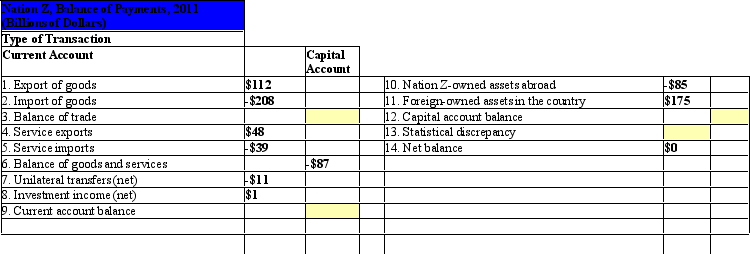 Refer to Exhibit 29-1.For Nation Z,the capital account balance for the year 2011 equals:
 (Multiple Choice)
4.9/5 (72)
(72) In a pure flexible exchange rate system,deficits and surpluses in the balance of payments:
(Multiple Choice)
4.9/5 (69)
(69) Which of the following is true of price changes in currencies under the fixed-rate system?
(Multiple Choice)
4.9/5 (91)
(91) If interest rates rise in the United States relative to those in the rest of the world,the exchange value of the dollar will tend to appreciate.
(True/False)
4.7/5 (76)
(76) If the dollar price of euros is lower than the equilibrium price,there will be an excess quantity of euros ____ at that price,and competition among euro ____ will push the price of Euros toward equilibrium.
(Multiple Choice)
4.9/5 (79)
(79) Prior to 1973,the world operated on a system of fixed exchange rates called the Bretton Woods system.
(True/False)
4.9/5 (73)
(73) A decrease in foreign demand for U.S.exports will ____ the demand for U.S.dollars and cause the U.S.dollar to ____ in value.
(Multiple Choice)
4.7/5 (93)
(93) The record of all transactions with foreign nations that involve the exchange of merchandise goods and services or unilateral gifts is called the:
(Multiple Choice)
4.9/5 (86)
(86) A change in the euro-dollar exchange rate from $1 per euro to $2 per euro would ____ the U.S.price of German goods,____ the number of German goods that would be demanded in the U.S.
(Multiple Choice)
4.7/5 (76)
(76) A decrease in U.S.interest rates will,other things equal,tend to:
(Multiple Choice)
4.9/5 (77)
(77) The agreement that established a system of fixed exchange rates immediately following World War II is known as the:
(Multiple Choice)
4.8/5 (82)
(82) The record of all international financial transactions in which a nation has engaged over a year is known as the:
(Multiple Choice)
4.9/5 (89)
(89) 
Filters
- Essay(0)
- Multiple Choice(0)
- Short Answer(0)
- True False(0)
- Matching(0)