



 Chat with AI
Exam 25: Monetary Institutions

Exam 1: The Role and Method of Economics198 Questions
Exam 2: Economics: Eight Powerful Ideas197 Questions
Exam 3: Scarcity, Trade-Offs, and Production Possibilities189 Questions
Exam 4: Demand, Supply, and Market Equilibrium240 Questions
Exam 5: Markets in Motion and Price Controls228 Questions
Exam 6: Elasticities206 Questions
Exam 7: Market Efficiency and Welfare136 Questions
Exam 8: Market Failure215 Questions
Exam 9: Public Finance and Public Choice64 Questions
Exam 10: Consumer Choice Theory149 Questions
Exam 11: The Firm: Production and Costs198 Questions
Exam 12: Firms in Perfectly Competitive Markets207 Questions
Exam 13: Monopoly and Antitrust189 Questions
Exam 14: Monopolistic Competition and Product Differentiation159 Questions
Exam 15: Oligopoly and Strategic Behavior146 Questions
Exam 16: The Markets for Labor, Capital, and Land177 Questions
Exam 17: Income, Poverty, and Health Care138 Questions
Exam 18: Introduction to Macroeconomics: Unemployment, Inflation, and Economic Fluctuations171 Questions
Exam 19: Measuring Economic Performance147 Questions
Exam 20: Economic Growth in the Global Economy127 Questions
Exam 21: Financial Markets, Saving, and Investment65 Questions
Exam 22: Aggregate Demand and Aggregate Supply163 Questions
Exam 23: The Aggregate Expenditure Model69 Questions
Exam 25: Monetary Institutions182 Questions
Exam 26: The Federal Reserve System and Monetary Policy147 Questions
Exam 27: Issues in Macroeconomic Theory and Policy130 Questions
Exam 28: International Trade182 Questions
Exam 29: International Finance138 Questions
Select questions type


The money ____ equals 1 divided by the reserve requirement.The larger the reserve requirement,the ____ the money multiplier.
(Multiple Choice)
4.8/5  (78)
(78) A single bank is severely limited in its ability to create money because:
(Multiple Choice)
4.9/5 (89)
(89) A reserve requirement of 12.5 percent implies a potential money multiplier of:
(Multiple Choice)
4.9/5 (82)
(82) Other things being equal,if you took money out of your demand deposit account and put it in a savings deposit account:
(Multiple Choice)
4.9/5 (78)
(78) 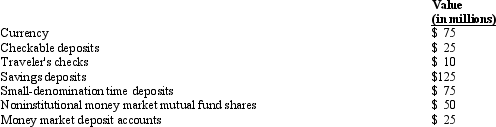
A commercial bank has $1,000,000 of outstanding demand deposits and actual reserves of $300,000.If the required reserve ratio is 20 percent,what is the maximum amount of new loans the bank can extend?
(Multiple Choice)
4.7/5 (80)
(80) An increase in the excess reserves banks want to hold,together with people depositing currency into their demand deposit accounts,would:
(Multiple Choice)
4.8/5 (75)
(75) Exhibit 25-1 A bank's assets consist of $500,000 in total reserves,$1,600,000 in loans,and a building worth $1,200,000.Its liabilities and capital consist of $2,000,000 in demand deposits and $1,300,000 in capital.
Refer to Exhibit 25-1.If the required reserve ratio is 25 percent,what is the level of the bank's excess reserves? How much could it loan out as a result?
(Multiple Choice)
4.8/5 (82)
(82) First Safety,a commercial bank,has $6,000,000 of outstanding demand deposits and actual reserves of $1,700,000.If the reserve ratio is 25 percent,what is the maximum amount of new loans the bank can extend?
(Multiple Choice)
4.7/5 (89)
(89) A reserve requirement of 25 percent would mean that each dollar of reserves could support ____ of demand deposits.
(Multiple Choice)
4.8/5 (84)
(84) A reserve requirement of 40 percent would mean that each dollar of reserves could support ____ of demand deposits.
(Multiple Choice)
4.9/5 (65)
(65) A conversion of checking account balances into savings account balances would ____ M1 and ____ M2.
(Multiple Choice)
4.9/5 (71)
(71) Exhibit 25-1 A bank's assets consist of $500,000 in total reserves,$1,600,000 in loans,and a building worth $1,200,000.Its liabilities and capital consist of $2,000,000 in demand deposits and $1,300,000 in capital.
Refer to Exhibit 25-1.If the required reserve ratio is 30 percent,what is the level of the bank's excess reserves? How much money could the excess reserves be used to create in the banking system as a result?
(Multiple Choice)
4.8/5 (79)
(79) A reserve requirement of 50 percent means a money multiplier of:
(Multiple Choice)
4.9/5 (99)
(99) Exhibit 25-1 A bank's assets consist of $500,000 in total reserves,$1,600,000 in loans,and a building worth $1,200,000.Its liabilities and capital consist of $2,000,000 in demand deposits and $1,300,000 in capital.
Refer to Exhibit 25-1.If the required reserve ratio is 20 percent,what is the level of the bank's excess reserves? How much could it loan out as a result?
(Multiple Choice)
4.9/5 (79)
(79) 
Filters
- Essay(0)
- Multiple Choice(0)
- Short Answer(0)
- True False(0)
- Matching(0)