



 Chat with AI
Exam 22: Aggregate Demand and Aggregate Supply

Exam 1: The Role and Method of Economics198 Questions
Exam 2: Economics: Eight Powerful Ideas197 Questions
Exam 3: Scarcity, Trade-Offs, and Production Possibilities189 Questions
Exam 4: Demand, Supply, and Market Equilibrium240 Questions
Exam 5: Markets in Motion and Price Controls228 Questions
Exam 6: Elasticities206 Questions
Exam 7: Market Efficiency and Welfare136 Questions
Exam 8: Market Failure215 Questions
Exam 9: Public Finance and Public Choice64 Questions
Exam 10: Consumer Choice Theory149 Questions
Exam 11: The Firm: Production and Costs198 Questions
Exam 12: Firms in Perfectly Competitive Markets207 Questions
Exam 13: Monopoly and Antitrust189 Questions
Exam 14: Monopolistic Competition and Product Differentiation159 Questions
Exam 15: Oligopoly and Strategic Behavior146 Questions
Exam 16: The Markets for Labor, Capital, and Land177 Questions
Exam 17: Income, Poverty, and Health Care138 Questions
Exam 18: Introduction to Macroeconomics: Unemployment, Inflation, and Economic Fluctuations171 Questions
Exam 19: Measuring Economic Performance147 Questions
Exam 20: Economic Growth in the Global Economy127 Questions
Exam 21: Financial Markets, Saving, and Investment65 Questions
Exam 22: Aggregate Demand and Aggregate Supply163 Questions
Exam 23: The Aggregate Expenditure Model69 Questions
Exam 25: Monetary Institutions182 Questions
Exam 26: The Federal Reserve System and Monetary Policy147 Questions
Exam 27: Issues in Macroeconomic Theory and Policy130 Questions
Exam 28: International Trade182 Questions
Exam 29: International Finance138 Questions
Select questions type


Greater and more extensive government regulations of safety standards and environmental controls will have what effect on short-run and long-run aggregate supply?
(Essay)
4.8/5  (81)
(81) According to the "misperception effect" explanation of short-run aggregate supply,firms increase output as the price level rises because they mistake the increase in overall prices for an increase in the relative price of their own output.
(True/False)
4.8/5 (85)
(85) 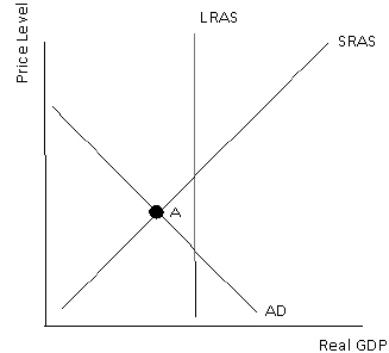
Exhibit 22-3 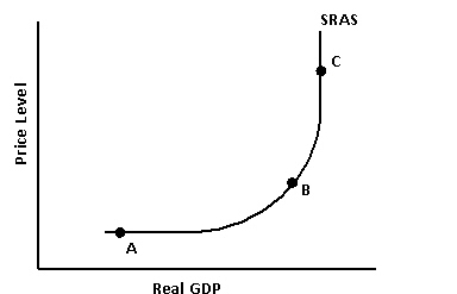 In Exhibit 22-3,at point B an increase in AD would lead to:
 (Multiple Choice)
4.7/5 (91)
(91) The real wealth and the real interest rate effects are both causes of the downward slope of the aggregate demand curve.
(True/False)
4.8/5 (78)
(78) Discuss some of the reasons behind downward stickiness of wages and prices.
(Essay)
4.8/5 (97)
(97) If exports and imports both rose,but exports rose more than imports,
(Multiple Choice)
4.9/5 (79)
(79) When the price level falls,households and firms reduce their holdings of money,leading to a lower interest rate and an increase in borrowing and an increase in RGDP demanded.
(True/False)
4.8/5 (78)
(78) Discuss the difference between an increase in the aggregate demand curve and an increase in the quantity of real GDP demanded.Include discussion of how the price level relates to each event.
(Essay)
4.9/5 (93)
(93) Exhibit 22-1 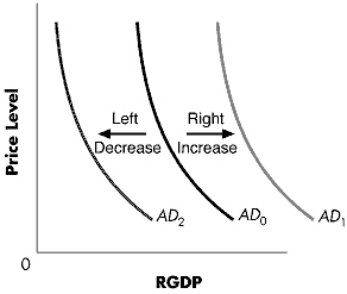 Refer to Exhibit 22-1.Which of the following would be illustrated by a shift in aggregate demand from AD0 to AD1?
 (Multiple Choice)
4.8/5 (86)
(86) Imports are not included in GDP because they do not reflect output produced within the domestic economy.
(True/False)
4.8/5 (78)
(78) Exhibit 22-2 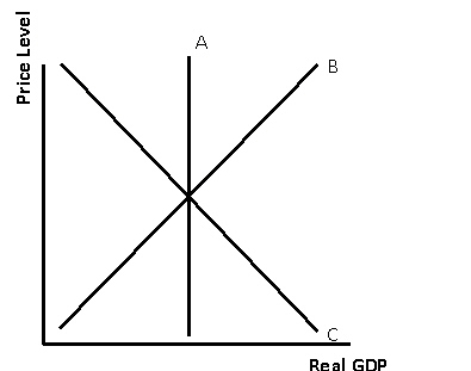 In Exhibit 22-2,which curve represents short-run aggregate supply?
 (Multiple Choice)
4.8/5 (85)
(85) A change that shifted the long-run aggregate supply curve to the right would also shift the short-run aggregate supply curve to the right.
(True/False)
4.8/5 (77)
(77) The interest rate effect helps explain why a lower price level will reduce the quantity of real goods and services demanded as an economy moves down along its aggregate demand curve.
(True/False)
4.9/5 (97)
(97) Stagflation could be caused solely by a shift in the aggregate demand curve.
(True/False)
5.0/5 (72)
(72) 
Filters
- Essay(0)
- Multiple Choice(0)
- Short Answer(0)
- True False(0)
- Matching(0)