



 Chat with AI
Exam 17: Income, Poverty, and Health Care

Exam 1: The Role and Method of Economics198 Questions
Exam 2: Economics: Eight Powerful Ideas197 Questions
Exam 3: Scarcity, Trade-Offs, and Production Possibilities189 Questions
Exam 4: Demand, Supply, and Market Equilibrium240 Questions
Exam 5: Markets in Motion and Price Controls228 Questions
Exam 6: Elasticities206 Questions
Exam 7: Market Efficiency and Welfare136 Questions
Exam 8: Market Failure215 Questions
Exam 9: Public Finance and Public Choice64 Questions
Exam 10: Consumer Choice Theory149 Questions
Exam 11: The Firm: Production and Costs198 Questions
Exam 12: Firms in Perfectly Competitive Markets207 Questions
Exam 13: Monopoly and Antitrust189 Questions
Exam 14: Monopolistic Competition and Product Differentiation159 Questions
Exam 15: Oligopoly and Strategic Behavior146 Questions
Exam 16: The Markets for Labor, Capital, and Land177 Questions
Exam 17: Income, Poverty, and Health Care138 Questions
Exam 18: Introduction to Macroeconomics: Unemployment, Inflation, and Economic Fluctuations171 Questions
Exam 19: Measuring Economic Performance147 Questions
Exam 20: Economic Growth in the Global Economy127 Questions
Exam 21: Financial Markets, Saving, and Investment65 Questions
Exam 22: Aggregate Demand and Aggregate Supply163 Questions
Exam 23: The Aggregate Expenditure Model69 Questions
Exam 25: Monetary Institutions182 Questions
Exam 26: The Federal Reserve System and Monetary Policy147 Questions
Exam 27: Issues in Macroeconomic Theory and Policy130 Questions
Exam 28: International Trade182 Questions
Exam 29: International Finance138 Questions
Select questions type


Most Americans experience significant fluctuations in their economic well-being from one year to the next.
(True/False)
4.8/5  (72)
(72) Adverse selection problems in health insurance are reduced by all of the following except:
(Multiple Choice)
4.7/5 (83)
(83) When the economy is in a recession,____ rises and poverty ____.
(Multiple Choice)
4.8/5 (88)
(88) The quantity of medical care demanded appears to be highly sensitive to changes in price.
(True/False)
4.9/5 (80)
(80) Which of the following is a source of inequality in incomes?
(Multiple Choice)
5.0/5 (73)
(73) Since 1935,the proportion of income received by the top 5 percent of Americans has:
(Multiple Choice)
4.9/5 (73)
(73) Women in the workplace seem to be narrowing the wage gap with males.What might be the cause of this shift during the past 25 years?
(Essay)
4.9/5 (74)
(74) Which of the following observations would be valid if the Gini coefficient is equal to zero?
(Multiple Choice)
4.9/5 (84)
(84) Investment in health care does bear similarities to investment in human or physical capital.
(True/False)
4.8/5 (77)
(77) There is a strong,positive correlation between educational attainment and lifetime earnings.
(True/False)
4.9/5 (94)
(94) Exhibit 17-1 The Lorenz Curve 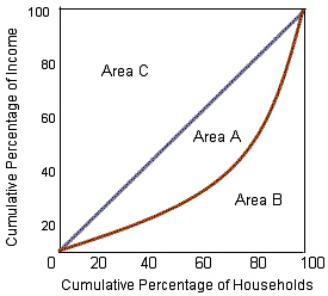 Refer to Exhibit 17-1.The Gini coefficient,G,is obtained by:
 (Multiple Choice)
4.7/5 (74)
(74) Which of the following factors leads to differences in income across individuals?
(Multiple Choice)
4.8/5 (68)
(68) Evaluate the accuracy of the following statement: Since health care is a necessity,the demand for health care will be perfectly inelastic.
(Essay)
4.9/5 (71)
(71) As a percentage of national income,the U.S.spends more money on health care than any other industrialized nation.
(True/False)
4.9/5 (78)
(78) A valid argument against redistributing income to achieve complete equality is that:
(Multiple Choice)
4.8/5 (80)
(80) If there were a decreased fraction of divorced couples and an increase in the proportion of two-income families:
(Multiple Choice)
4.9/5 (91)
(91) When a child-care agency refuses to hire Jack simply because he is male,it is called:
(Multiple Choice)
4.8/5 (85)
(85) High school graduates in the United States earn roughly ____ of those with Bachelor's degrees.
(Multiple Choice)
4.9/5 (68)
(68) 
Filters
- Essay(0)
- Multiple Choice(0)
- Short Answer(0)
- True False(0)
- Matching(0)