



 Chat with AI
Exam 16: The Markets for Labor, Capital, and Land

Exam 1: The Role and Method of Economics198 Questions
Exam 2: Economics: Eight Powerful Ideas197 Questions
Exam 3: Scarcity, Trade-Offs, and Production Possibilities189 Questions
Exam 4: Demand, Supply, and Market Equilibrium240 Questions
Exam 5: Markets in Motion and Price Controls228 Questions
Exam 6: Elasticities206 Questions
Exam 7: Market Efficiency and Welfare136 Questions
Exam 8: Market Failure215 Questions
Exam 9: Public Finance and Public Choice64 Questions
Exam 10: Consumer Choice Theory149 Questions
Exam 11: The Firm: Production and Costs198 Questions
Exam 12: Firms in Perfectly Competitive Markets207 Questions
Exam 13: Monopoly and Antitrust189 Questions
Exam 14: Monopolistic Competition and Product Differentiation159 Questions
Exam 15: Oligopoly and Strategic Behavior146 Questions
Exam 16: The Markets for Labor, Capital, and Land177 Questions
Exam 17: Income, Poverty, and Health Care138 Questions
Exam 18: Introduction to Macroeconomics: Unemployment, Inflation, and Economic Fluctuations171 Questions
Exam 19: Measuring Economic Performance147 Questions
Exam 20: Economic Growth in the Global Economy127 Questions
Exam 21: Financial Markets, Saving, and Investment65 Questions
Exam 22: Aggregate Demand and Aggregate Supply163 Questions
Exam 23: The Aggregate Expenditure Model69 Questions
Exam 25: Monetary Institutions182 Questions
Exam 26: The Federal Reserve System and Monetary Policy147 Questions
Exam 27: Issues in Macroeconomic Theory and Policy130 Questions
Exam 28: International Trade182 Questions
Exam 29: International Finance138 Questions
Select questions type


Which of the following is most likely to incorporate a great deal of economic rent?
(Multiple Choice)
4.8/5  (98)
(98) An increase in the price of a firm's output will shift the firm's demand curve for labor to the right,other things being equal.
(True/False)
4.9/5 (82)
(82) Which of the following will contribute to higher wage rates for labor?
(Multiple Choice)
4.9/5 (81)
(81) Increases in income from other sources than employment can cause the labor ____ curve to shift ____.
(Multiple Choice)
4.9/5 (72)
(72) Exhibit 16-3 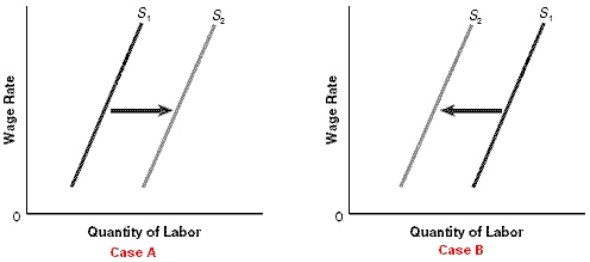 Refer to Exhibit 16-3.Which of the following situations is relevant to Case B?
 (Multiple Choice)
4.7/5 (92)
(92) Exhibit 16-3 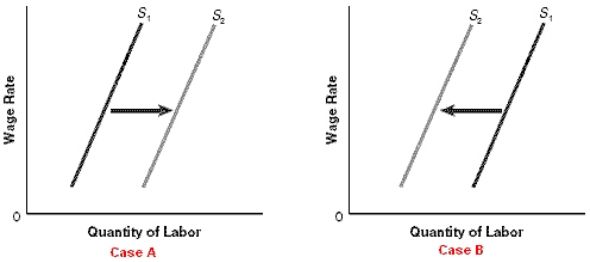 Refer to Exhibit 16-3.Which of the following situations is relevant to Case A?
 (Multiple Choice)
4.8/5 (78)
(78) Other things being equal,if the quantity of labor supplied is less than the quantity of labor demanded,wages will tend to fall.
(True/False)
4.8/5 (94)
(94) In Japan,the market value of the land is approximately four times that of all the land in the United States,even though Japan is only about the size of California.The most likely explanation for this fact is?
(Essay)
4.7/5 (80)
(80) Other things being equal,a ____ supply of workers tends to ____ real wages.
(Multiple Choice)
4.8/5 (88)
(88) If labor is the only variable input,an additional worker increases output from 72 to 78 units,and the product price is $6,the marginal revenue product from an additional worker:
(Multiple Choice)
4.9/5 (78)
(78) When a profit-maximizing firm makes a decision to employ a worker,that decision is based on:
(Multiple Choice)
4.7/5 (76)
(76) In the last 60 years,the percentage of workers in union jobs has increased substantially.
(True/False)
4.7/5 (81)
(81) Even though non-union workers maybe just as skilled as union workers,wages are almost 15 percent higher in union jobs.Why?
(Essay)
4.8/5 (82)
(82) 
Filters
- Essay(0)
- Multiple Choice(0)
- Short Answer(0)
- True False(0)
- Matching(0)