



 Chat with AI
Exam 8: Market Failure

Exam 1: The Role and Method of Economics198 Questions
Exam 2: Economics: Eight Powerful Ideas197 Questions
Exam 3: Scarcity, Trade-Offs, and Production Possibilities189 Questions
Exam 4: Demand, Supply, and Market Equilibrium240 Questions
Exam 5: Markets in Motion and Price Controls228 Questions
Exam 6: Elasticities206 Questions
Exam 7: Market Efficiency and Welfare136 Questions
Exam 8: Market Failure215 Questions
Exam 9: Public Finance and Public Choice64 Questions
Exam 10: Consumer Choice Theory149 Questions
Exam 11: The Firm: Production and Costs198 Questions
Exam 12: Firms in Perfectly Competitive Markets207 Questions
Exam 13: Monopoly and Antitrust189 Questions
Exam 14: Monopolistic Competition and Product Differentiation159 Questions
Exam 15: Oligopoly and Strategic Behavior146 Questions
Exam 16: The Markets for Labor, Capital, and Land177 Questions
Exam 17: Income, Poverty, and Health Care138 Questions
Exam 18: Introduction to Macroeconomics: Unemployment, Inflation, and Economic Fluctuations171 Questions
Exam 19: Measuring Economic Performance147 Questions
Exam 20: Economic Growth in the Global Economy127 Questions
Exam 21: Financial Markets, Saving, and Investment65 Questions
Exam 22: Aggregate Demand and Aggregate Supply163 Questions
Exam 23: The Aggregate Expenditure Model69 Questions
Exam 25: Monetary Institutions182 Questions
Exam 26: The Federal Reserve System and Monetary Policy147 Questions
Exam 27: Issues in Macroeconomic Theory and Policy130 Questions
Exam 28: International Trade182 Questions
Exam 29: International Finance138 Questions
Select questions type


Exhibit 8-2 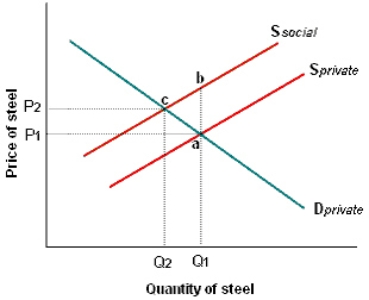 Refer to Exhibit 8-2.Which of the following observations is correct?
 (Multiple Choice)
4.8/5  (72)
(72) Sellers may choose not to sell in certain markets because:
(Multiple Choice)
4.8/5 (78)
(78) Various new cars are sold with sensors that automatically turn on the headlights at night or any low light conditions.Would these sensors create a positive externality or a negative externality? How?
(Essay)
5.0/5 (81)
(81) Exhibit 8-3 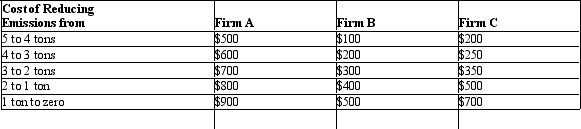 Refer to Exhibit 8-3.What would be the total cost if the government established a standard of 3 tons maximum pollution per firm in order to decrease pollution by a total of 6 tons?
 (Multiple Choice)
4.9/5 (70)
(70) Nancy loves to landscape her yard,but her neighbor Tom places a low value on his landscaping.When Tom's grass is neglected and gets long,Nancy will mow for Tom.This is an example of:
(Multiple Choice)
4.8/5 (82)
(82) The free rider problem suggests that a producer will tend to:
i.produce more than the optimal quantity of a public good.
ii.produce less than the optimal quantity of a public good.
iii.produce the optimal quantity of a public good if it is funded out of tax revenue.
(Multiple Choice)
4.7/5 (86)
(86) Economists prefer greater effort made to force internalization of externalities through taxes rather than using alternative approaches.
(True/False)
4.8/5 (94)
(94) Someone who does not contribute toward covering the cost of a good he desires,and yet he cannot be excluded from receiving the good,is called a free rider.
(True/False)
4.8/5 (84)
(84) Beginning from a situation where there were no clear property rights to clean air and water:
(Multiple Choice)
4.8/5 (90)
(90) Exhibit 8-1  Refer to Exhibit 8-1.Suppose that education provides spillover benefits to the community as illustrated in the diagram.Based on this information,we can say that:
 (Multiple Choice)
4.9/5 (77)
(77) Assume that production of a good imposes external costs on others.The equilibrium price will be ____ and the equilibrium quantity ____ for efficient resource allocation.
(Multiple Choice)
4.7/5 (88)
(88) If a subsidy was imposed on an industry whose production imposed external benefits on others,then the goods' consumers of the good would be ____ and the result would be a(n)____ in efficiency.
(Multiple Choice)
4.7/5 (78)
(78) 
Filters
- Essay(0)
- Multiple Choice(0)
- Short Answer(0)
- True False(0)
- Matching(0)