



 Chat with AI
Exam 5: Markets in Motion and Price Controls

Exam 1: The Role and Method of Economics198 Questions
Exam 2: Economics: Eight Powerful Ideas197 Questions
Exam 3: Scarcity, Trade-Offs, and Production Possibilities189 Questions
Exam 4: Demand, Supply, and Market Equilibrium240 Questions
Exam 5: Markets in Motion and Price Controls228 Questions
Exam 6: Elasticities206 Questions
Exam 7: Market Efficiency and Welfare136 Questions
Exam 8: Market Failure215 Questions
Exam 9: Public Finance and Public Choice64 Questions
Exam 10: Consumer Choice Theory149 Questions
Exam 11: The Firm: Production and Costs198 Questions
Exam 12: Firms in Perfectly Competitive Markets207 Questions
Exam 13: Monopoly and Antitrust189 Questions
Exam 14: Monopolistic Competition and Product Differentiation159 Questions
Exam 15: Oligopoly and Strategic Behavior146 Questions
Exam 16: The Markets for Labor, Capital, and Land177 Questions
Exam 17: Income, Poverty, and Health Care138 Questions
Exam 18: Introduction to Macroeconomics: Unemployment, Inflation, and Economic Fluctuations171 Questions
Exam 19: Measuring Economic Performance147 Questions
Exam 20: Economic Growth in the Global Economy127 Questions
Exam 21: Financial Markets, Saving, and Investment65 Questions
Exam 22: Aggregate Demand and Aggregate Supply163 Questions
Exam 23: The Aggregate Expenditure Model69 Questions
Exam 25: Monetary Institutions182 Questions
Exam 26: The Federal Reserve System and Monetary Policy147 Questions
Exam 27: Issues in Macroeconomic Theory and Policy130 Questions
Exam 28: International Trade182 Questions
Exam 29: International Finance138 Questions
Select questions type


If both market demand and supply decrease simultaneously,then equilibrium quantity will (be)____ and equilibrium price will (be)____.
(Multiple Choice)
4.7/5  (75)
(75) If a price ceiling is a binding constraint on a market,then
(Multiple Choice)
4.8/5 (85)
(85) Either a price floor or a price ceiling will result in a smaller quantity exchanged than if the price was at its equilibrium level.
(True/False)
4.9/5 (76)
(76) Exhibit 5-2  Refer to Exhibit 5-2.The movement from ____ is consistent with an increase in supply.
 (Multiple Choice)
4.8/5 (74)
(74) In January,2,500 quarts of ice cream are sold in Boston at $2 per quart.In February,3,000 quarts are sold at $2.50 a quart.This change in the price and quantity sold of ice cream may have been caused by:
(Multiple Choice)
4.8/5 (81)
(81) Say that the equilibrium price of natural gas would be $5 per thousand cubic feet,but there is a price floor imposed at $7 per thousand cubic feet.That price floor is then lowered to $5 per thousand cubic feet.As a result,
(Multiple Choice)
4.9/5 (82)
(82) For a normal good,if incomes rise,we would expect that the equilibrium price will increase and that the equilibrium quantity will increase.
(True/False)
4.9/5 (74)
(74) Whenever there is a surplus at a particular price,the quantity sold at that price will equal:
(Multiple Choice)
4.8/5 (81)
(81) Beach resorts raise their prices during the summer months and yet more people book rooms at those times.Is this a violation of the law of demand?
(Essay)
4.9/5 (77)
(77) The imposition of a binding price floor on a market causes quantity demanded to be
(Multiple Choice)
4.8/5 (61)
(61) To be binding,a price ceiling must be set above the equilibrium price.
(True/False)
4.9/5 (86)
(86) Exhibit 5-6 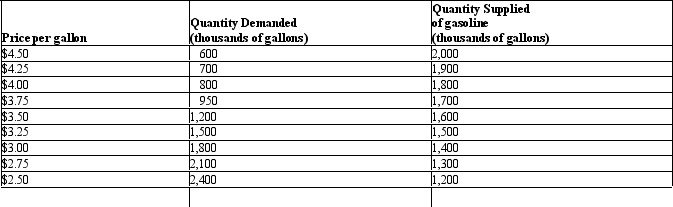 Refer to Exhibit 5-6.According to the data in the above table,the equilibrium price of gasoline is:
 (Multiple Choice)
4.8/5 (62)
(62) If input prices rose and production technology improved at the same time,as a result:
(Multiple Choice)
4.8/5 (92)
(92) Which of the following is likely to result in a lower equilibrium price?
(Multiple Choice)
4.9/5 (70)
(70) Ceteris paribus,if the market demand for a product increases,then equilibrium quantity will (be)____ and equilibrium price will (be)____.
(Multiple Choice)
4.8/5 (66)
(66) 
Filters
- Essay(0)
- Multiple Choice(0)
- Short Answer(0)
- True False(0)
- Matching(0)